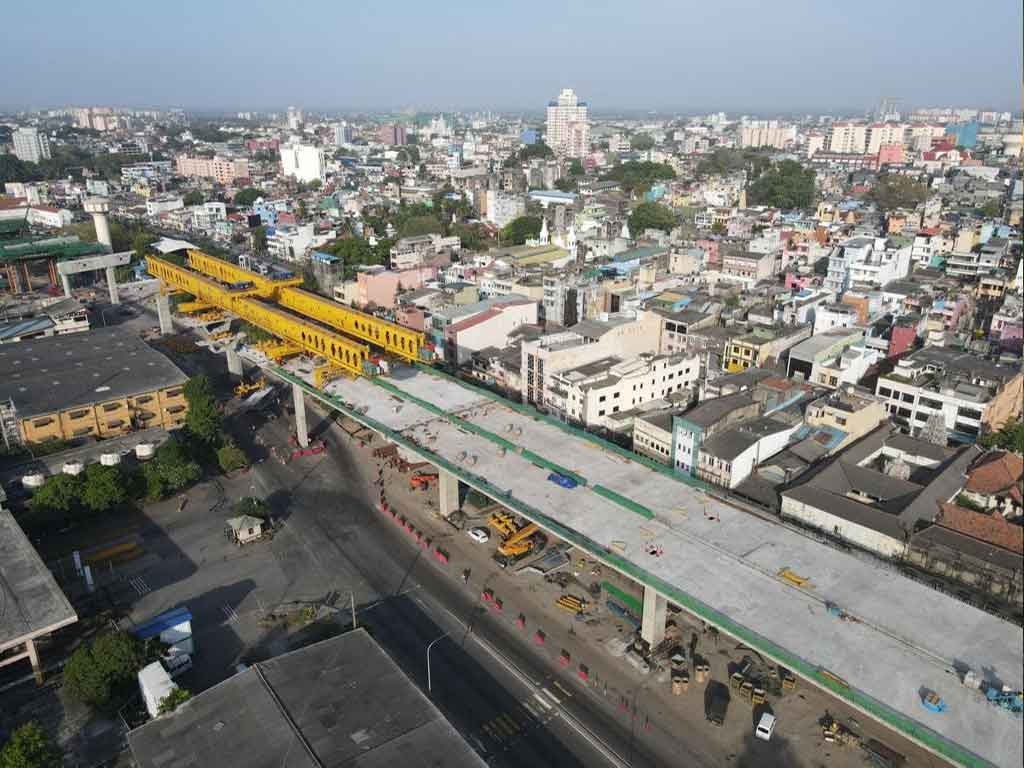
In Colombo, the long-delayed Port Access Elevated Expressway has become a cocktail of skeletons, stalled work, billion-rupee penalties, and now another committee.
The Port Access Elevated Expressway, once hailed as Colombo’s gateway to faster connectivity, has turned into a showcase of delay, dispute, and dysfunction. Construction, which began in 2019 under the funding of the Asian Development Bank, was supposed to end in 2021, with the road open to traffic in early 2022. Instead, years later, the project remains incomplete, with a committee now appointed to decide its fate.
The expressway, designed as a four-lane elevated highway linking the Colombo Port with the city through multiple access points, was awarded to a joint venture of three companies: China Civil Engineering Corporation, Hubei Provincial Road and Bridge Group, and Henan Provincial Communications Planning and Design Institute. The tender was fixed at a single lump sum price, meaning the Road Development Authority (RDA) had no bill of quantities to fall back on. As delays mounted, the RDA sought to claim Rs. 1.2 billion in late penalties from the joint venture.

The situation grew murkier when several human skeletons were unearthed at the site, stalling further progress. Adding to the drama, the RDA proposed two new ramps linking the expressway to Aluthmawatha in Mattakuli and the Wimaladharma Roundabout in Pettah. These ramps were not in the original contract but were intended to be handed to the same joint venture via a variation order. Officials argue this would save time, as the existing contractor is familiar with the project.
Critics within the RDA, however, have voiced sharp opposition. They argue that awarding these ramps to the same joint venture amounts to reviving a “dead contract,” potentially undermining efforts to settle damages and giving the contractor fresh grounds to dispute. They insist a fresh tender process would safeguard transparency and allow competitive bidding, even if it takes more time.
The debate boils down to speed versus accountability. Supporters of handing the ramps to the joint venture emphasize urgency, citing public demand for the long-awaited road. Opponents warn of legal tangles, financial losses, and the danger of letting contractors escape responsibility for repeated failures. The newly appointed committee must now navigate these conflicting interests while ensuring the public does not pay the price for bureaucratic missteps and private inefficiency.
The expressway was envisioned as a flagship project to modernize Colombo’s transport infrastructure and ease congestion. Instead, it has become a cautionary tale of delays, cost overruns, and questionable governance. With every missed deadline, public confidence erodes further, turning optimism into frustration.
For Colombo’s commuters, the stakes remain high. If completed, the expressway could ease bottlenecks and unlock smoother access to the port. Yet today, it stands as a half-built reminder of promises broken and priorities misplaced. The skeletons found on-site are more than a literal discovery—they symbolize the buried accountability of those responsible for this mess.
Whether the new committee delivers clarity or merely adds another layer of indecision remains to be seen. What is clear is that the expressway has become more than a road project. It is a reflection of governance itself—slow, stuck, and spiraling.