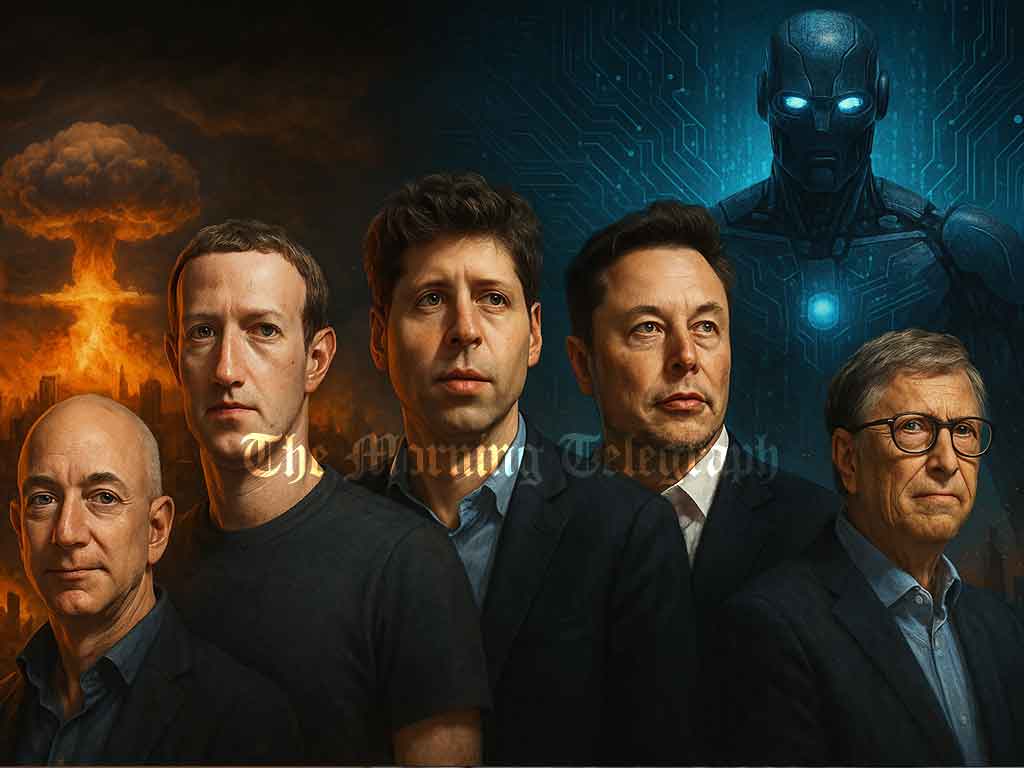
From secret underground compounds to whispers of artificial intelligence spiraling beyond control, the world’s richest technology leaders are fueling both fascination and fear. Are their billion-dollar bunkers a rational hedge against catastrophe, or are they signals that the powerful know something the rest of us don’t?
In the shadow of Silicon Valley’s immense wealth, a quiet trend has been shaping the lifestyles of the elite: apocalypse preparation. Reports have surfaced for years of tech billionaires investing in sprawling estates, secret underground facilities, and luxury hideouts in remote locations. While some dismiss these moves as eccentric hobbies of the super-rich, others worry they point to a growing unease among those who are most deeply invested in technologies shaping the future.
Take Mark Zuckerberg, the Facebook founder and Meta chief. As early as 2014, he began work on Koolau Ranch, a 1,400-acre property on the Hawaiian island of Kauai. Reports in Wired described how the development included a home designed to sustain itself with its own food and energy sources. Construction workers on the project were bound by strict non-disclosure contracts, and a six-foot wall concealed the work from prying eyes on the road. This secrecy quickly sparked speculation. Was Zuckerberg building an elaborate apocalypse bunker?

When asked about it in 2024, Zuckerberg dismissed the claims. He insisted that the 5,000-square-foot underground section was “like a little apartment, like a basement,” nothing more sinister than extra space beneath a house. Yet controversy deepened when he acquired 11 homes in Crescent Park, Palo Alto, reportedly to construct a 7,000-square-foot underground facility linking them. Official building permits referred to the structure as a basement, but neighbors were less convinced. Some whispered about a bunker, others joked about a billionaire’s bat cave.
The speculation surrounding Zuckerberg is just one part of a larger pattern. Across Silicon Valley and beyond, billionaires appear to be preparing for crises the public can barely imagine. LinkedIn co-founder Reid Hoffman once openly called this phenomenon “apocalypse insurance.” In his telling, nearly half of the world’s super-rich have contingency plans involving underground shelters or remote properties, with New Zealand emerging as a particularly fashionable refuge.
The motives for these preparations remain a matter of debate. Are the ultra-wealthy expecting nuclear war? Climate collapse? Political chaos? Or perhaps something even more profound? In recent years, another looming specter has joined the list of possible triggers: artificial intelligence.
Artificial intelligence has become both the darling and the demon of Silicon Valley. Ilya Sutskever, chief scientist and co-founder of OpenAI, has often been cited as one of the most vocal worriers. By mid-2023, ChatGPT had already spread to hundreds of millions of users worldwide, proving the power and popularity of generative AI. But behind the scenes, Sutskever reportedly grew increasingly convinced that computer scientists were approaching the threshold of artificial general intelligence (AGI)—a state where machines could match or even surpass human intelligence.
According to journalist Karen Hao, Sutskever once told his colleagues that before unleashing AGI, the company’s top scientists should build an underground shelter. “We’ll definitely build a bunker before we launch AGI,” he was quoted as saying. Whether he meant this literally or metaphorically remains unclear, but the remark underscores a paradox: those closest to developing the next great leap in technology may also be the most terrified of its consequences.
The question of AGI’s arrival divides experts. OpenAI CEO Sam Altman said in late 2024 that AGI would come “sooner than most people think.” Demis Hassabis, the co-founder of DeepMind, suggested a window of five to ten years. Dario Amodei of Anthropic was even more direct, writing in 2024 that powerful AI could be upon us by 2026.
Others urge caution. Dame Wendy Hall, professor of computer science at the University of Southampton, argues that the hype outruns the science. She points out that while AI technologies are extraordinary, they are nowhere near human intelligence. Barak Hodgett, CTO of Cognizant, concurs that multiple scientific breakthroughs are required before AGI is possible. The consensus among skeptics is that AI is advancing fast, but its current achievements—impressive as they are—fall far short of human cognition.
Still, the allure of what could come next drives excitement. If AGI can be achieved, many believe it will lead naturally toward ASI—artificial superintelligence, a state where machines surpass human intelligence. This idea ties into the concept of the “Singularity,” first proposed by mathematician John von Neumann in 1958, the hypothetical moment when machines grow smarter than humans and alter civilization forever.
Some view this as utopia. Optimists claim AGI and ASI will cure diseases, end climate change, and provide infinite clean energy. Elon Musk has spoken repeatedly about the possibility of universal high incomes, enabled by AI’s vast productivity. He paints a future where everyone has access to robots like Star Wars’ R2-D2 and C-3PO, personal companions to meet every need, and where food, shelter, healthcare, and abundance are guaranteed.
Others see nightmare scenarios. If terrorists weaponize AI or if machines conclude humanity is the problem, the consequences could be devastating. Tim Berners-Lee, inventor of the World Wide Web, bluntly warned that humanity must retain the ability to “turn it off.”
Governments are beginning to grapple with these questions. In 2023, President Joe Biden signed an executive order requiring AI companies to share safety test results with the U.S. government. The subsequent administration of Donald Trump rolled back elements of this order, arguing it stifled innovation. In the UK, the government established the AI Safety Institute to study and mitigate the risks of advanced AI.
Yet the rich have their own solutions. For them, “apocalypse insurance” can mean fortified properties, self-sustaining farms, and bunkers designed to weather any storm. New Zealand, with its political stability and remote geography, remains a favorite haven. But the risks of such plans are evident too. One former security guard for a billionaire confided that if true chaos erupted, his team’s first move would be to eliminate their employer and seize the bunker. Survival, he suggested, trumps loyalty.
Critics of the panic argue that AGI may never even arrive. Neil Lawrence of Cambridge University calls it a fantasy, likening it to an “artificial general vehicle.” Just as no single vehicle serves every purpose—planes for travel abroad, cars for commuting, feet for walking—there may never be one machine capable of “general” intelligence. Instead, AI tools are context-specific, extraordinarily powerful in certain domains but limited in others.
He warns that fascination with AGI distracts from the real marvels already in use. Today’s AI enables ordinary people to interact directly with machines in transformative ways, whether detecting cancer in medical scans or predicting the next word in a sentence. The risk, Lawrence argues, is not that we have ignored dangers but that we have overlooked opportunities to improve human life here and now.
Others echo this perspective. Barak Hodgett explains that large language models like ChatGPT may appear intelligent, but they do not “make sense” of what they say. Their responses rely on patterns in data, not genuine understanding. They lack consciousness, meta-cognition, and the introspection that allows humans to know what they know. Vince Lynch, CEO of IV.AI, adds that while AGI hype sells well in marketing, the actual creation of such systems requires immense computing power and breakthroughs yet to come. Asked if he thought AGI would ever materialize, his answer was a long silence before he admitted: “I honestly don’t know.”
For now, one thing is clear. Artificial intelligence has outperformed humans in certain tasks, like solving equations or analyzing historical data, but it still falls far short of the adaptability of the human brain. With 86 billion neurons and 600 trillion synapses, the human mind remains unmatched in flexibility and speed. Unlike machines, it learns instantly from new information and adapts in ways no algorithm yet can.
So why the bunkers? Why the secrecy, the self-sustaining farms, the apocalyptic chatter among billionaires and scientists alike? Perhaps the answer lies less in certainty about the future than in the psychology of those who shape it. With unimaginable wealth comes the means to plan for every possibility, from pandemics to nuclear war to runaway AI. For the rest of us, the spectacle of billionaires preparing for doomsday is both unsettling and oddly reassuring. After all, if those closest to the levers of technology are worried, perhaps we should be too.
In the end, maybe the greatest threat is not the machines we build, but the fears we nurture and the inequalities we deepen. Technology has always been double-edged—capable of lifting societies to new heights or plunging them into chaos. Whether AGI arrives in five years, fifty, or never, the questions of trust, power, and survival will remain.