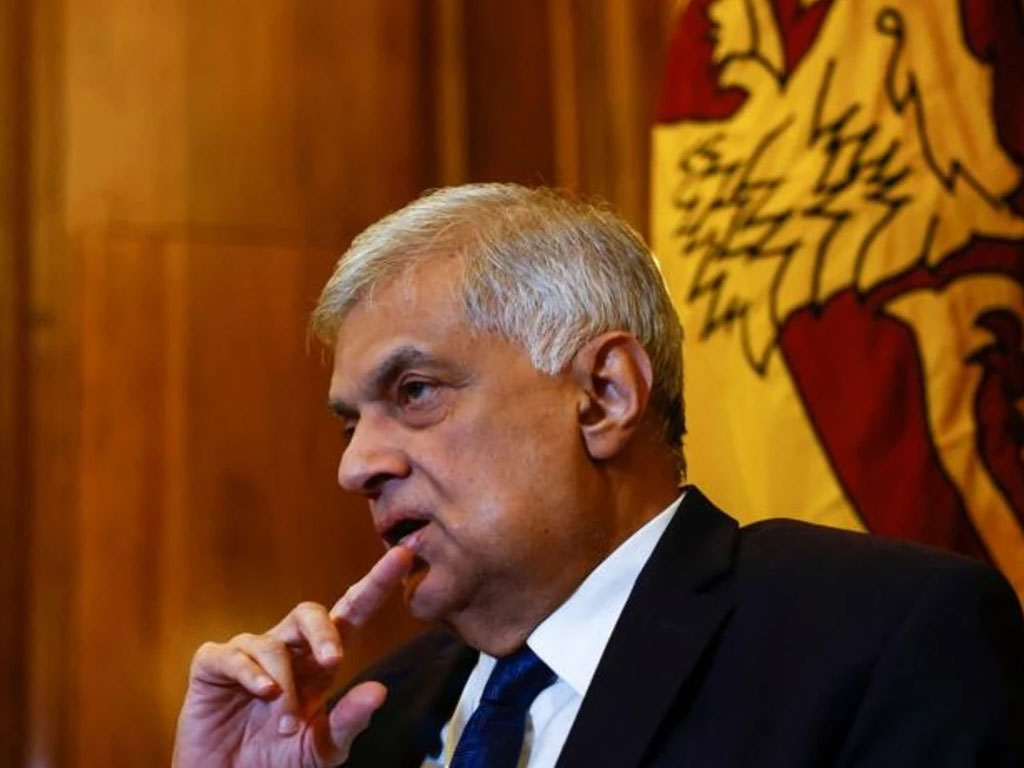
A dramatic political confrontation has erupted as a former President accuses the JVP of operating a covert power center in Pelawatta, overriding Parliament during Sri Lanka’s worst disaster mismanagement crisis in years.
Former President Ranil Wickremesinghe has issued an urgent warning to the President, calling for the immediate removal of all state authority allegedly being exercised from the Janatha Vimukthi Peramuna headquarters in Pelawatta and demanding that constitutional power be restored to Parliament. Speaking on December 3 in Colombo during a meeting with political party leaders and representatives, Wickremesinghe said the President must summon party leaders without delay and take corrective action that aligns with Sri Lanka’s constitutional framework.

He claimed that the JVP political committee operating in Pelawatta is functioning as a parallel center of state authority, overshadowing the legitimate institutions of governance. According to Wickremesinghe, both the President’s Office and the Prime Minister’s Office lack disaster operations facilities, while the JVP headquarters has effectively become the central command hub for the nation’s disaster response during the Cyclone Ditwa emergency. The discussion was held at his Flower road (Mal Para) political office as political leaders gathered to address the country’s worsening disaster situation and the mounting criticism surrounding the government’s disaster preparedness.
Wickremesinghe said that although workshops and seminars were carried out in 2025 to educate government institutions on the National Disaster Management Plan 2023 to 2030, the Disaster Management Act was not implemented on November 27, the day before Cyclone Ditwa caused catastrophic impact across the island. He said the decision to declare Friday, November 28 as a public holiday crippled all departments assigned to the disaster response plan and delayed emergency coordination. He accused the government of politicizing aid distribution and creating a parallel disaster fund outside Parliament, the Cabinet and the Disaster Management Center, weakening official disaster governance structures.
He said there had been no strategy to respond to the disaster, no plans for rehabilitation and no immediate measures such as regulating the sale of meat, fish and eggs to stabilize supply. Due to what he described as government inexperience and administrative paralysis, he recommended that Parliament immediately appoint an oversight committee on disaster management and reconstruction, chaired by an experienced MP such as Kabir Hashim, with equal representation from government and opposition members. He argued that an independent oversight committee was necessary to restore credibility and ensure transparent crisis management.
According to Wickremesinghe, responsibility for post-disaster normalization and reconstruction must be assigned to Parliament, the Cabinet and the Disaster Management Center in line with constitutional provisions. He proposed that the oversight committee establish an economic analysis unit to assess short and long-term economic consequences, including reconstruction costs, food security pressures and disrupted national infrastructure. He also called for a parliamentary select committee, headed by an opposition MP, to investigate failures in disaster management related to November 28 and deliver a report within six months so that accountability is documented in a formal parliamentary record.
Wickremesinghe said relief and reconstruction at district level should be entrusted to district secretaries, who must report directly to the Disaster Management Center without political interference. He insisted political actors and JVP cadres be removed from disaster operations to avoid misuse of state machinery during a national emergency. He urged the government to suspend the national budget temporarily and present a new one in January 2026 after assessing the full extent of damage caused by Cyclone Ditwa. He argued that a revised budget would allow Sri Lanka to allocate resources more effectively for reconstruction, livelihood recovery and climate resilience.
He warned that foreign assistance for reconstruction is unlikely in the short or medium term. He pointed to economic crises in the UK and EU, the refusal of the United States to provide reconstruction aid and the diversion of global funds toward the war in Ukraine. He said Sri Lanka, alongside Indonesia, Thailand and Malaysia, had been severely affected by the regional weather pattern and should seek long-term concessional loans from ADB, AIIB, JBIC and KOICA, while India could support railway reconstruction. He emphasized that Sri Lanka must revive its climate change policy with a strong focus on landslides and environmental risk mitigation.
Referring to recent Supreme Court rulings, Wickremesinghe said negligence, constitutional violations and breaches of public trust had been clearly established. He warned that economic losses and reconstruction costs could exceed 15 percent of GDP and that IMF conditions would reduce the primary balance from 2.3 percent to 2 percent. He said this would leave the country without sufficient resources for recovery unless GDP growth reaches at least 7 percent annually, emphasizing the urgency of economic stabilization measures.
He proposed a national meeting of religious and political leaders, chaired initially by the four Mahanayake Theros, to guide reforms of social and institutional structures. He suggested involving archbishops and cardinals, with Karu Jayasuriya serving as a convener alongside a government-appointed counterpart. He said Articles 9 and 10 of the Constitution should be reaffirmed and that individuals acceptable to the Mahanayake Theros be appointed to lead the Ministry of Buddhasasana, its secretariat and the Department of Buddhist Affairs. He said the affairs of temples and shrines must remain free from interference and recommended that white attire be worn at state ceremonies held in major Buddhist temples.
He also proposed appointing a Minister for Hindu Affairs, a ministry secretary and a director following consultations with Hindu leaders. Concluding his remarks, Wickremesinghe said the ultimate cause of the disaster was the violation of the Constitution, which he argued had enabled the erosion of lawful authority and the breakdown of state governance during a moment when Sri Lanka needed stability most.