As Sri Lankans struggle to recover from Cyclone Ditwah’s devastation, growing criticism targets the government’s new ‘Rebuilding Sri Lanka’ fund, raising legal questions, political tensions and fears of repeating past financial scandals.
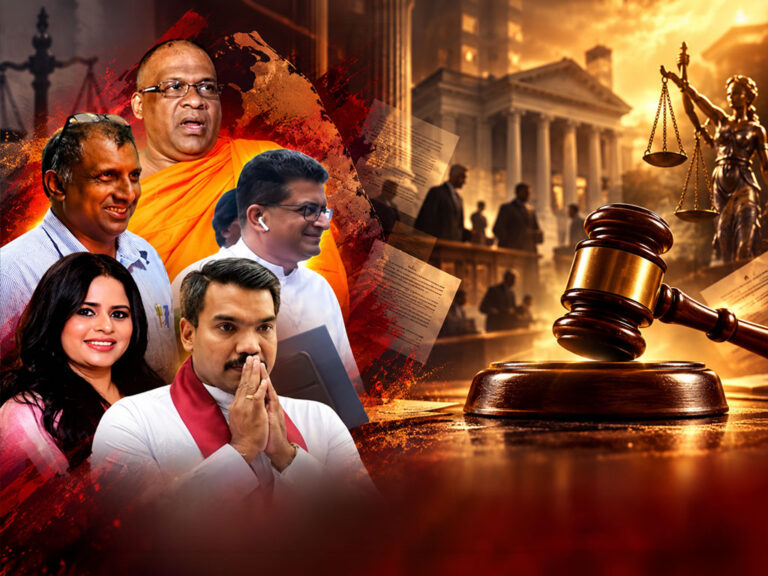
The creation of the new ‘Rebuilding Sri Lanka’ fund has sparked intense debate across the country. Established in the aftermath of Cyclone Ditwah, which inflicted unprecedented damage, displaced hundreds of thousands and pushed the nation into a humanitarian emergency, the government says the fund is essential to accelerate recovery. Yet critics argue that the government has bypassed long-established legal frameworks under the Sri Lanka Disaster Management Act, raising concerns about transparency and accountability during a national crisis. The new management committee, chaired by Minister of Labour and Deputy Minister of Finance and Planning Dr. Anil Jayantha Fernando, has also attracted criticism for its composition, its purpose, and its legality.

As questions continue to surface from opposition leaders, legal analysts, civil society and the public, the establishment of the fund has become a flashpoint in the larger debate over how Sri Lanka manages major disasters, public funds and national recovery.
Who are the members of the ‘Rebuilding Sri Lanka’ Management Committee?
The management committee of the ‘Rebuilding Sri Lanka’ fund is chaired by Deputy Minister Dr. Anil Jayantha Fernando, with Senior Additional Secretary to the President G. M. R. D. Aponsu appointed as its convener. According to the Presidential Media Division’s statement dated December 01, the committee includes several high-ranking government officials and influential private sector leaders.
The governmental members are:
- Presidential Special Representative for Foreign Investment, Governor of the Western Province Hanif Yusuf
- Secretary to the Ministry of Finance Dr. Harshana Suriyapperuma
- Senior Economic Advisor to the President Duminda Hulangamuwa
- Director General for Europe and North America at the Ministry of Foreign Affairs, Foreign Employment and Tourism Sugeeshwara Gunaratne
In addition to these senior officials, the committee includes prominent business leaders, raising concerns about private sector influence over public disaster funds:
- Mohan Pandithage, Chairman, Helis Group
- Krishan Balendran, Chairman, John Keells
- Dr. Parakrama Dissanayake, Vice Chairman and Managing Director, Aitken Spence
- Ashraf Omar, CEO, Brandex Group
- Ishara Nanayakkara, Executive Chairman, LOLC
The Presidential Media Division states that the committee is empowered to assess national recovery needs, set priorities, allocate funds and release money for approved reconstruction activities. It has been promoted as a mechanism to ensure efficient coordination and rapid financial deployment at a time when the country faces its largest disaster in modern history.
Bank account details for both local and foreign donors have been released, encouraging contributions in Sri Lankan rupees or any international currency. According to the Ministry of Finance Secretary Dr. Harshana Suriyapperuma, as of December 04, donations to the Bank of Ceylon account exceeded Rs. 635 million. More than 30,000 individual deposits have been made, and the Central Bank’s foreign currency account has received nearly Rs. 61 million, bringing total contributions above Rs. 697 million. Donations have come from individuals across 33 different currencies, indicating widespread public and international engagement.
However, despite this financial momentum, the committee has faced severe backlash on social media. Critics argue that private businessmen should not play a central role in managing public funds meant for disaster recovery, with others pointing out the complete absence of women in the committee’s membership. Another observation has further intensified scrutiny: three members of this committee, Mohan Pandithage, Krishan Balendran and Ashraf Omar, also served on former President Gotabaya Rajapaksa’s Advisory Committee to the Economic Council in March 2022. This connection has aggravated distrust among the public, who fear a repeat of controversial financial and governance decisions.
Opposition opposition
On December 3, opposition parliamentary groups voiced serious concerns about the fund’s legality and purpose. BBC Sinhala interviewed Samagi Jana Balawegaya MP and lawyer Mujibur Rahuman, who argued that the government has no justification for creating a new fund outside the legally established framework of the Sri Lanka Disaster Management Act of 2005.
“There is a fund that can be taken during disasters under the Disaster Management Act passed in 2005. It clearly states how the fund is collected, how it is spent, and who are the official members of the Disaster Management Council,” he said.
He went on to question the lawfulness of the President’s actions.
“In that case, the President has gone beyond the Act and appointed a committee. It is a different fund. There is a question regarding the legality of this, why is this another fund being created when there is a fund approved by an Act of Parliament,” he stated.
Rahuman further pointed to inconsistencies in the fund’s structure.
“There are some bank numbers there. The account number of the Deputy Treasurer is there, the number of the Central Bank Governor is there. That means that no such fund has been created. They appointed a committee and say that a fund has been created.”
The MP warned that Sri Lanka has faced serious controversies with disaster-related funds in the past, highlighting “problems with the Helping Hambantota and Itukama funds.”
Former MP Patali Champika Ranawaka also drew attention to the legal provisions for fund collection under the Disaster Management Act in a Facebook post, implying that the government’s new approach contradicts established law.

When did the National Disaster Management Council, which is supposed to meet once a quarter, meet for the last year?
The National Disaster Management Council, a key structure under the 2005 Act, plays a pivotal role in planning, coordinating and executing disaster response and preparedness. This council is legally required to meet as needed and at least once every three months.
The President serves as the ex officio Chairman, the Prime Minister as the ex officio Vice Chairman and the Leader of the Opposition is also a member, along with five representatives nominated by him. The council further includes ministers overseeing critical sectors such as irrigation, electricity, environment, statistics, defense, police, lands, fisheries and others that directly affect disaster planning and response.
This council is empowered to make all major decisions required before and after a disaster and also maintains its own statutory fund under Section 17 to finance necessary activities.
The council was convened on November 27 following Cyclone Ditwah’s impact, yet questions have emerged about whether it met its legally mandated frequency. According to Suranga Ranasinghe, Secretary to the Leader of the Opposition, the last meeting prior to November 27 took place on August 6. This timeline was confirmed by the Disaster Management Center as well.
If accurate, this means the council did not meet within the required three-month interval, implying a deviation from the law at a time when disaster preparedness was crucial.
Meanwhile, Public Security Secretary Ananda Wijepala told Parliament on December 5 that the council had not been convened for seven years and that President Anura Kumara Dissanayake convened the meeting in August. Opposition members reportedly participated. This conflicting narrative has added to public confusion regarding the consistency and legitimacy of disaster governance in Sri Lanka.
What are the rules regarding fund raising in a disaster?
Section 17 of the Disaster Management Act establishes the National Council’s official fund. This fund is empowered to accept loans, donations, gifts and grants from legal domestic and international sources. It must be audited, and all financial activity must adhere to strict legal and accountability requirements.
This framework was designed to prevent misuse of money collected during emergencies and to ensure that all funds reach affected communities transparently and efficiently. Critics argue that the creation of the ‘Rebuilding Sri Lanka’ fund disregards these established safeguards, raising fears of potential mismanagement during a vulnerable moment for the nation.
What happened to the Helping Hambantota and Itukama funds?
Concerns over the new fund are also shaped by historical controversies. After the 2004 tsunami, Mahinda Rajapaksa, who was then Prime Minister, was accused of transferring foreign tsunami donations meant for the Prime Minister’s Relief Fund into a private account known as the Helping Hambantota Fund. This allegation sparked national outrage and remains a reference point whenever new disaster funds are announced.
Similarly, during the Covid-19 pandemic in 2020, former President Gotabaya Rajapaksa created the Itukama fund. The Ministry of Defence announced in May 2020 that it had received Rs. 1,128 million in donations. However, according to data obtained through a Right to Information request filed by Verite Research, over Rs. 1,800 million was in the fund by September 2021, yet only 10.6 percent of it had been spent. The lack of transparency and slow disbursement of funds raised serious questions about the management of public donations during crises.
These past cases have amplified concerns that the newly established fund may follow similar patterns of opacity unless governed strictly by established laws.
What is the government’s view on the fund and the committee?
During parliamentary debates, Minister of Labour and Deputy Minister of Finance and Planning Dr. Anil Jayantha Fernando defended the creation of the new fund in response to questions raised by MP Kabir Hashim.
“He raised the issue of whether this fund is being privatized. We will never have an issue of misusing public funds like that,” the minister said.
He argued that immediate financial mobilization is necessary.
“As soon as those institutions through the Disaster Management Center are operational, we have to know the losses of this very important situation at this moment. The amount of money we have, if we were a country that had really strengthened the economy, we would not have to ask for assistance for this at once.”
He added that Sri Lanka’s weakened economic condition requires additional fund-raising mechanisms.
“When we took over the government, there was a shattered economy. This is what is happening when we are stabilizing it. So the practical need at the moment is to raise funds as soon as possible,” he explained.
Minister Fernando insisted that the fund is lawful and part of a structured plan.
“This fund is being established to explore various ways to raise funds and for the financial purpose of managing those funds. Cabinet approval will be given to it immediately. We hope to bring legal provisions for it in the future. Otherwise, this is not something that goes beyond the law and is done by anyone in the private sector.”
He also justified the chosen committee members.
“Look carefully at who these people are. We need to engage them. When looking for financial resources, I am also there to demonstrate accountability, including the private sector, international connections. There is also the Secretary to the Ministry of Finance. There is also a Senior Additional Secretary attached to the Presidential Secretariat.”
His remarks attempt to counter public fear by emphasizing expertise, accountability and collaboration between government officials and private sector leaders.
Yet critics remain unconvinced. They argue that legal ambiguity, past scandals, and the hurried creation of the committee could undermine public trust and hinder Sri Lanka’s long-term disaster resilience.