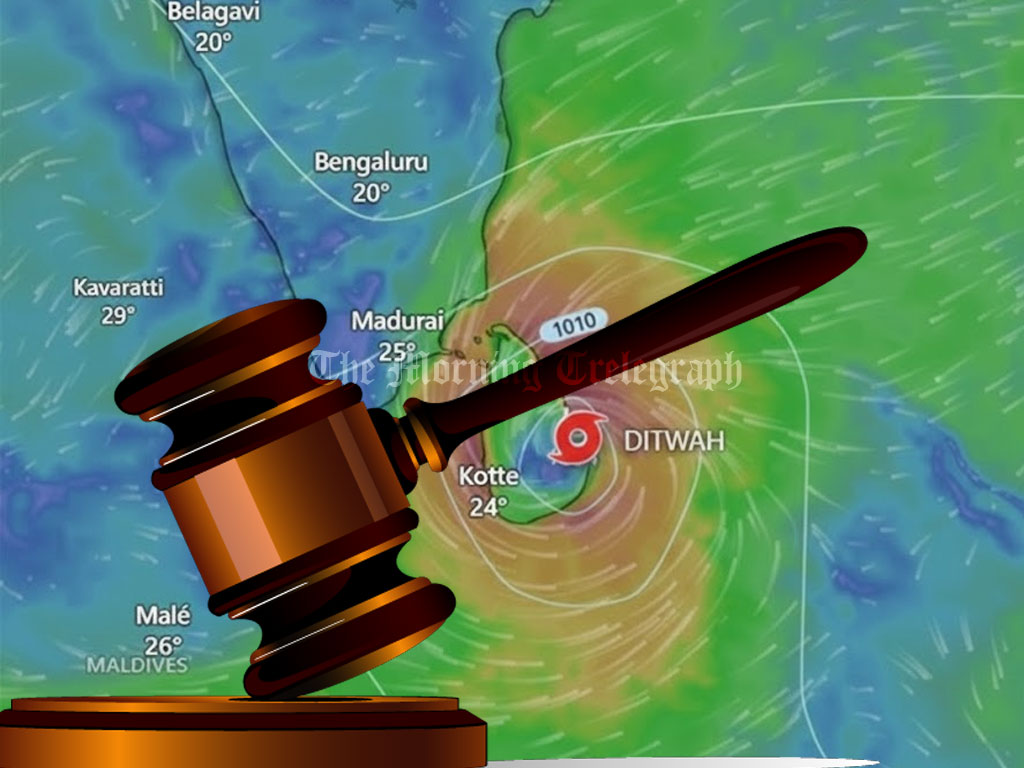
A powerful legal challenge is brewing as senior lawyers move to hold officials accountable for allegedly ignoring early storm warnings, leaving thousands exposed to the devastation caused by Cyclone Ditwah.
A panel of senior lawyers is preparing to initiate legal action against authorities who allegedly failed to take timely and positive steps despite receiving prior warnings from the Meteorological Department before the recent extreme weather disaster. The legal team is also making arrangements to provide legal assistance to affected citizens and to challenge what they describe as attempts to control the media and social media under emergency regulations.

The lawyers, operating under the banner of Free Lawyers, met at the Nippon Hotel in Colombo on December 5 to discuss the issue. The meeting was organized by Professor G.L. Peiris, bringing together legal experts to examine institutional accountability following the Cyclone Ditwah disaster.
The legal panel is expected to study possible actions against officials who hold formal authority over disaster preparedness and response. There are serious allegations that key individuals failed in their responsibility despite clear early warning systems being in place. Attorney Gunaratne Wanninayake has been appointed as the convener of the panel, which reportedly includes a number of senior legal figures including President’s Counsel.
Subject experts state that the Director General of the Disaster Management Center and the Secretary of Defense hold direct legal authority to activate the national disaster response mechanism. These positions are entrusted with coordinating all state agencies once verified meteorological data is received.
Sri Lanka already operates under the National Disaster Management Plan 2023 to 2030, which functions under the Disaster Management Act of 2005. This plan was passed by Parliament and outlines how the state must respond to natural disasters including cyclones, floods, landslides and tsunamis. The plan was finalized during the tenure of retired Major General Sudantha Ranasinghe as Director General of the Disaster Management Center following years of data analysis, field surveys and risk assessments. Alongside this, the National Emergency Operation Plan was also designed to guide real time execution during disaster situations.
However, a senior subject expert speaking anonymously stated that all three legal instruments, the Act, the National Disaster Management Plan, and the Emergency Operation Plan, appear to have been ignored during the Cyclone Ditwah emergency. The expert stressed that disaster response cannot be managed by a single institution and that the greatest responsibility within the mechanism rests with the Director General of Disaster Management and the Secretary of Defense.
Attempts to contact the current Director General of the Disaster Management Center, retired Major General Sampath Kotuwegoda, were unsuccessful. Meanwhile, when questioned, Defense Secretary Air Vice Marshal Sampath Thuiyakontha denied the allegations and said that he was fully aware of the monsoon situation and that necessary steps had been taken in response.