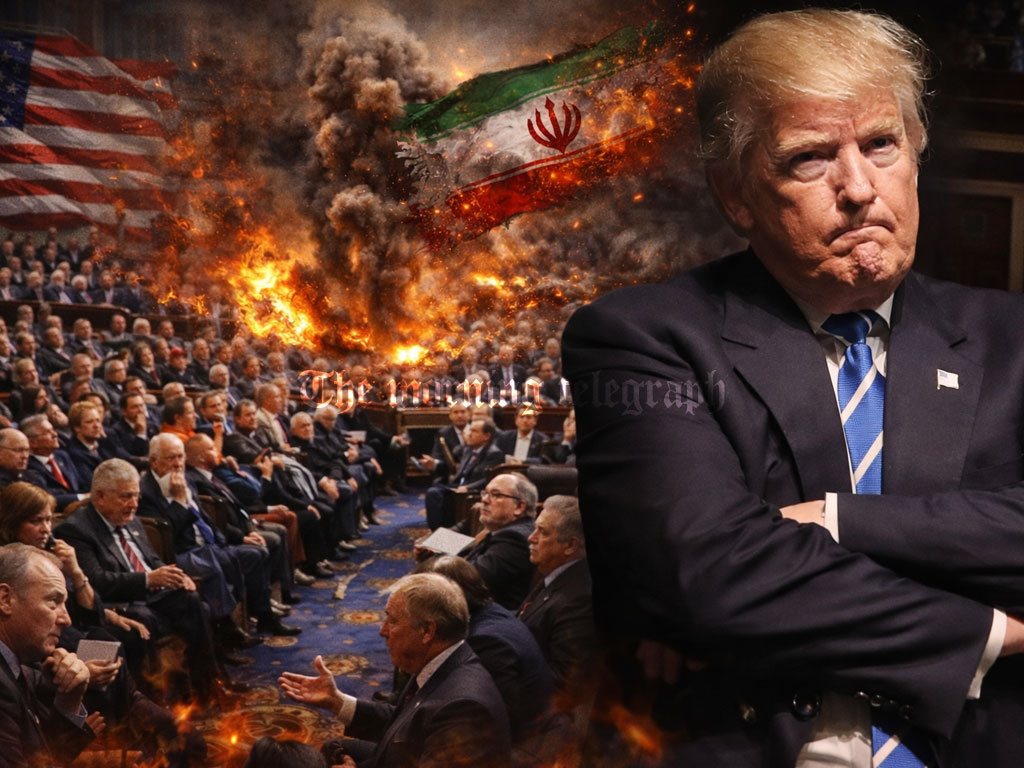
Republican and Democratic lawmakers clash over Trump’s unilateral military strike on Iran, spotlighting a constitutional crisis over Congress’s war powers.
President Donald Trump’s sudden military strike aimed at assassinating Iranian Supreme Leader Ayatollah Ali Khamenei has triggered fierce debate in the United States over the constitutional limits of presidential war powers. Congress was informed about the operation only moments before it began, and the Trump administration did not seek formal approval from lawmakers before authorizing the attack.

Critics argue this move represents a clear abuse of Congress’s exclusive authority to declare war under the Constitution. According to the White House, Secretary of State Marco Rubio briefed the so-called Gang of Eight, a group of senior lawmakers and intelligence leaders, shortly before the strike. While briefings had occurred during the Iran crisis, formal legal authorization from Congress was not obtained.
Democratic lawmakers have been outspoken in their criticism. Senator Andy Kim, a former Obama administration official, warned that involving the United States in a dangerous military action without broad congressional input could lead to a national crisis. Senate Minority Leader Chuck Schumer also said the administration has failed to provide sufficient details about the alleged threat from Iran.
There is concern across Capitol Hill that the conflict could escalate into a wider regional war, potentially exposing American forces in the Gulf to direct attacks. This is not the first instance in which the Trump administration has acted without congressional permission, with prior strikes on Venezuela and Iranian nuclear facilities also bypassing formal approval.
Some senior Republicans and a few Democrats defended Trump’s decision, including Senators John Thune, Lindsey Graham, and John Fetterman, who argue the action was necessary to confront Iran’s nuclear ambitions. Others, like Senator Lisa Murkowski of Alaska, have questioned the effectiveness of such unilateral strikes.
Lawmakers including Senator Tim Kaine are preparing bipartisan resolutions invoking the War Powers Act to require congressional approval for future military actions. Even if passed, the measure may serve more as political protest than binding constraint, as overriding a presidential veto would require a difficult two-thirds majority vote.