A growing land dispute in Northern Sri Lanka sparks serious allegations of cultural erasure, religious bias, and forced land control, raising fears of renewed ethnic tensions.
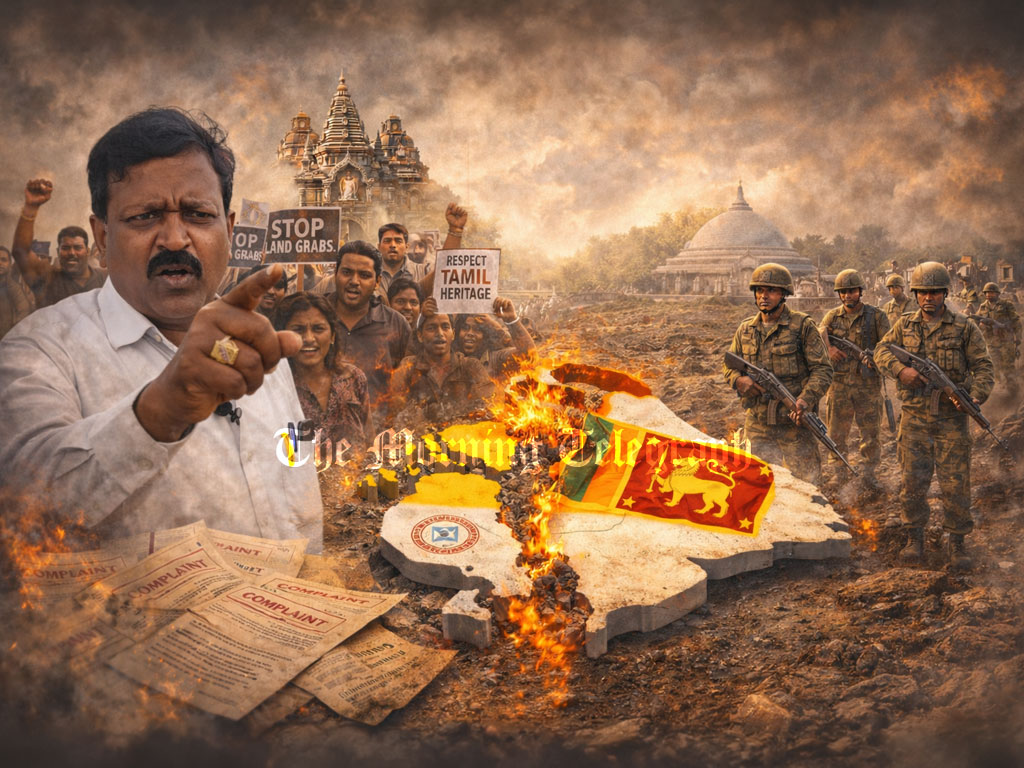
Former Member of Parliament Thurairasa Ravikaran has accused the government of advancing a controversial agenda in Northern Sri Lanka, alleging attempts to seize land belonging to Tamil communities while pushing a broader effort of cultural and religious transformation in the region. Addressing the issue publicly, he stated that Vedukkunarai Malai in Vavuniya North has long stood as a historically and culturally significant site for Tamil people, warning that recent developments could reignite ethnic tensions and deepen divisions.
Ravikaran’s remarks were made in response to a recent statement delivered in Parliament by the Minister of Buddhasasana, who claimed that Vedukkunarai Malai is associated solely with Buddhist religious identifiers. The minister further announced that 229 acres of land in Kurunthur Malai would be handed over to the Department of Archaeology, a decision that has drawn strong criticism and concern from Tamil political representatives and community leaders.

Emphasizing the deep ancestral and cultural ties to the land, Ravikaran pointed out that Tamil worshippers have continuously practiced religious traditions at the Aadi Sivan temple in Vedukkunarai Malai across generations. He noted that despite facing numerous challenges over the years, these practices have endured, reinforcing the strong spiritual and cultural connection that Tamil communities maintain with the land.
Rejecting the government’s archaeological justification, Ravikaran argued that claims of Buddhist heritage cannot be used as a basis to occupy land without clear, transparent, and credible evidence. He accused authorities of applying double standards by undermining Tamil identity, heritage, and religious traditions while publicly presenting themselves as representatives of all communities in Sri Lanka.
He further warned the current administration that continuing along a similar path followed by previous governments accused of comparable actions could lead to serious consequences. Raising questions about the legitimacy of the claims, he asked when and by whom the alleged Buddhist identifiers were discovered, pointing out that no impartial or scientifically credible archaeological excavation has been conducted to establish such claims.
Drawing comparisons with past controversies, Ravikaran challenged the government’s current approach, questioning how it differs from earlier instances where land claims were made on religious grounds without sufficient evidence. He cautioned that such actions risk deepening ethnic divisions and reviving long-standing accusations of bias and discrimination based on religion and ethnicity.
Strongly condemning the proposed transfer of 229 acres to the Department of Archaeology, Ravikaran stated that the move would displace local communities by depriving them of agricultural land, thereby affecting livelihoods that have been sustained for generations. He described the decision as unjust and harmful to people who depend on the land for survival and economic stability.
Concluding his statement, Ravikaran declared that these actions would be firmly opposed and urged the Tamil community to remain vigilant. He stressed that they would not remain silent and would resist any attempts to alter the identity, ownership, or traditional use of their ancestral lands.