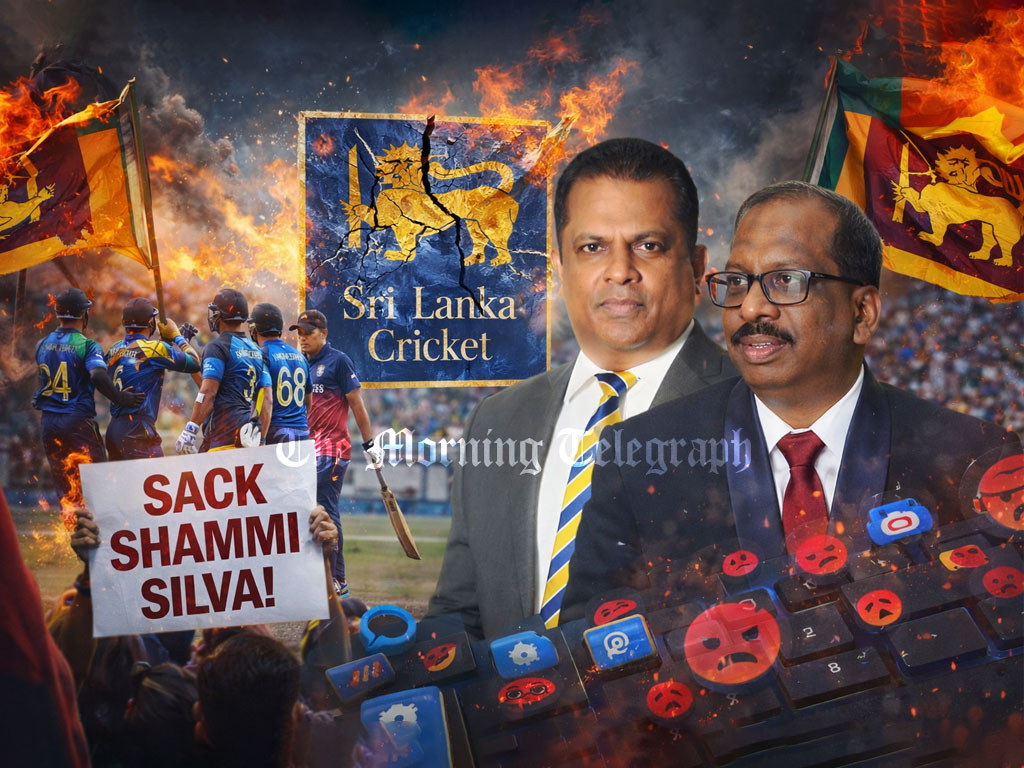
Sri Lanka’s cricket fans are once again demanding the head of Sri Lanka Cricket President Shammi Silva after a string of disappointing performances, but beneath the outrage lies a far more complex story. From emotional swings between hero worship and boycott calls, to the hidden role of selectors appointed by the Sports Ministry, the truth behind Sri Lanka’s latest cricket crisis raises uncomfortable questions about who is really responsible when the team fails. As anger grows on social media and protests fizzle out in reality, a closer look reveals that the administrators may not be the ones holding the bat when wickets fall and that the real accountability might lie somewhere entirely different.
Public emotion in Sri Lanka often runs high when it comes to cricket. When the national team wins, players are celebrated as heroes; when the team loses, frustration quickly turns toward the administrators. The recent calls by sections of the public for the removal of the Sri Lanka Cricket (SLC) Executive Committee led by Shammi Silva must be understood within this familiar cycle of emotional reaction that accompanies the country’s most beloved sport.

Sri Lankan cricket supporters are passionate, but that passion often swings to extremes. The national team’s recent overseas tour to Pakistan and its struggles in white-ball formats triggered widespread criticism, with some fans even urging a boycott of Sri Lanka’s matches at the T20 World Cup. However, the mood shifted dramatically after a memorable victory against Australia that secured Sri Lanka a place in the Super Eight stage of the tournament. Suddenly the same team that had been condemned days earlier was being celebrated once again.
Yet the pendulum swung back once more when Sri Lanka produced disappointing performances against England and New Zealand, results that ended their hopes of reaching the semi-finals. Frustration returned immediately, with social media campaigns calling for the removal of Shammi Silva and the SLC administration. Despite this backlash, the team’s final Super Eight encounter offered a measure of redemption. In a losing cause against Pakistan, captain Dasun Shanaka produced a remarkable unbeaten 76, nearly pulling off what would have been an extraordinary victory.
A Different Sporting Culture
Comparisons with other cricketing nations reveal an interesting contrast. When Cricket Australia suffered an unexpected early exit from the same T20 World Cup after defeats to Zimbabwe and Sri Lanka, Australian fans did not immediately demand the resignation of their board or administrators. The public discourse focused largely on the players and performance on the field rather than administrative leadership.
Sri Lanka, by contrast, often directs its frustration toward administrators regardless of where responsibility truly lies.
Selection Decisions and Ministerial Authority
One critical aspect frequently overlooked in public discussions is the role played by the Ministry of Sports of Sri Lanka in the selection of the national team. The current selection panel, headed by Pramodaya Wickramasinghe, was appointed by the Minister of Sports Sunil Kumara Gamage only months before the World Cup.
Under Sri Lanka’s sports governance structure, selectors are appointed by the Minister, and the team selection process is approved by the National Sports Selection Committee and signed off by the Minister himself. Meanwhile, the SLC President and Executive Committee are responsible primarily for the administration and management of Sri Lanka Cricket.
This creates a paradoxical situation: when the team performs well, praise goes to the players; when results are poor, administrators such as Shammi Silva become the targets of public anger, while those responsible for selection decisions often escape scrutiny.
The Return of the Wickramasinghe Selection Panel
The current selectors were brought back for a second time. In 2021, during the tenure of former Sports Minister Namal Rajapaksa, the then Chairman of the National Sports Selection Committee Shavendra Silva reportedly refused to appoint the same panel despite pressure from the Technical Advisory Committee led by Aravinda de Silva, which included prominent figures such as Mahela Jayawardene, Kumar Sangakkara, Roshan Mahanama, and Muttiah Muralitharan.
Eventually, political insistence saw Wickramasinghe’s panel appointed, and critics argued that the influence of individuals connected to the Sinhalese Sports Club became increasingly prominent in national team decisions.
The Role of the Sports Minister
Criticism has also been directed toward Sports Minister Sunil Kumara Gamage, who entered Parliament through the national list rather than being directly elected. Early in his tenure he pledged sweeping reforms and suspended the Secretary General of the National Olympic Committee of Sri Lanka, Maxwell de Silva, amid disputes involving funding from the International Olympic Committee.
However, critics argue that subsequent actions have been inconsistent. The Minister has been accused of showing favouritism toward certain sports associations, including the Boxing Association of Sri Lanka and the National Shooting Sport Federation of Sri Lanka, where one of his political supporters is said to hold influence.
Perhaps the most embarrassing episode occurred when the Minister invited President Anura Kumara Dissanayake to lay the foundation stone for a new cricket stadium, only for the project to be halted soon after due to the absence of necessary environmental approvals. The incident drew criticism and turned what was intended to be a high-profile development initiative into a public relations setback.
The Failed Protest Against Sri Lanka Cricket
Against this backdrop, calls to remove Shammi Silva culminated in a protest outside Sri Lanka Cricket headquarters in March 2026, reportedly instigated by a controversial Buddhist monk known for outspoken rhetoric. Yet the demonstration failed to attract significant public support, with only a handful of participants attending before the gathering dispersed.
The outcome suggested that public anger, while loud online, may not reflect the broader cricket community’s views.
Shammi Silva’s Record
Critics often highlight the financial power accumulated by Sri Lanka Cricket under Shammi Silva’s presidency. Yet the same period has also seen significant contributions by SLC to the wider sporting ecosystem.
Under the current administration, Sri Lanka Cricket has:
- Provided financial support to multiple sports associations
- Assisted athletes across different sporting disciplines
- Donated funds to children’s hospitals and public initiatives
- Contributed financial assistance to the Ministry of Sports
- Increased the salaries and match payments of national cricketers
- Distributed funding to domestic cricket clubs for infrastructure and renovation
- Expanding the sport to rural areas by distributing cricket equipment to hundreds of schools
- Embarking on building new cricket stadium in Jaffna
In addition, SLC has ensured that national players have access to modern training facilities, international exposure, and improved contractual security.
Performance Ultimately Lies on the Field
Administrators can manage structures, finances and infrastructure. Selectors can choose squads. But ultimately cricket matches are decided by performances on the field.
The current Sri Lanka team has been provided with resources, facilities and opportunities. The final responsibility for results, many argue, lies with those who walk onto the field wearing the national jersey.
In the emotionally charged world of Sri Lankan cricket, it may be easier to demand the removal of administrators. But a closer look suggests that the story is far more complex and that the contributions of Shammi Silva and his executive committee to the game should not be overlooked amid the noise of public frustration.
“We have given the cricketers everything they need. The only thing we have not given them is common sense and a brain” said a senior official of Sri Lanka Cricket.