A powerful reflection on how the Sinhala and Tamil New Year is slowly losing its deeper meaning, even as traditions continue to thrive across Sri Lanka and Asia.
Across Sri Lanka and much of Asia, April is no longer simply a time of celebration. It has evolved into something performed, consumed, and in some ways quietly misunderstood. The Sinhala and Tamil New Year continues to arrive with its familiar rhythm of ritual meals, auspicious times, and family gatherings. Streets fill with life, homes awaken with preparation, and for a fleeting moment, the nation seems to reconnect with something older than itself. Yet beneath this continuity lies a deeper and more unsettling question. Are we preserving a living philosophy, or merely repeating its outer shell?

Historical accounts from colonial writers such as John Davy and Robert Knox reveal a fascination with these April New Year traditions. They documented the precision of astrological timing, the deliberate suspension of labour, and the careful sequencing of rituals. What they observed, even if they did not fully grasp it, was not simply a festival. It was a structured pause in the flow of ordinary life. Their writings hint at a society that chose to stop, not out of necessity, but as an act of alignment with forces beyond human control.
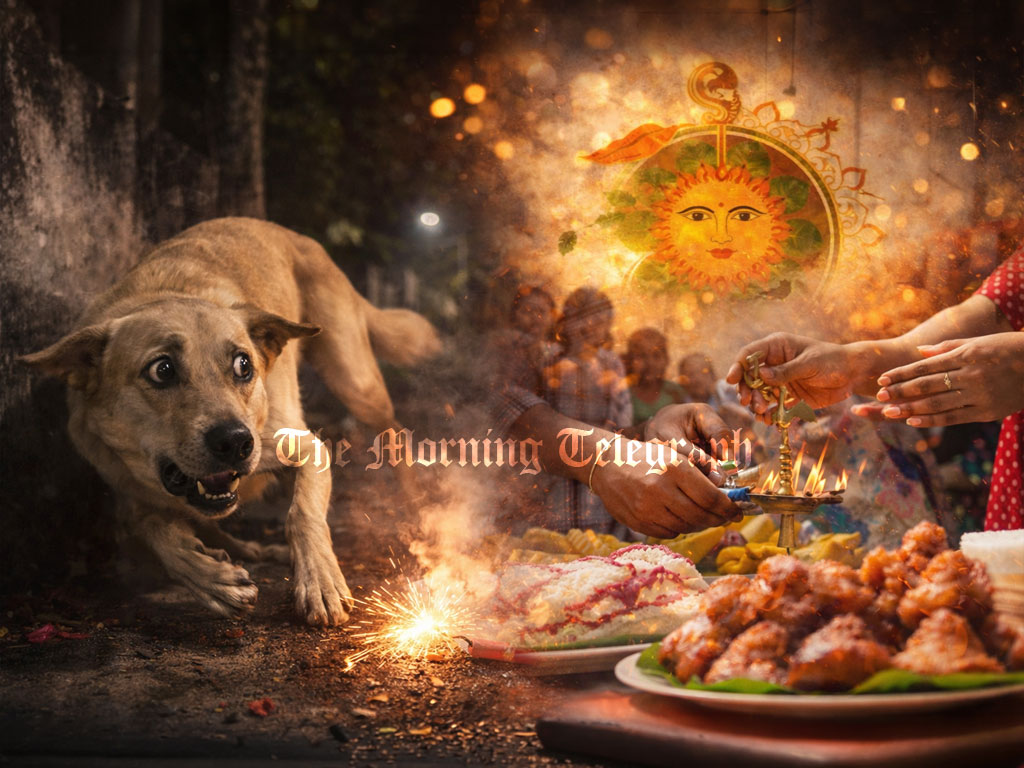
This act of stopping feels almost radical in the modern world. The nonagathe period, once observed with discipline and seriousness, represented a complete pause. Fires were not lit, tools remained untouched, and transactions ceased. In some communities, even speech was reduced, as if language itself risked disturbing the fragile balance between past and future. These were not symbolic gestures. They were lived practices that are now fading from collective memory. What once represented a meaningful interruption has, in many places, been reduced to a brief pause squeezed between television specials and commercial promotions.
It is within this transformation that the New Year begins to reveal its contradictions. Despite its emphasis on renewal, the modern observance often reinforces the very patterns it was meant to disrupt. The careful timing of rituals, once guided by an understanding of cosmic rhythms, now sits uneasily alongside the impatience of modern life. People check clocks and mobile phones instead of looking to the sky. The ritual continues, but its meaning grows thinner with each passing year.
The relationship between these traditions and power also adds complexity to their story. Historical accounts show that the New Year was not only a domestic celebration but also a political moment. Kings presided over ceremonies that reinforced authority and hierarchy. By aligning themselves with cosmic cycles, rulers presented their power as natural and inevitable. Participation in the New Year became, in part, participation in a broader affirmation of order. This dimension is often overlooked in contemporary narratives, which tend to present the festival as purely communal and egalitarian.
There are also quieter, less visible elements that reveal the depth of these traditions. In rural Sri Lanka, the use of herbal oils during rituals was once connected to systems of indigenous medicine and seasonal health practices. These rituals were not arbitrary. They aligned with environmental conditions and climatic shifts that affected human well being. What appears today as symbolic cleansing once held practical and even scientific relevance. Similarly, the lighting of the hearth at an auspicious time was not merely about fortune. It represented the synchronization of domestic life with a wider natural rhythm.
Across the region, similar festivals have undergone comparable transformations. In Thailand, Songkran has expanded into large scale public celebrations. In Myanmar, Thingyan has become a vibrant spectacle. Water, once a symbol of purification and respect, is now central to energetic public festivities. While these changes reflect cultural evolution, they also signal a shift away from deeper meanings. What was once a medium of spiritual cleansing risks becoming entertainment.
Recognising this shift does not mean resisting change. Cultures are not static, and they must adapt. However, there is a critical difference between evolution and erosion. When a tradition continues in form but loses its meaning, it becomes vulnerable to commodification and trivialisation. The Sinhala and Tamil New Year, despite its resilience, is not immune to this process.
There is also a lingering colonial influence in how these traditions are perceived. Early observers documented rituals with curiosity, but often reduced their deeper philosophy to something exotic or quaint. This framing still echoes today. The festivals are widely celebrated and admired for their colour and vibrancy, yet their intellectual and philosophical depth is rarely engaged with. They are appreciated visually and culturally, but not always understood.
Despite these tensions, there remains a core idea that refuses to disappear. The insistence on pause continues to challenge modern life. The New Year is not just a sequence of rituals. It is a cycle that requires conscious transition. It reminds us that human life cannot be driven solely by speed, productivity, and control. It calls for moments where continuity is broken and meaning is rediscovered.
Perhaps the most important question is not whether these traditions are being preserved, but whether they are being understood. To truly celebrate the New Year is to accept that renewal cannot happen without interruption. It requires acknowledging moments when productivity stops, certainty fades, and the future remains undefined, even if only briefly.
Today, as households across Sri Lanka light their hearths at carefully chosen times, many continue to follow the rituals with sincerity. The customs endure, the timings are observed, and the greetings are exchanged. Yet the deeper philosophy behind these actions often remains unexamined. The rituals survive, but the idea at their core, that life must sometimes stop in order to begin again, sits uneasily in a world that has forgotten how to pause.
If this idea feels uncomfortable, it is because it challenges more than tradition. It questions our understanding of time, work, and meaning. In that challenge lies the enduring power of the April New Year, a power that persists quietly, even when it is not fully understood.