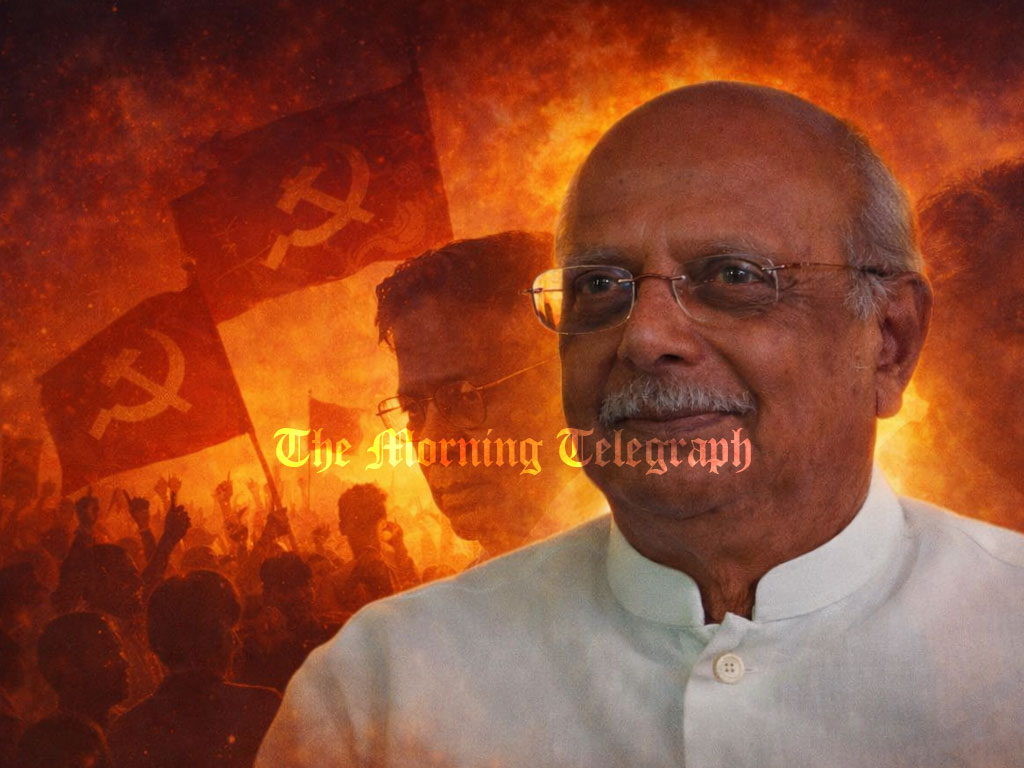
The passing of LSSP patriarch Professor Tissa Vitharana extinguishes the last bright flame of Sri Lanka’s classical leftist generation, forcing a critical examination of the movement’s fading relevance against the formidable rise of the JVP-led NPP in today’s turbulent political landscape.
The mortal journey of Lanka Sama Samaja Party patriarch Professor Tissa Vitharana concluded recently, marking an event that transcends the ordinary passing of a political figure. His departure represents something far more profound and irreversible, the ceremonial closing of a chapter in Sri Lankan political history that can never be reopened. With his death, the nation bids a somber farewell to one of the last remaining statesmen from a generation distinguished by remarkable intellectual prowess, unwavering ideological commitment, and an almost missionary dedication to the socialist vision that fundamentally shaped the nation’s early post-colonial identity and its subsequent developmental trajectory.

Professor Vitharana, who began his earthly journey in 1934, was a man of extraordinary and varied talents that defied simple categorization. A physician and scientist by rigorous academic training, he brought unprecedented scientific temper to public service while serving with distinction as the Director of the Medical Research Institute, where his contributions to public health left an indelible mark on the nation’s healthcare infrastructure. His political awakening and subsequent journey began in 1974 when he made the conscious decision to join the LSSP, eventually entering Parliament three decades later in 2004. Throughout his parliamentary career, he held several key ministerial portfolios of national importance, including Science and Technology, Technology and Research, and served with distinction as Senior Minister of Scientific Affairs, consistently advocating for the integration of scientific thinking into governance. For his outstanding and lifelong contributions to the advancement of science in Sri Lanka, he was rightfully awarded the prestigious national honor of Vidya Jyothi, a recognition that acknowledged both his scientific achievements and his efforts to bridge the gap between scientific progress and political decision-making.
There existed a golden period in Sri Lankan political history when the firmament was illuminated by a magnificent constellation of political giants proudly representing the leftist cause in all its diverse manifestations. These were individuals of remarkable intellectual caliber, oratorical skills, and unwavering commitment to the working classes whose interests they championed. Today, following Professor Vitharana’s departure, only a handful of these distinguished veterans remain among us, the most prominent being Communist Party of Sri Lanka leader D. E. W. Gunasekera, who continues to carry the torch of a bygone era. Their progressively dwindling numbers force upon us a critical and urgent examination that can no longer be postponed: What exactly does the future hold for Sri Lanka’s traditional left movement in an increasingly complex and globalized political environment? Can these historic parties reinvent themselves to remain relevant in a rapidly changing political landscape where old certainties no longer apply? And how will the more radical leftist movements, particularly the Janatha Vimukthi Peramuna under its new National People’s Power umbrella, navigate the enormous challenges of national governance? Will they eventually suffer the same fate of marginalization and decline as the traditional left, which currently stands as but a pale shadow of its former influential and vibrant self, struggling to maintain even a foothold in national politics?
The Revolutionary Birth of a Political Tradition
The Lanka Sama Samaja Party was never merely a political party in the conventional sense of the term; it was fundamentally a movement born of intense intellectual ferment and passionate anti-colonial fervor that swept across the global South during the early twentieth century. It came into formal existence on 18 December 1935 as Ceylon’s first modern political party, predating even the major bourgeois nationalist formations that would later dominate the political landscape. It was forged in the crucible of colonial oppression by groups of young intellectuals and activists who were deeply influenced by Marxist-Leninist ideas circulating globally, galvanized by the catastrophic global depression that exposed capitalism’s fundamental contradictions, and outraged by the systematic exploitation inherent in British colonial rule over their homeland.
The founding fathers of this remarkable political formation included iconic figures whose names would become legendary in Sri Lankan political discourse: Leslie Goonewardene, the organizational genius behind the movement; N. M. Perera, the brilliant economist and orator; Colvin R. de Silva, the constitutional lawyer and firebrand speaker; and the Gunawardena brothers, Philip and Robert, who brought rural organizing experience and militant trade unionism to the party’s arsenal. From its very inception, the LSSP distinguished itself from all other political formations as a party of intellectuals who refused to divorce theoretical understanding from practical political engagement. The party made immense and lasting contributions to the political education of the Sri Lankan public, publishing newspapers, pamphlets, and theoretical journals that brought sophisticated Marxist analysis to the masses in accessible language. It successfully bridged class divides that other parties found insurmountable, attracting both affluent, English-educated youth from Colombo’s elite families and ordinary working people from plantations and urban factories under its ideological banner, creating a unique political coalition that confounded conventional political analysis.
The party was instrumental in the protracted struggle for Independence from the British Crown, though its vision of independence differed fundamentally from that of the bourgeois nationalists who merely sought to replace British rulers with native elites. It opposed British rule vehemently and without compromise, establishing transnational links with like-minded Trotskyist groups throughout South Asia through revolutionary organizations such as the Bolshevik-Leninist Party of India, Ceylon and Burma, creating an internationalist network that challenged colonial domination across the region. The colonial authorities responded with characteristic aggression and repression, proscribing party activities and incarcerating its leaders during World War II when the party’s anti-war stance brought it into direct conflict with the imperial war effort. Yet remarkably, the LSSP demonstrated extraordinary resilience each time it was suppressed, bouncing back from each wave of repression to re-establish itself as a formidable political force in the post-war era, its leaders emerging from prison with their ideological convictions strengthened rather than diminished by the experience of state persecution.
Internal Strife and Ideological Fractures
The history of the LSSP, for all its glorious achievements, is also a chronicle of persistent internal dissent, ideological warfare, and organizational schism that progressively weakened the party over decades. In 1943, a significant split of monumental importance occurred, leading directly to the emergence of the Communist Party of Sri Lanka as a separate political formation. The Marxist-Leninist faction within the LSSP, profoundly disillusioned with the party’s dominant Trotskyist orientation that emphasized permanent revolution and criticized Stalin’s Soviet Union, broke away to form the United Socialist Party during the wartime period. Though promptly proscribed by the colonial government, this group eventually evolved into the Communist Party of Sri Lanka, which became known for its Stalinist leanings and unwavering alignment with the Soviet Union throughout the Cold War period, creating a permanent division within Sri Lankan Marxism that would have lasting consequences for the left movement.
Despite these debilitating fractures, the LSSP continued to have an eventful and colorful political history that shaped the nation’s development in countless ways. In the early post-Independence years, it emerged as the primary opposition force, leading major labor struggles that repeatedly challenged government authority and expanded working-class consciousness. Its pinnacle of extra-parliamentary power arguably came in 1953, when it led a massively successful hartal against the UNP government’s decision to cut the rice subsidy, a protest that nearly toppled the government and demonstrated the immense power of organized labor when united behind clear political objectives. However, a moot point remains that continues to divide historians and political analysts: whether the LSSP was able to strategically invest its considerable political and electoral capital during this period to expand its national footprint and work systematically towards the ultimate goal of forming a socialist government in Sri Lanka. This vibrant socio-political milieu of the 1950s and 1960s had a lasting and formative influence on young Sri Lankans like Professor Vitharana, shaping their worldview and drawing them inexorably into the ranks of either the LSSP or the Communist Party, where they would spend their lives fighting for the socialist cause.
The Coalition Conundrum and Devastating Fallout
A pivotal turning point of incalculable consequence came in 1964 when the LSSP made the momentous and controversial decision to close ranks with the Sri Lanka Freedom Party and join an SLFP-led coalition government for the first time in its history. This move caused immediate consternation among its core supporters and internal factions, who viewed it as an unforgivable betrayal of the fundamental socialist cause for which the party had been fighting since 1935. It was only natural that the Fourth International, the global Trotskyist coordinating body, turned decisively hostile towards the LSSP for what it perceived as a fundamental abandonment of revolutionary principles. The party suffered further debilitating splits as a direct consequence of this momentous decision, losing some of its most principled cadres who could not countenance participation in a bourgeois nationalist government.
The subsequent SLFP-led United Front government of 1970 to 1977, of which the LSSP was a full and active constituent part, embarked upon a series of unpopular economic experiments that would have disastrous consequences for both the party and the nation. These experiments were defined by excessive statism, import substitution industrialization behind high protective barriers, and stringent rationing of essential commodities that created massive black markets and public resentment. This dirigisme, or heavy state control over every aspect of economic life, progressively alienated the masses who endured untold hardships while waiting in endless queues for basic necessities. The cumulative effect of economic mismanagement and mounting public discontent created the perfect conditions for the United National Party’s triumphant return to power in 1977 with an unprecedented five-sixths parliamentary majority that effectively made it a temporary dictatorship within the framework of Westminster-style democracy.
This traumatic period is widely cited by political historians as the beginning of the LSSP’s irreversible and seemingly terminal decline. The party’s fortunes within the government fluctuated dramatically until Prime Minister Sirimavo Bandaranaike summarily sacked its Cabinet members in 1975, humiliating a party that had sacrificed so much to join her government. The LSSP was forced to break ranks under the most undignified circumstances, and the Communist Party followed suit in 1977, just ahead of the general election that would sweep the left entirely from the parliamentary stage. All partners in the defeated United Front suffered an ignominious defeat at the polls, with most of their parliamentary leaders losing their seats in the devastating UNP landslide that permanently altered the country’s political landscape.
The Strike That Irreparably Blotted the Copybook
Perhaps more than any policy failure or electoral defeat, it is a single traumatic event that perfectly encapsulates the LSSP’s fundamentally compromised position within the coalition government: the brutal crushing of the 1972 Ceylon Bank Employees Union strike. The workers had launched legitimate industrial action demanding better working conditions and equitable pay scales commensurate with their professional responsibilities. Many observers and trade unionists naturally expected the then Finance Minister, Dr. N. M. Perera, an LSSP leader of towering stature and a lifelong champion of labor causes, to readily grant their reasonable demands given his entire political career had been built on defending workers’ rights against capitalist exploitation.
Instead, in a move that shocked and dismayed his lifelong supporters, he chose a hardline approach that contradicted everything he had ever stood for, playing a dangerous game of chicken with the determined strikers. The painful strike dragged on for 108 agonizing days, during which Perera issued increasingly threatening warnings under the draconian Emergency Regulations and threatened to terminate the strikers permanently, ultimately forcing a humiliating end to the action through state coercion rather than collective bargaining. His fateful decision drew widespread and lasting criticism from the very labour unions that had historically formed the LSSP’s bedrock support base, creating a breach that would never fully heal.
Eight years later, in a cruel historical irony that demonstrated how precedent-setting works in politics, President J. R. Jayewardene would take a leaf directly out of N. M. Perera’s book and go several steps further, summarily sacking tens of thousands of workers who participated in the massive July 1980 strike against his government’s anti-labour policies. In an additional twist of tragic irony, the LSSP was among the primary organizers of that very strike, which the UNP government crushed in the most despicable and authoritarian manner imaginable, using the precedent the LSSP itself had established to destroy the very workers the party claimed to represent.
There exists no reasonable doubt that the LSSP historically empowered the Sri Lankan labour movement and was instrumental in winning fundamental workers’ rights through decades of sustained struggle. From the 1930s through the mid-twentieth century, leftist parties fought heroically and successfully to embed rights like the eight-hour workday, old-age pensions, overtime pay for extra work, paid annual leave, and comprehensive social security benefits into the national legislation that protected all workers. They successfully ensured security of employment through legal protections against arbitrary termination and established collective bargaining rights that gave workers genuine power in negotiating with employers. These achievements fundamentally shaped workplace standards in both the public and private sectors, creating a protective framework that workers today often take for granted.
Yet despite this proud legacy of achievement, the LSSP’s shameful role in crushing the bank employees’ strike badly blotted its copybook and permanently sullied the reputation of the grand old party in ways from which it never fully recovered. This fateful action, driven by the perceived exigencies of coalition governance rather than socialist principle, demonstrated a fundamental mellowing of core ideology that had once been uncompromising. It inevitably created a yawning political vacuum on the left, effectively paving the way for the emergence of far-left forces like the Janatha Vimukthi Peramuna that could credibly claim to represent authentic revolutionary socialism uncontaminated by the compromises of parliamentary politics and coalition governance.
The Dramatic Rise of the Radical Alternative
The political conformism of the traditional left parties, the resultant progressive dilution of their once-revolutionary ideology, and their increasing adoption of policies they had historically rejected as fundamentally capitalist and exploitative created the perfect historical storm for a radical alternative to emerge and flourish. Rohana Wijeweera, a brilliant and charismatic organizer with a instinctive understanding of rural youth psychology, masterfully exploited this situation to build a revolutionary movement from almost nothing. He advocated tirelessly for a truly socialist movement and armed revolution as the only genuine path to capture state power from the bourgeoisie, rejecting the parliamentary cretinism he accused the old left of embracing.
The formal birth of the Janatha Vimukthi Peramuna on May 14, 1965, was facilitated by several converging factors of historical importance: the United National Party’s decisive ascent to power in the 1965 elections, the severe economic hardships faced by ordinary people across the country, the unpopular slashing of the rice subsidy by the new government, and the growing unemployment crisis among rural Sinhala-educated youth who saw no future for themselves within the existing social order. Crucially, it was also a direct reaction to the lukewarm and ineffective response of the traditional left parties to these unpopular government policies, a stark and damning contrast to their militant opposition to a similar subsidy cut in 1953 when the LSSP had led the nearly successful hartal against the UNP government.
Wijeweera, initially a committed member of the Communist Party’s Peking Wing led by the legendary Nagalingam Shanmugathasan, became progressively disillusioned with what he saw as its creeping revisionism and abandonment of genuine revolutionary principles. He founded the Janatha Vimukthi Peramuna as a breakaway formation, positioning it as the authentic revolutionary alternative, the real Communist Party of Sri Lanka in its original undiluted form. He was thus distinctly different from the old left parties, which he publicly condemned as a collection of revisionist and conformist organizations lacking the necessary courage and political vitality to effectively challenge the rising capitalist forces in the country.
The fundamental differences between the Janatha Vimukthi Peramuna and the traditional left parties were stark and mutually defining:
- The JVP positioned itself as truly revolutionary; the old left was characterized as irredeemably reformist and parliamentarian.
- The JVP openly advocated armed struggle to capture state power; the old left had definitively abandoned violence as a political method.
- The JVP’s initial support base consisted primarily of rural, Sinhala-educated youth from petit-bourgeois backgrounds facing economic hardship; the old left’s support was predominantly urban, English-educated, and upper-middle-class.
- The JVP maintained strict secrecy about its activities and membership initially; the traditional left operated openly and transparently.
- The JVP remained doctrinally rigid and uncompromising; its rivals were accused of becoming increasingly right-leaning while rhetorically claiming socialism.
- The JVP’s early support came mainly from the Sinhala majority community, a limitation that would only change with the later formation of the National People’s Power.
Despite its uncompromising radicalism, the JVP demonstrated surprising tactical pragmatism when necessary, backing the SLFP-led United Front in the crucial 1970 election to increase its political strength and expand its influence among the masses. Its energetic activists led the United Front’s propaganda campaign with tremendous enthusiasm, helping propel the coalition to a historic electoral victory, though they made it explicitly clear they were not supporting the LSSP or Communist Party within it, viewing them as compromised formations unworthy of genuine revolutionary support. This uneasy and temporary alliance shattered dramatically in April 1971, when the JVP launched its first armed insurrection against the very government it had helped elect, leading to a brutal state crackdown and a direct, bloody confrontation with the traditional leftists who now held power in the government.
The JVP’s Complex Dance with Democracy and Violence
The comprehensive defeat of the United Front government in the historic 1977 elections and the subsequent release of JVP prisoners from detention marked a significant strategic shift in the movement’s approach to power. The JVP made a calculated decision to operate temporarily as a democratic political force, contesting the 1981 District Development Council elections and the historic 1982 presidential election, where Wijeweera’s colorful and melodramatic campaign managed to secure a respectable third-place finish despite limited resources and media access.
However, the JVP’s brief and tentative foray into democratic politics was dramatically cut short by historical circumstances. Following the horrific anti-Tamil pogrom of July 1983, which saw widespread violence against Tamil civilians in Sinhala-majority areas, the Jayewardene government, seeking desperately to deflect mounting international condemnation and derail a pending court case challenging a controversial referendum result, proscribed the JVP along with other leftist parties, falsely accusing them of instigating the ethnic violence. While the other parties successfully challenged the unjust ban in court, the JVP made the fateful decision to go underground permanently, initiating its bloody second insurrection that would bring the country to the brink of complete collapse.
The signing of the Indo-Lanka Peace Accord in 1987 and the subsequent introduction of Provincial Councils through the Thirteenth Amendment to the Constitution provided the JVP with a powerful new rallying point for nationalist mobilization. Adopting a stridently hyper-nationalistic agenda, it vehemently opposed any form of power devolution to the provinces and unleashed a terrifying campaign of political terror intended to scuttle the Provincial Council elections entirely. The traditional leftist parties, who courageously supported devolution as a necessary step toward ethnic conflict resolution and contested the elections despite the threats, were systematically branded as traitors and traitors who deserved nothing less than physical elimination at the hands of the JVP’s murderous military wing.
For a considerable period, the JVP held terrifying sway over substantial portions of the country through systematic fear and intimidation, but it progressively alienated ordinary citizens with its wanton and indiscriminate violence against innocent people. The traditional left parties, including the LSSP and Communist Party, played a crucial and courageous role as defenders of democratic institutions and processes, actively encouraging people to vote in defiant opposition to JVP boycotts and paying an extremely heavy price with the actual lives of some of their most dedicated members who were brutally assassinated for their principled stand. The state’s brutal and often extra-legal counterterror campaign eventually succeeded in decimating the JVP’s entire leadership structure by late 1989, effectively ending the second insurrection through the most violent means imaginable.
The Long Road Back and the Transformed Political Landscape
The JVP slowly and carefully re-emerged from the ashes of its destruction in the mid-1990s under the cautious leadership of Somawansa Amarasinghe, who had survived by fleeing the country and living in exile. The movement painstakingly re-entered the democratic mainstream, contesting elections and gradually rebuilding its organizational structure and popular support. By the crucial 2004 elections, it had become such a powerful political force that it joined the United People’s Freedom Alliance government and held cabinet posts with considerable authority, serving alongside its old rivals from the LSSP and Communist Party in an ironic reunion that would have seemed impossible just fifteen years earlier during the height of the insurrection. This period of uneasy cohabitation was, however, temporary and ultimately unsatisfactory for both sides.
The traditional left parties, represented by historic formations like the LSSP and Communist Party, continued their agonizingly slow but seemingly irreversible decline throughout this period, struggling heroically but unsuccessfully to maintain political relevance as increasingly junior and marginalized partners to the Sri Lanka Freedom Party in various coalition arrangements. Their support bases steadily eroded, their organizational capacity weakened, and their intellectual influence waned as younger generations found their message increasingly irrelevant to contemporary concerns.
In stark contrast, the JVP patiently bided its time and built incrementally toward a broader political platform that could appeal beyond its traditional support base. This long-term strategic vision culminated triumphantly in the formal formation of the National People’s Power and its historic, landslide victory in the 2024 general election, which fundamentally transformed the country’s political landscape. The NPP’s resounding success represents the ultimate vindication of the JVP’s long and painful march from the violent fringes of political life to the very center of governmental power, effectively displacing both the traditional left and even its former coalition partner, the Sri Lanka Freedom Party, as the primary opposition force to the United National Party. The NPP now stands as the dominant force on the Sri Lankan left, commanding electoral support that the old left parties can only dream of regaining.
Professor Tissa Vitharana’s deeply mourned passing, therefore, represents far more than simply the end of a distinguished personal era; it serves as a poignant historical marker of a fundamental power transition that has already decisively occurred in Sri Lankan politics. The foreseeable future of Sri Lanka’s once-glorious left movement now rests not with the venerable but irreversibly enfeebled parties of the past, but squarely with the ascendant National People’s Power and its leadership. The monumental challenge for this new political formation is to consciously avoid the same catastrophic pitfalls that historically befell the old left parties—the seductive temptations of state power, the progressive dilution of core ideology for short-term political gain, and the fatal compromises inherent in coalition politics that ultimately destroy movements from within. The NPP must prove it can govern with the same unwavering integrity and profound intellectual depth that distinguished figures like Professor Vitharana brought to their lifetime of dedicated political work.
The last great legend of Sri Lanka’s classical left has now departed from this earthly realm, and the entire future of the socialist movement he so passionately championed for nearly five decades now lies irrevocably in the hands of those who once rose in armed opposition to everything he represented. Only time will reveal whether this historical irony represents the final death of one political tradition or the hopeful birth of another, transformed and renewed for the challenges of a new century.