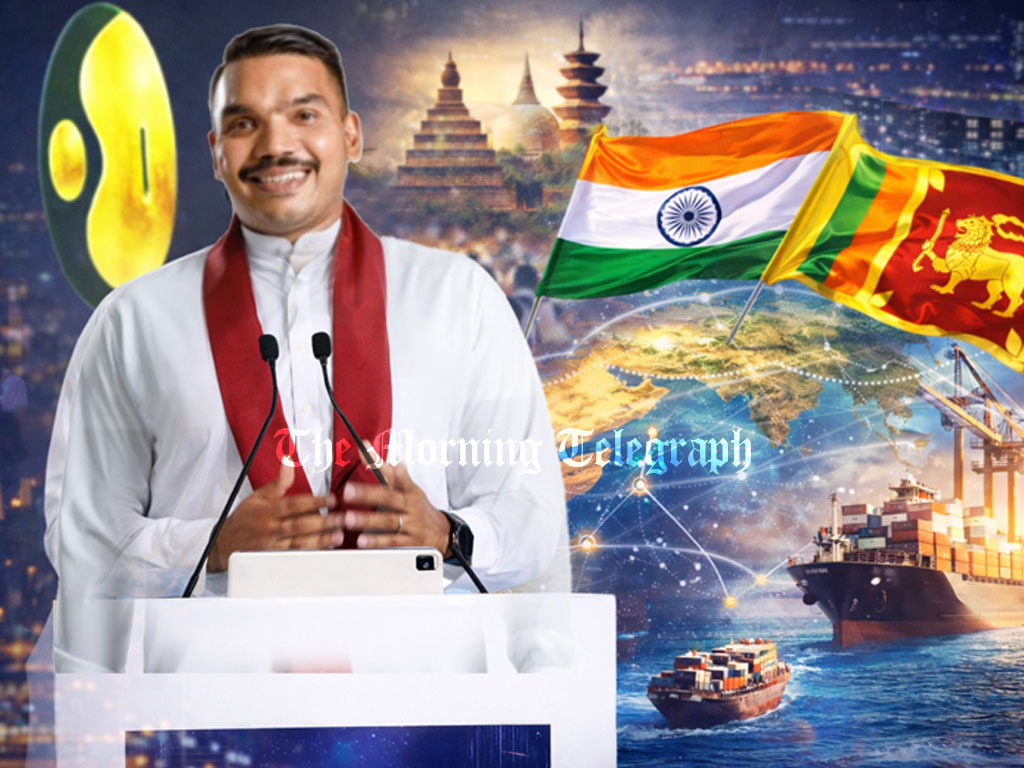
At a time of rising global tension, Namal Rajapaksa delivers a powerful vision positioning the Indian Ocean as a unifying force of trade, culture, and cooperation rather than a theatre of conflict, urging nations to choose stability over rivalry.
The Indian Ocean is not a conflict zone but a bridge between civilizations, said Sri Lanka Podujana Peramuna National Organizer and Parliamentarian Namal Rajapaksa.
He made this statement while addressing the WION Global Summit in New Delhi, India, today. Speaking here, Mr. Namal Rajapaksa said:
“It is a privilege to address you today at the WION Global Summit. This forum brings together ideas from around the world to discuss the forces shaping our global future.
We meet at a time when the global system is undergoing profound transformation. Trade routes are being disrupted, technological competition is reshaping the balance of power between nations, and wars continue to rage in various regions of the world. At the same time, the institutions that once guided global cooperation are facing unprecedented challenges. The post-war world, based on economic integration and relative stability, is now changing.

We are now entering a world of shared and shifting balances of power, where geography is once again decisive. Strategic regions that were once considered distant or secondary are now at the center of global politics. The Indian Ocean is becoming a hub. One such region is the Indian Ocean.
For thousands of years, the Indian Ocean has been a bridge between civilizations, not a zone of conflict. Long before the emergence of modern geopolitics, traders, scholars, and travelers traversed this seabed. Ideas flowed across the ocean, cultures interacted, and trade flourished between Asia, Africa, and the Middle East. Rather than dividing societies, the Indian Ocean has connected them.
The relationship between India and Sri Lanka is one of the oldest examples of that connection. Two thousand years ago, the teachings of Gautama Buddha reached Sri Lanka from India. It is worth remembering that this journey was not just about spreading a philosophy, but also the beginning of a deep civilizational relationship that continues to shape our societies today.
Through these trade routes, our ports were connected, and cultural exchange shaped our traditions. Over the centuries, our peoples have built one of the strongest relationships in the Indian Ocean region.
Today, the Indian Ocean is once again becoming the center of global economic and strategic activity. About two-thirds of global oil shipments pass through this sea, and about half of the world’s container traffic passes through its sea lanes. Undersea cables that carry the digital lifeblood of the global economy run along the ocean floor. Energy flows through it, supply chains depend on it, and global trade relies on it. The Indian Ocean has become one of the world’s most important economic highways.
When these routes are threatened, the consequences are felt around the world. Recent global events remind us of how fragile this stability can be. As unrest in the Middle East continues to affect energy markets and global security, strategic rivalries between major powers are increasingly visible in maritime regions. When instability occurs in one region, its impact quickly spreads across global trade routes. As energy prices rise, supply chains slow down, and markets respond accordingly. As a result, the stability of the Indian Ocean has once again become crucial.
Sri Lanka, located at the heart of these sea lanes, holds one of the most strategic positions in the Indian Ocean. Ships sailing between East Asia, the Middle East, and Europe pass just south of our shores. For centuries, Sri Lanka’s ports have served as trading hubs connecting civilizations. Today, Sri Lanka is at the crossroads of global commerce due to its geographical location.
However, geographical location alone does not matter. It matters how wisely a nation manages its position. For countries located in strategically sensitive regions, foreign policy must be guided by balance, foresight, and discipline. We must protect our sovereignty and secure our maritime region, while building strong partnerships with all nations. Strategic balance is not a weakness; it is a necessity for small states.
In this changing global context, India’s rise is one of the most significant developments of the 21st century. India’s economic growth, technological innovation, and demographic strength are reshaping the Indo-Pacific region. Under the leadership of Narendra Modi, India is emerging not only as a major economic power but also as a stabilizing force in the Indian Ocean.
This creates significant opportunities for neighboring countries like Sri Lanka. Our futures are naturally intertwined. Sri Lanka’s strategic location and infrastructure complement India’s economic scale, and together our two countries can strengthen regional stability and prosperity.
There are several areas where this partnership can be promoted. The first is maritime security; cooperation is essential to ensure safe and secure sea lanes. India’s growing maritime capability and Sri Lanka’s location make it a natural partnership to keep these lanes open. The second is regional connectivity; Sri Lanka’s geographical location and infrastructure can support its growth as a logistics, energy, maritime, financial, and aviation hub for regional trade. Strengthened by India’s National Green Hydrogen Mission and corporate investment, this partnership can even develop a South Asian Hydrogen Corridor that drives innovation and positions the Indian Ocean as a sustainable energy hub. The third is the blue economy; our two countries can work together to promote ocean research, sustainable fisheries, ocean technology, and renewable ocean energy.
Another striking feature of the emerging global order is technological competitiveness. Artificial intelligence, cybersecurity, digital infrastructure, and space technology are no longer just economic sectors; they are strategic areas that will shape global power in the coming decades. The challenge for developing countries is to ensure that technology creates opportunities, not inequalities, and that regional cooperation plays a central role in that.
My generation has inherited the responsibility not just to respond to global change, but to lead and shape it, to build a world where cooperation prevails over rivalry and where stability is guided by international law.
The Indian Ocean must remain, as it has always been, a bridge between civilizations. India, Sri Lanka, and the countries of the Indian Ocean region must work together to keep this seabed open, secure, and cooperative. Because if the Indian Ocean is stable, the global economy will be stable. If the Indian Ocean prospers, our region will prosper too. For centuries, this ocean has shaped our past. In the decades to come, it will shape the future of the world.
It is the responsibility of our generation to ensure that it remains an ocean of peace, cooperation, and shared prosperity.