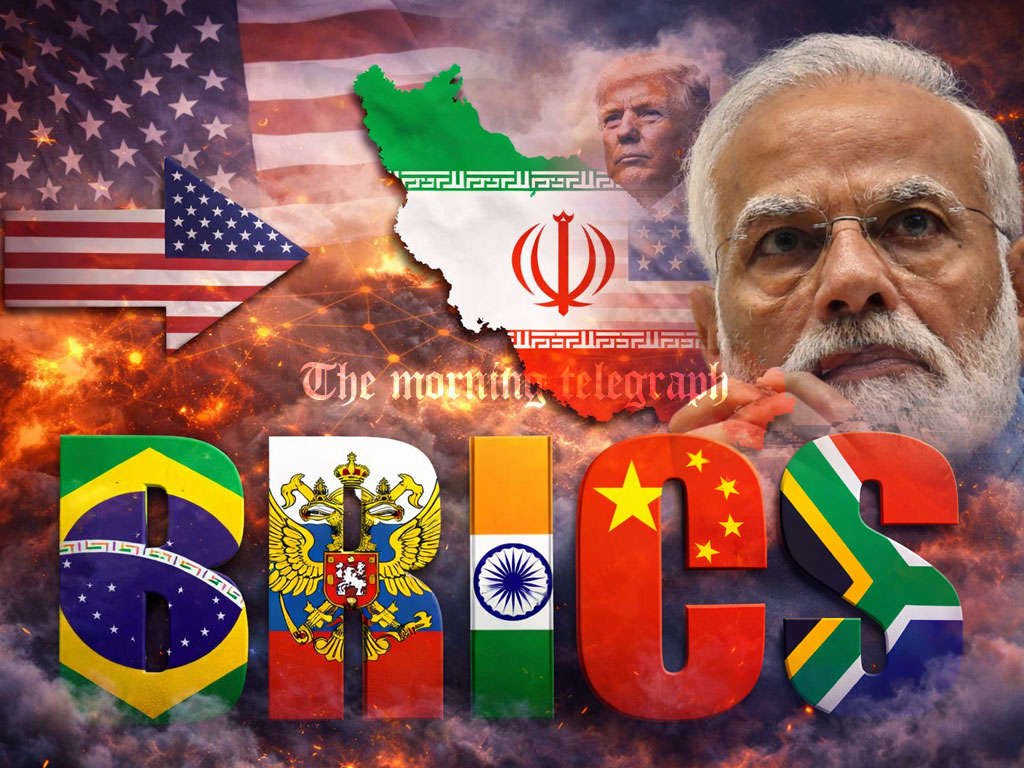
India’s moment in the global spotlight has turned into a diplomatic minefield. As the BRICS chair for 2026, New Delhi must navigate a raging US-Iran war, Trump’s tariff tantrums, and its own contradictory West Asia policy all while trying to hold together the world’s most divided economic bloc.
India assumed the chairmanship of BRICS in January 2026 with grand ambitions. The July summit was supposed to showcase New Delhi’s leadership credentials and restore its standing among developing nations. Instead, the shadow of a full scale US Iran war now looms over every preparation, every agenda item, and every diplomatic calculation. The conflict has already shaken the geopolitical order to its foundations while triggering a global energy crisis that threatens economies far beyond the immediate theater of operations.

Even if hostilities cease in the coming weeks, the aftershocks will reverberate through multiple systems for years to come. Long before missiles began flying, US President Donald Trump had already disrupted the old economic order through sanctions backed tariff policies that sent shockwaves through global supply chains. The emerging scenario demands nothing less than a fundamental revision of the principles governing the world order. But the question haunting diplomatic circles from Delhi to Brasilia remains unanswered: can BRICS measure up to this task despite controlling 41 percent of global GDP and 28 percent of world trade?
The numbers suggest capability. The reality suggests something far more complicated.
Iran’s expectations from India as BRICS chair have become impossible to ignore. Iranian President Masoud Pezeshkian and Foreign Minister Abbas Araghchi have made their position unmistakably clear. They want India to spearhead a strong and constructive BRICS intervention in the Iran US war. For Tehran, this represents a test of whether the bloc holds any meaningful influence when its members face existential threats. For India, the demand creates an excruciating dilemma that exposes every contradiction in its foreign policy approach.
New Delhi would find it extremely difficult to oblige Iran given its deepening dependence on the United States for defense cooperation against regional rivals Pakistan and China. The strategic calculus that drives Indian decision making simply cannot accommodate antagonizing the obdurate and mercurial Trump. Silence has become India’s watchword when faced with any Trumpian conundrum, a pattern established through years of careful observation of how the former president responds to perceived challenges.
Even if India summoned the courage to present Iran’s case, would Trump lend any ear to such suggestions while nursing a bruised ego after failing to subdue what he once dismissed as a third world country? The probability approaches zero, yet Iran continues pressing its case through every available channel.
India’s policy on West Asia has grown increasingly contradictory with each passing month. When Prime Minister Narendra Modi stood in Israel during February, he pledged everlasting support to that nation without apparent qualification. Yet when forced into direct communication with the Iranian President to secure passage for stranded Indian tankers through the Strait of Hormuz, he declared himself a friend of Iran according to the Iranian state run Mehr News Agency. Both statements cannot be simultaneously true, yet Indian diplomacy attempts precisely that impossible balancing act.
It remains uncertain whether Iranian leaders found Modi’s declaration of friendship convincing, especially following his failure to condole the death of their Supreme Leader Ayatollah Ali Khamenei at Israeli hands. The government of India dispatched only an official representative to sign the Iranian condolence book, and that gesture came four days after the event. Such signals speak louder than any diplomatic platitudes about enduring friendship.
Iran must have felt some measure of pity for the Indian people when it allowed three Indian vessels to pass through the Strait of Hormuz unharmed, though many more remain in the vicinity awaiting Tehran’s approval. This selective humanitarian gesture underscores the complex relationship between nations that can simultaneously cooperate and conflict depending on circumstances.
India desperately needs the BRICS summit to succeed. A successful outcome would help rehabilitate its lost position within the Global South following its eternal commitment to Israel and its demonstrated inability to stand up to Trump’s brazen weaponisation of trade instruments against friend and foe alike. The credibility deficit has grown steadily as developing nations watch India align itself increasingly with Western powers while claiming leadership among those same countries bearing the brunt of Western economic pressure.
Yet BRICS has become an unwieldy organization stretched thin by internal contradictions. It includes both Iran and the United Arab Emirates, two nations positioned on opposing sides of the current West Asian conflict. So far under India’s chairmanship, which began in January 2026, BRICS has not issued any joint statement on the war. The silence speaks volumes about the difficulties inherent in achieving consensus among members whose vital interests directly conflict.
BRICS also houses rivals India and China as founding members permanently at odds. These two Asian giants do not see eye to eye on many critical issues operating both within and outside the bloc’s formal structures. Their competition shapes every BRICS discussion whether the agenda concerns trade, finance, expansion, or geopolitical positioning.
The organization stands as a divided house despite the widely acknowledged benefits of presenting unified positions. India’s approach to BRICS has remained fundamentally cautious, differing sharply from China’s and Russia’s more aggressive postures. The latter two view the grouping primarily as a platform to challenge Western influence and particularly to undermine dollar dominance in global finance. But India has backed away from the BRICS anti dollar campaign specifically to dodge Trump’s threat of 100 percent US tariffs on any nation actively working to displace the greenback.
India watches warily as China attempts to make BRICS a pathway for extending its Belt and Road Initiative projects. New Delhi maintains fundamental objections to the BRI’s China Pakistan Economic Corridor, which India insists violates its sovereignty over Kashmir. This core dispute prevents any meaningful cooperation on infrastructure connectivity through BRICS mechanisms, limiting what the bloc can achieve in practical terms.
China and Russia strongly oppose the US led global order while India pursues what it describes as a multi alignment strategy engaging simultaneously with the United States and other major powers. Brazil and South Africa have similarly adopted flexible foreign policies responsive to changing circumstances rather than fixed ideological positions. Iran stands firmly against the West while Egypt aligns with Western powers having secured an eight billion dollar bailout from the International Monetary Fund. These fundamental disparities reveal BRICS as a group more defined by its differences than by any shared values or common interests that might unite such diverse members.
The expansion question has divided members as much as any substantive issue. China advocates swift expansion of BRICS to spread its influence through an ever widening circle of partner nations. India approaches expansion with extreme caution, strongly opposing the entry of Pakistan under any circumstances. But Pakistan enjoys strong support from China, creating another arena for their ongoing competition within BRICS forums. China, possessing by far the largest economy among members, naturally stakes a claim to leadership within the organization. India, having fought wars with China, refuses to bow to Beijing’s leadership aspirations in BRICS or any other international platform.
Despite these profound divisions, BRICS maintains institutional mechanisms offering genuine value to members. The New Development Bank launched in 2015 provides an alternative source of funding for developing countries seeking to avoid the conditionalities attached to Western dominated financial institutions. By 2024, trade among BRICS countries reached approximately five trillion dollars, accounting for roughly 22 percent of global exports. The NDB could potentially facilitate much of this commerce given appropriate policy direction.
During the 2024 summit held in Kazan Russia, BRICS members engaged in serious discussions around creating a gold backed currency to replace US dollar dominance in their mutual transactions. India initially supported this concept but later withdrew as did Brazil, given the overwhelming dominance of the United States in their respective foreign trade profiles. The retreat illustrated how economic reality constrains even ambitious geopolitical projects when members remain dependent on the very system they propose to challenge.
India recently signaled that Chinese investments in Indian industries would be permitted up to 10 percent without security scrutiny. This pragmatic adjustment reflects economic necessity rather than any fundamental shift in bilateral relations. It will not mean that basic foreign policies, fears and rivalries between these two nuclear armed neighbors will change in any meaningful way.
India’s continued presence in BRICS stems partly from unwillingness to leave a vacuum for China to exploit. Withdrawal would invariably cede agenda setting powers to Beijing without any constraint or counterbalance. At the Kazan summit in October 2024, Prime Minister Modi stated explicitly that all expansion decisions must proceed by consensus and that criteria established at the 2023 Johannesburg summit should be rigorously observed, including the requirement that new members maintain diplomatic and friendly relations with all existing members. By this standard Pakistan was neither admitted nor designated as a partner state.
This positioning serves not merely to block a rival but also to reduce pro Pakistan China’s influence within the bloc. China and Pakistan have consistently used each other against Indian interests across multiple forums and will continue doing so whenever opportunity arises. The fact that BRICS operates by consensus gives India an effective veto and New Delhi treats this procedural protection as a matter of principle rather than exception to be negotiated away.
The New Development Bank established at China’s initiative offers multiple practical benefits despite internal disagreements. It maintains equal voting in terms of shares distributed among the five founding members. It imposes no conditionalities on borrowing nations and demonstrates greater orientation toward local currency financing than traditional Western institutions. Each founding member holds approximately 20 percent voting rights, and the founding five will always retain at least 55 percent of voting power regardless of future membership expansion.
On local currency lending, the NDB set a target of making 30 percent of its loans in local currencies from 2022 to 2026. It has issued bonds denominated in renminbi and South African rand, demonstrating practical progress toward reduced dollar dependence. India has permitted bilateral local currency settlement with select partners including the UAE and Indonesia. The Reserve Bank of India has authorized Vostro accounts enabling foreign entities to settle trades directly in Indian rupees with BRICS members.
However, Indian and South African officials have explicitly stated there exists no agenda to create a BRICS currency nor to replace the dollar’s role in global finance. China’s position differs considerably with Beijing pursuing more aggressive de dollarization through its Cross Border Interbank Payment System which had 1,467 indirect participants across 119 countries as of January 2025, linking banks in 185 countries. Beijing has sought to use the NDB as a vehicle supporting its BRI related infrastructure projects but faces resistance from New Delhi at every turn.
The NDB’s governance norm requiring greater agreement if not full consensus means that Indian objections carry institutional weight, limiting the bank’s expansion into China’s preferred operational territory. The BRICS financial architecture thus remains in motion but internally riven by contradictions about fundamental direction. The NDB remains underutilized relative to its potential because members cannot agree on priorities. The result leaves BRICS with institutional capacity exceeding political will, a frustrating gap that India must somehow bridge during its chairmanship.
The July summit approaches with these unresolved tensions hanging over every preparatory meeting. India must somehow produce a successful outcome demonstrating BRICS relevance while managing irreconcilable differences among members. The shadow of US Iran war darkens every calculation while Trump’s unpredictable responses to any perceived challenge complicate Indian decision making. New Delhi’s contradictory West Asia policy offers no clear path through these obstacles.
Yet India needs this summit to succeed perhaps more than any other member. Success would help restore credibility damaged by its Israel alignment and its inability to resist Trump’s trade weaponisation. Failure would confirm growing perceptions that BRICS cannot translate economic weight into political influence when it matters most. The choice confronting India’s diplomats could not be starker as they prepare to welcome the world to July’s high stakes gathering.