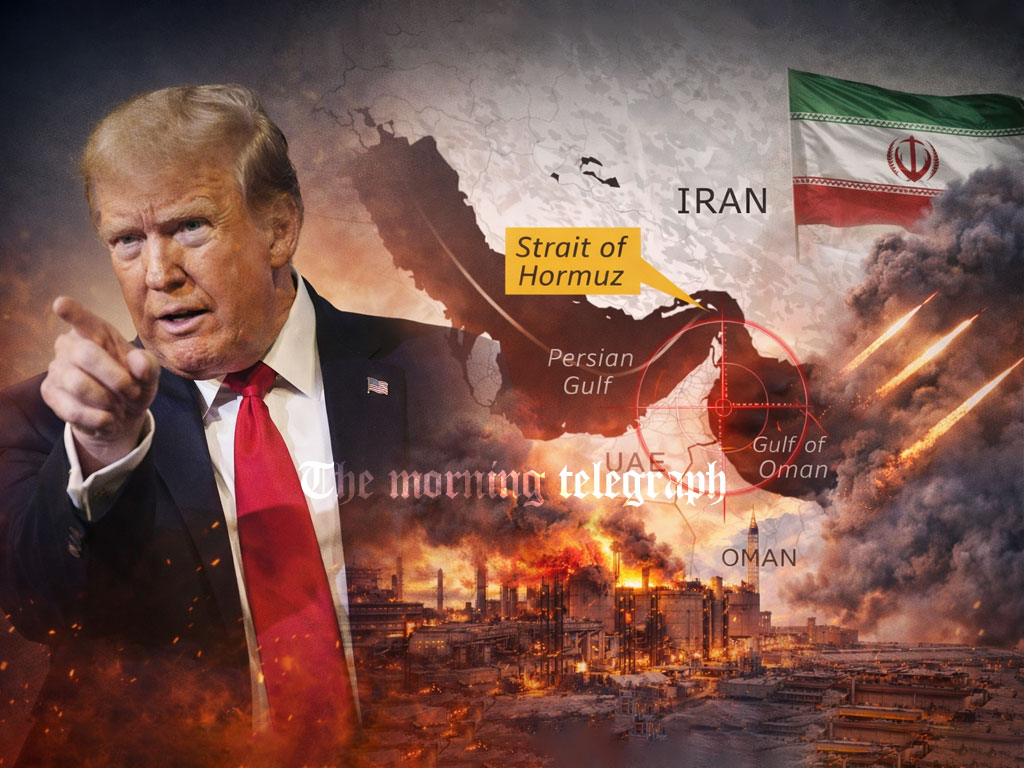
US President Donald Trump threatens to obliterate Iran’s power plants unless the Strait of Hormuz is fully reopened within 48 hours, as the Middle East war escalates with long-range missile strikes and growing fears of a global energy shock.
US President Donald Trump has issued a dramatic 48-hour ultimatum to Iran, threatening to obliterate the country’s power plants if Tehran does not fully reopen the Strait of Hormuz without threat. The warning marks a significant escalation just a day after Trump spoke about winding down the war, leaving allies struggling to interpret Washington’s shifting objectives.

“If Iran doesn’t FULLY OPEN, WITHOUT THREAT, the Strait of Hormuz, within 48 HOURS from this exact point in time, the United States of America will hit and obliterate their various POWER PLANTS, STARTING WITH THE BIGGEST ONE FIRST,” Trump declared on social media. The threat expands the scope of US strikes to civilian infrastructure, targeting facilities that affect daily life for millions of Iranians.
The near closure of the Strait of Hormuz, a narrow waterway through which approximately one fifth of global oil and liquefied natural gas supplies pass, has already triggered a global energy shock. European gas prices surged as much as 35 percent last week as shipping ground to a halt. Iran’s military command has warned that if the US attacks Iranian energy infrastructure, Tehran will target all American energy, information technology, and desalination facilities across the region.
Long-Range Missiles Enter the Conflict
The conflict entered dangerous new territory as Iranian forces fired long-range missiles for the first time. Israeli military chief Eyal Zamir confirmed that Iran launched two ballistic missiles with a range of 4,000 kilometers at the US British military base at Diego Garcia in the Indian Ocean. Zamir noted that these missiles can reach European capitals including Berlin, Paris, and Rome, significantly expanding the threat beyond the Middle East.
Late Saturday, Iranian missiles struck the southern Israeli cities of Dimona and Arad, injuring dozens of people including children. Dimona lies approximately 13 kilometers from Israel’s secretive nuclear reactor site. The Israeli military acknowledged that its air defenses did not intercept the strikes, promising to investigate the incident.
Mixed Messages and Rising Casualties
The Trump administration has sent mixed signals throughout the four week war, leaving US allies uncertain about how to respond. Earlier this month, Trump raised the idea of destroying Iran’s power grid while downplaying the notion, telling reporters that while the US could dismantle Iran’s electric capacity within an hour, he would prefer not to do so.
More than 2,000 people have been killed during the conflict. In Israel, 15 people have died from Iranian strikes. The war has also sparked energy price shocks that are fueling inflation, creating a political liability for Trump as November elections approach.
Allies Reluctant to Join
Trump has accused NATO allies of cowardice over their reluctance to help open the Strait of Hormuz. Some allies have indicated they will consider joining, but most remain hesitant to enter a conflict that began without their consultation. Meanwhile, US Marines and heavy landing craft continue heading to the region as the 48-hour countdown unfolds.
Iran’s largest power plants include the Damavand facility near Tehran with 2,868 megawatts of capacity, the Kerman plant in southeastern Iran, and the Ramin steam power plant in Khuzestan province. The country’s sole nuclear plant at Bushehr produces approximately 1,000 megawatts.