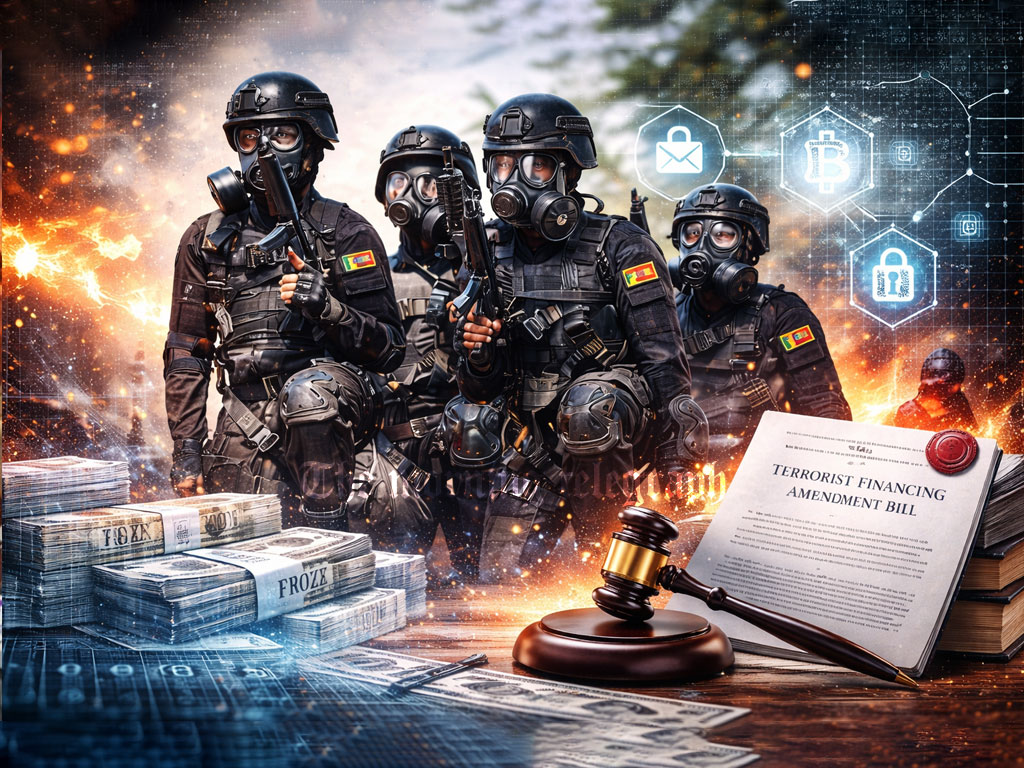
The government has published the Terrorist Financing (Amendment) Bill 2026, introducing virtual assets under its scope, granting police surveillance and undercover operation powers, and extending freezing orders up to six months in a major overhaul of counter-terrorism legislation.
The government has published the Convention on the Suppression of Terrorist Financing (Amendment) Bill of 2026 in the gazette, introducing sweeping changes that expand the scope of terrorist financing offences, grant new investigative powers to law enforcement, and overhaul the management of seized assets.

The bill aligns with the proposed Prevention of Money Laundering (Amendment) and Financial Transactions Reporting (Amendment) Bills by explicitly including virtual assets within its definitions. These are digital representations of value that can be digitally traded, used for payment, or held as investments.
Under the new framework, offences committed wholly or partially outside Sri Lanka will be punishable if they are intended to carry out a terrorist act within the country, target a Sri Lankan citizen, involve a Sri Lankan government facility, or seek to compel the Sri Lankan government to act or refrain from acting.
A key provision clarifies that to establish a terrorist financing offence, prosecutors need not prove that the funds or assets were actually used in an offence or linked to a specific terrorist act. The bill criminalizes organizing, directing, or participating as an accomplice in terrorist financing, as well as financing individuals for terrorist training, traveling abroad to become foreign terrorist fighters, or engaging in human trafficking for terrorist purposes.
Penalties have been updated to include imprisonment, a fine of up to one hundred million rupees, or both.
Investigative powers have been significantly expanded. Police officers may now use surveillance, observation, undercover operations, video recording, listening devices, controlled deliveries, and access to computer data and systems. Covert monitoring requires a magistrate issued warrant. The bill also permits joint investigation teams with domestic or international authorities, with evidence collected admissible in court.
The timeframe for police to make an ex parte application to the High Court to confirm a freezing order has been extended from seven days to 14 working days. The maximum extension period for freezing orders has increased from three months to six months. Individuals whose legitimate business interests are affected may petition the High Court to authorize essential transactions under judicial supervision.
The High Court may appoint a Receiver or Special Manager, or direct the Proceeds of Crime Management Authority to take possession of and manage frozen or forfeited assets. Courts can also order institutions to provide documents and information relating to business transactions involving frozen funds.
For international cooperation, the Mutual Assistance in Criminal Matters Act applies to investigations, prosecutions, and forfeitures under the Act.