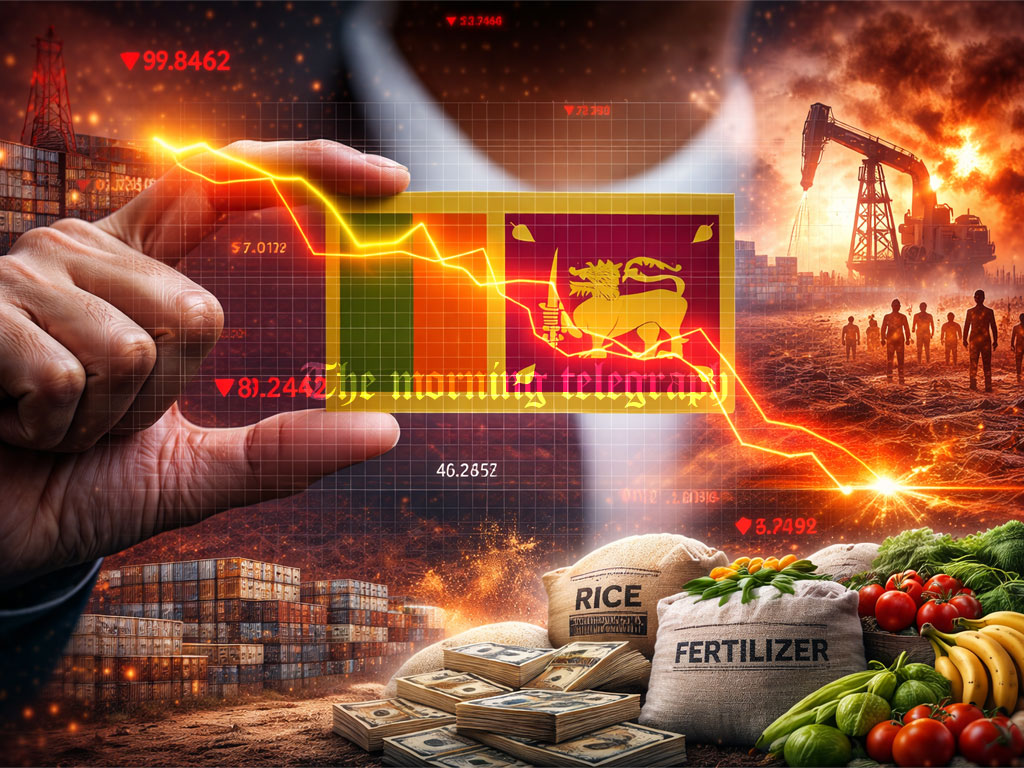
Escalating Middle East tensions threaten Sri Lanka’s food security, fertilizer supply, and export economy, pushing the nation toward a potential agricultural collapse unless urgent, centralized action is taken at the highest level.
Sri Lanka now stands at a dangerous crossroads as global geopolitical tensions begin to directly impact its fragile food security and agricultural economy. The ongoing Middle East conflict has triggered fears of a wider global disruption, with the potential to severely affect countries that are heavily dependent on imports, including Sri Lanka.

Recent developments have intensified these concerns. Former United States President Donald Trump warned that Iran’s energy infrastructure could be targeted if access through the Strait of Hormuz is not restored within a strict timeframe. In response, Iranian officials issued strong counter warnings, stating that any attack on their infrastructure would result in retaliatory strikes against critical energy and technological systems linked to the United States and its allies across the region.
If such threats materialize, the consequences would extend far beyond the Middle East. A global energy crisis would follow, disrupting supply chains and driving up costs. For vulnerable economies like Sri Lanka, the fallout could be severe, particularly in terms of food availability and agricultural sustainability.
Even before these escalating threats, Sri Lanka was already facing mounting challenges linked to food production and export performance. The country’s plantation sector, which includes tea, rubber, and coconut, remains a vital source of foreign exchange. However, its survival is closely tied to stable agricultural inputs and efficient logistics.
The most pressing concern lies in the country’s dependence on chemical fertilizer. Within the current global context, disruptions to shipping routes and rising input costs have made fertilizer both scarce and expensive. Without sufficient fertilizer supply, agricultural productivity will decline sharply, leading to food shortages and reduced export output.
Data from international agricultural agencies suggests that disruptions to fertilizer supply chains could cost Sri Lanka between 700 million dollars and 1 billion dollars annually in direct agricultural losses. These losses would be driven by declining crop yields, increased food imports, and reduced export income from key sectors.
While authorities are likely assessing these risks, the scale and urgency of the crisis demand a more coordinated response. Addressing both food availability and foreign exchange challenges requires a centralized strategy that brings together all relevant sectors under one command structure.
A proposed solution is the establishment of a high-level Agricultural Command Centre reporting directly to the President. Such a body would have the authority to coordinate policy implementation, manage resources, and respond rapidly to evolving conditions.
This centralized approach would move beyond traditional bureaucratic processes and create a focused system capable of handling the crisis in real time. By functioning as a strategic operations hub, the centre would oversee food security planning and monitor the broader impact of global developments on agriculture.
One of its primary responsibilities would be ensuring that subsidies continue to support farmers. Current subsidy levels, estimated between 300 million and 400 million dollars annually, are essential for maintaining production. However, rising input costs may require increased allocations to prevent farmers from abandoning cultivation.
The risk of a production collapse is real. A decline in plantation output would not only affect domestic food supply but also reduce export earnings, further weakening the economy. Immediate action is therefore critical to prevent long-term damage.
Traditional administrative approaches are unlikely to meet the demands of this crisis. What is required is a more dynamic system capable of rapid decision-making and execution. The concept of a centralized command structure, often used in crisis management scenarios, offers a practical solution.
Recent data highlights the scale of the challenge. Fertilizer prices have surged significantly, with urea costs rising by nearly 50 percent within a short period. This sharp increase is expected to double Sri Lanka’s import expenditure on fertilizer, placing additional strain on foreign reserves.
Sri Lanka relies heavily on imports from China, where production is less directly affected by Middle East instability. However, shifts in China’s export policies have created new uncertainties. Efforts to protect domestic supply have led to restrictions that could limit availability for international buyers.
The global situation is further complicated by rising energy prices. Increased costs of oil and gas have raised production expenses for fertilizers worldwide. China’s reliance on Middle Eastern inputs such as sulphur and liquefied natural gas means that disruptions in these supply chains have indirect effects on fertilizer output.
Shipping challenges have added another layer of complexity. Higher freight costs and logistical delays have pushed up the final price of fertilizer for Sri Lankan farmers, making agricultural inputs even less affordable.
The consequences for agriculture are severe. Past fertilizer shortages resulted in sharp declines in rice production, forcing the country to spend heavily on imports. Similar trends were observed in vegetable and cash crop sectors, where yields dropped significantly during periods of input scarcity.
The tea industry, a cornerstone of Sri Lanka’s export economy, is particularly vulnerable. A sudden reduction in fertilizer use previously led to a substantial drop in production. Given that smallholders account for the majority of tea output, they are especially exposed to price fluctuations and supply disruptions.
If current trends continue, Sri Lanka risks losing market share to competing countries such as Kenya and India. Other sectors, including coconut and rubber, would likely face similar declines, further reducing export income.
To address these challenges, the proposed Agricultural Command Centre should develop a comprehensive risk mitigation plan within a short timeframe. This plan must assess current fertilizer stocks, identify future supply sources, estimate costs, and outline strategies for distribution under varying conditions.
It should also consider transportation challenges, particularly in the event of worsening fuel shortages, and develop contingency plans to ensure continuous supply to farmers. Maintaining food security under uncertain global conditions must remain a top priority.
Exploring alternative sources of fertilizer is another key requirement. Countries such as China and Russia may provide additional supply, while traditional suppliers in the Middle East could face limitations due to the ongoing crisis.
While immediate action is essential, long-term planning cannot be ignored. Strengthening food security and improving agricultural resilience require a broader strategy that addresses systemic weaknesses in the sector.
A ministerial-level committee led by the Prime Minister could support this effort by ensuring coordination across ministries. This would help align policies related to agriculture, irrigation, and plantation industries, reducing fragmentation and improving efficiency.
Sri Lanka’s previous attempt to transition away from chemical fertilizer offers important lessons. Although the policy had a strong conceptual basis, its implementation failed to account for the complexities involved in shifting agricultural systems.
The resulting decline in productivity forced farmers to return to chemical inputs, highlighting the need for a more gradual and structured transition. Future strategies should adopt a hybrid approach that balances organic and inorganic methods over time.
Developing a domestic fertilizer industry is also critical. Reducing dependence on imports would enhance resilience and provide greater control over supply. Achieving this goal will require sustained investment and long-term planning.
However, long-term planning has often been overshadowed by short-term political priorities. Frequent policy shifts and fragmented institutional responsibilities have hindered the development of a cohesive agricultural strategy.
Multiple agencies currently oversee different aspects of the sector, creating inefficiencies and delays. Without a unified authority to drive policy implementation, long-term initiatives struggle to gain momentum.
Food security must therefore be recognized as a national priority. Effective coordination, supported by strong institutional frameworks, is essential for both immediate crisis response and sustainable development.
Ultimately, Sri Lanka’s ability to navigate this crisis will depend on decisive leadership and strategic planning. Failure to act could result in prolonged food insecurity and declining export performance, with serious implications for the country’s economic future.