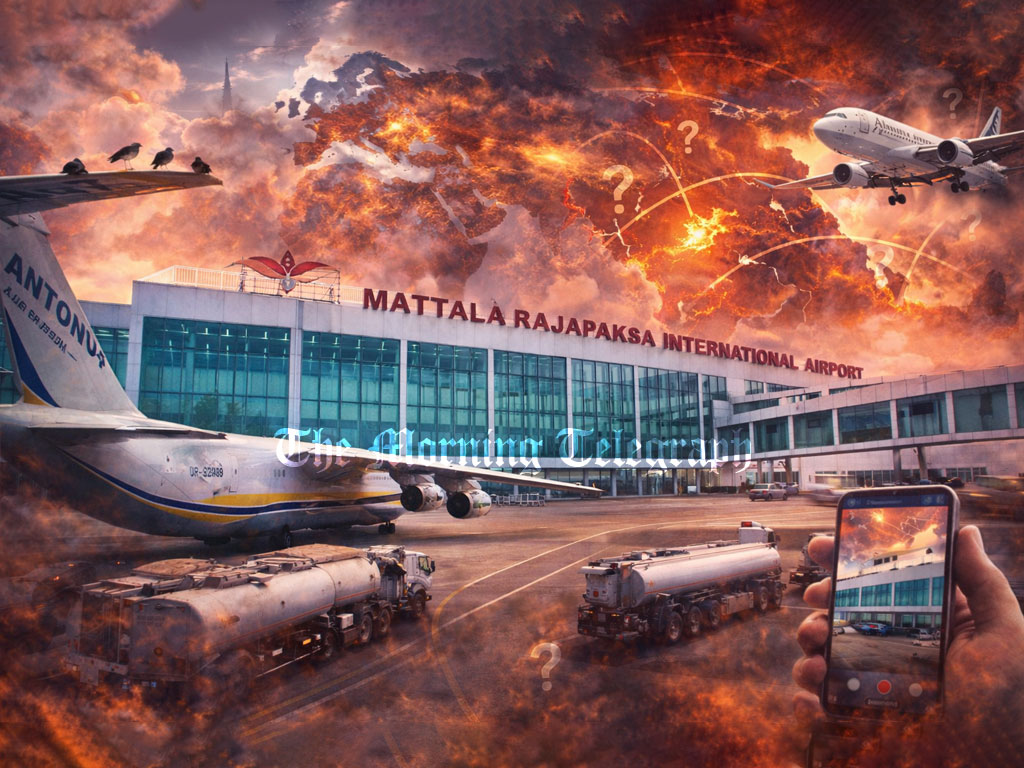
As Persian Gulf airspace faces disruption and global aviation networks strain under pressure, Sri Lanka’s Mattala Airport is emerging from obscurity, raising a critical question: can a long-mocked “ghost airport” transform into a strategic global hub or will its revival fade once the crisis passes?
In the intense heat of southern Sri Lanka, Mattala Rajapaksa International Airport stands as a paradox of ambition and isolation. Located just 18 kilometers from the Port of Hambantota, the airport was designed as a future-ready aviation hub. Its 3,500-meter runway can accommodate the largest commercial aircraft, including the Airbus A380. The terminal is modern, the infrastructure is polished, and the layout reflects long-term planning. Yet, for years, it has struggled to attract consistent traffic, earning the label of “the world’s emptiest airport.” What exists is not a failure of construction, but a failure of utilization.

This perception, however, is beginning to shift under extraordinary global conditions. The ongoing Middle East crisis, combined with disruptions in Persian Gulf airspace, has forced the aviation industry to reconsider its dependencies. What was once dismissed as redundant infrastructure is now being reevaluated as a potential strategic asset. In this context, MRIA is no longer just an underused facility. It is being viewed as a possible contingency hub in a rapidly changing global aviation landscape.
My understanding of Mattala does not come from reports alone. It comes from repeated visits, from conversations with those who work there, and from the unique stillness that defines the space. The approach road to the airport is smooth and well-maintained, but the surrounding landscape offers little indication of an international gateway. Open scrubland stretches into the distance. Wildlife moves freely. Traffic is minimal. The environment feels disconnected from the scale of the infrastructure.
One afternoon, after completing an interview, I offered a ride to a ground crew member who had been waiting by the roadside. He had spent nearly two hours hoping for transport back to Hambantota Town. His daily routine begins before dawn and ends late in the evening. His story reflects the disconnect between the airport’s physical scale and the realities of those who sustain it. The contrast is stark. The facility represents ambition, but the human experience around it reveals the challenges of underutilization.
Over time, the airport has evolved in ways that were not originally intended. While it has not become a major passenger hub, it has developed a niche role in cargo and technical operations. In 2018, the world’s largest cargo aircraft, the Antonov An-225, landed at MRIA. At the time, it was a rare but significant event. That aircraft no longer exists, destroyed during the early days of the Ukraine conflict, but its presence at Mattala remains a reminder of the airport’s capacity.
More consistently, Antonov Airlines used MRIA as a staging point for its heavy-lift operations. The An-124 Ruslan, one of the largest cargo aircraft in operation, regularly stopped here for refueling and crew changes. These flights carried high-value cargo, including industrial equipment and technological components. In these moments, the airport’s infrastructure proved its relevance. The long runway and quiet environment became advantages rather than liabilities.
MRIA has also functioned as a relief valve for Bandaranaike International Airport during periods of strain. During the COVID-19 pandemic, it played a role in maintaining essential connectivity. In subsequent years, charter operations from carriers such as Red Wings and SkyUp introduced seasonal traffic. Incentives such as reduced fees and direct fuel access from Hambantota Port made the airport attractive for specific use cases. These developments did not transform MRIA into a major hub, but they demonstrated its operational potential.
Financial assessments of the airport remain complex. Official records classify it as a loss-making project due to debt obligations. However, operational perspectives suggest that revenue from refueling and service charges may cover day-to-day costs. This distinction is important. It indicates that while the airport may struggle under its financial structure, it is not entirely devoid of economic activity. It has, in effect, maintained a baseline level of functionality.
The turning point came in 2025, when passenger and flight activity reached record levels. Although the numbers were modest by global standards, they represented a significant improvement for MRIA. The government responded by launching initiatives to revitalize the airport. These included incentives for airlines, proposals for public-private partnerships, and plans to expand both aviation and non-aviation activities. The focus shifted from symbolic value to commercial viability.
The escalation of tensions in the Middle East in 2026 added a new dimension to this trajectory. Airspace disruptions in the Persian Gulf created a ripple effect across global aviation networks. Major carriers, particularly those based in the Gulf, faced operational challenges that required alternative routing and contingency planning. In this context, MRIA’s geographic position and underutilized capacity became strategically valuable.
The Civil Aviation Authority of Sri Lanka actively positioned the airport as a contingency hub. Proposals were extended to major airlines, offering MRIA as a location for emergency landings, refueling, and technical stops. The concept was straightforward. In a region affected by instability, an isolated and well-equipped airport could serve as a stable node. This repositioning marked a significant shift in how the airport was perceived.
At the same time, MRIA’s isolation introduces unique strategic considerations. Its remote location makes it suitable for operations that require discretion. This has been evident in various instances, including humanitarian missions and logistical operations. The airport’s ability to operate away from major population centers adds to its appeal in certain scenarios.
However, this potential is accompanied by challenges. Infrastructure limitations remain a concern. Key systems related to baggage handling, maintenance, and fuel logistics require further development. The reliance on road-based fuel transport highlights the need for more efficient solutions, such as a dedicated pipeline from Hambantota Port. Without such improvements, the airport’s ability to scale operations will be constrained.
Regional competition also plays a role. Other countries in the region are equally aware of the opportunities created by aviation disruptions. Airports in India, the Maldives, and Southeast Asia are positioning themselves as alternatives. In this competitive environment, MRIA must differentiate itself through efficiency, cost advantages, and reliability.
The long-term viability of the airport depends on its ability to transition from a crisis-driven role to a sustainable model. Temporary increases in activity, driven by external factors, do not guarantee lasting success. The challenge lies in converting short-term relevance into long-term integration within global aviation networks.
There is also a domestic dimension to this transformation. The renewed focus on MRIA reflects a shift in political approach. Previous administrations often treated the airport as a symbol of excess or miscalculation. The current strategy attempts to reframe it as a functional asset. This change in perspective is significant, as it allows for a more pragmatic evaluation of its potential.
Ultimately, MRIA represents a broader question about infrastructure in a globalized world. In times of stability, efficiency drives consolidation around major hubs. In times of crisis, redundancy becomes valuable. The airport exists at the intersection of these dynamics. Its future will depend on how effectively it can navigate them.
The story of Mattala is not yet complete. It is neither a definitive failure nor a guaranteed success. It is a case study in how context can reshape perception. What was once seen as unnecessary may become essential under different circumstances. The key question is whether this transformation can be sustained.
For MRIA to evolve into a meaningful aviation hub, it must go beyond opportunistic use. It must develop the systems, partnerships, and infrastructure required for consistent operation. This is not a simple task, but it is a necessary one.
As global conditions continue to shift, the airport stands at a crossroads. Its empty runways may yet find purpose, but that purpose will depend on decisions made in the present. The opportunity exists. The outcome remains uncertain.