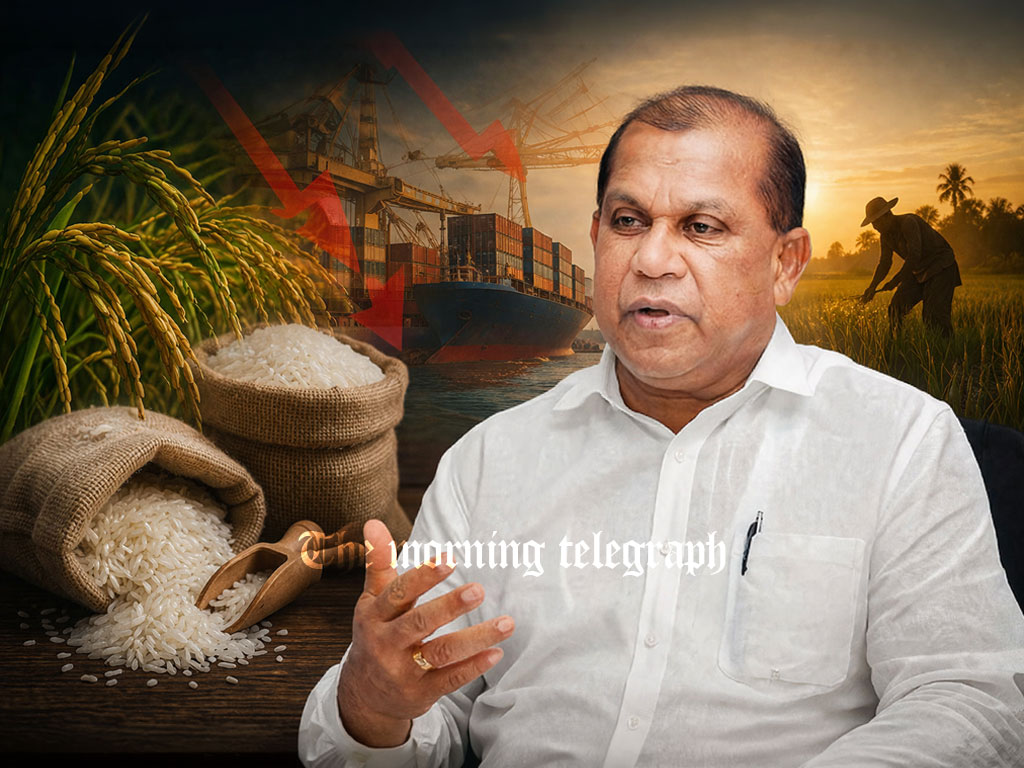
A political storm erupts as fresh allegations claim the government is undermining local farmers by importing rice ahead of harvest, sparking fears of economic loss and agricultural collapse.
The General Secretary of the Samagi Jana Balawegaya and Parliamentarian Ranjith Madduma Bandara has claimed that the government has dealt a serious blow to Sri Lankan farmers by moving ahead with rice imports despite an imminent harvest season.
He emphasized that the NPP government risks becoming the only administration to push farmers into extreme helplessness through such policy decisions, raising concerns about agricultural sustainability and food security.

Speaking at a media briefing held at the Opposition Leader’s Office yesterday, Ranjith Madduma Bandara stated that the government, which had earlier pledged not to import rice, has continued importing rice over an extended period, contradicting its own promises.
The MP further revealed that the government is preparing to import 67,000 metric tons of rice in 2025, while approval has also been granted to a private importer to bring in 1,040 tons of milk powder. He noted that all logistical arrangements have already been finalized to proceed with rice imports even as a significant local harvest is expected.
He added that farmers are now left in a deeply vulnerable position due to what he described as a mismanaged agricultural policy by the NPP government, which had originally come to power with strong promises to uplift the farming community.
The SJB General Secretary also accused the government of planning to import rice just days before the Sinhala and Hindu New Year, warning that such actions could result in major financial losses for the country, similar to the impact caused by the controversial importation of substandard coal.
Highlighting a long-term economic concern, he pointed out that farmers’ income, which accounted for 21 percent of the gross domestic product in 1994, has now declined sharply to just 7 percent, reflecting a significant drop in the agricultural sector’s contribution to the economy.
He further stated that farmers are struggling due to a severe shortage of fertilizer required for the Yala season, and criticized the government for failing to use available time to negotiate with international suppliers and secure adequate fertilizer stocks for the country.