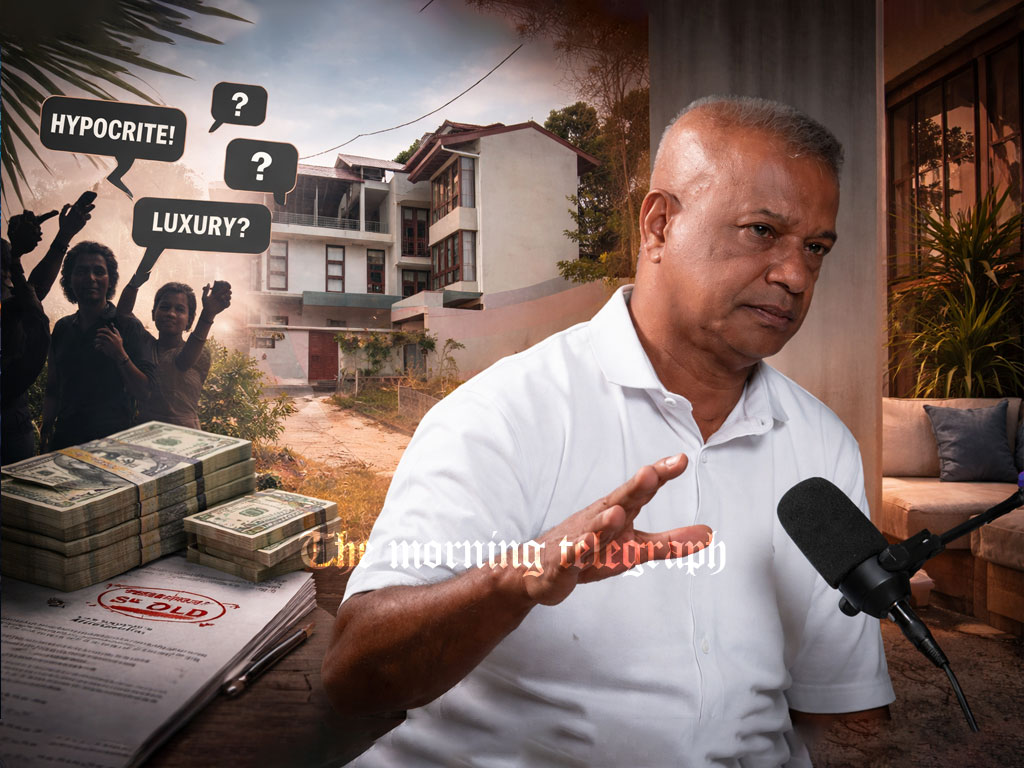
A heated political controversy unfolds as Minister Lal Kantha defends his modern home, revealing how decades of relationships, personal sacrifices, and family assets shaped his lifestyle, while dismissing public criticism as pure hypocrisy.
Recently, Minister of Agriculture, Lands, Irrigation and Livestock Lal Kantha made a striking revelation about his new house and the modern amenities within it, a topic that has triggered widespread debate across social media platforms and mainstream media discussions.
According to Lal Kantha, he had purchased two separate plots of land measuring 7 perches and 6 perches respectively in order to construct the house, clarifying the origins of his property investment amid rising public scrutiny.

He explained that the funds required to acquire these lands were generated by selling a long-held family property located near Kandy Road in the Matale Junction area, which had deteriorated over time and was no longer viable.
The Minister stated that he officially moved into the new residence in late 2024, adding that public attention intensified only after footage of an alms-giving ceremony held at the house surfaced in the media.
Addressing the controversy, Lal Kantha highlighted several key points about the financial sources used to build and sustain the house, emphasizing transparency in his personal finances and political life.
He remarked that the most valuable asset he has accumulated during nearly 40 years in politics is what he described as social capital, referring to the strong network of relationships built over decades.
He further stated that if necessary, he could easily raise even five hundred thousand rupees each from a hundred trusted associates within a short period, underscoring the depth of his connections.
The Minister firmly assured the public that no government funds, taxpayer money, or party finances were used in the construction of his house, stressing that party funds are handled strictly under official procedures.
Reflecting on earlier years, he recalled that during his time as a full-time political activist, household expenses were largely supported by his wife’s income, indicating a history of financial discipline.
He also addressed social media attention surrounding a piano in his home, clarifying that the instrument is nearly 15 years old and was originally used by his daughter during her childhood music lessons, not a recent luxury purchase.
Lal Kantha pointed out that owning furniture such as a sofa set in a modern home should not be viewed as extraordinary, arguing that questioning such basic items reflects hypocrisy within society.
The Minister stated that he does not subscribe to the belief that individuals with socialist values must live in constant hardship, challenging traditional perceptions tied to political ideology.
He further explained that lifestyles associated with earlier eras of repression or armed struggle are no longer relevant in today’s context, especially for those holding public office.
As a serving minister, he emphasized the need to adapt one’s attire, environment, and overall lifestyle to match the responsibilities of the position, warning that failing to do so would create an outdated and isolated image.
According to Lal Kantha, his house and accumulated assets are ultimately the result of long-standing personal relationships and financial returns from the sale of ancestral property, rather than any misuse of public resources.
He concluded by asserting that the true essence of socialism lies in enabling people to live better lives, not in promoting or glorifying poverty as a standard for political authenticity.