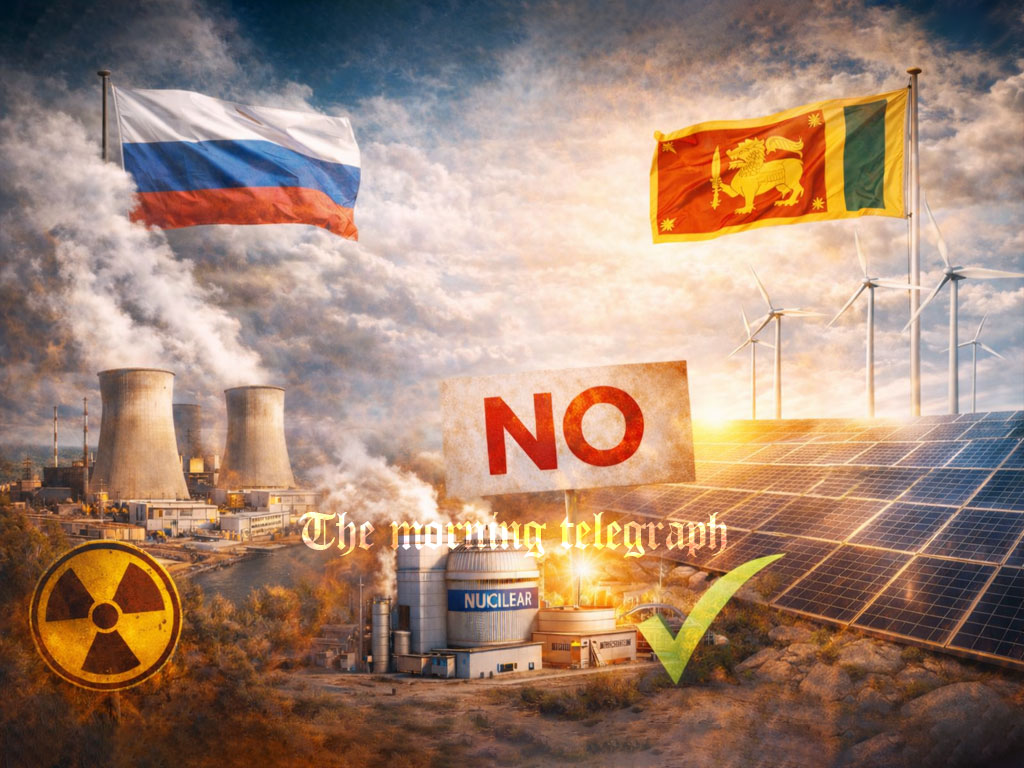
Sri Lanka firmly shuts down Russia’s push for a nuclear power plant, choosing renewable energy instead amid ongoing energy policy debates and long-standing feasibility discussions.
Sri Lanka has rejected a renewed Russian offer to enter the nuclear energy sector, signaling a clear policy direction toward renewable energy despite continued international interest in nuclear power development. The proposal resurfaced during a recent visit by Russian Deputy Foreign Minister Andrey Rudenko, who indicated that formal discussions could begin if Sri Lanka showed interest in acquiring a small modular nuclear power plant.

Discussions between Sri Lanka and Russia regarding nuclear energy cooperation have been ongoing for several years, reflecting a broader strategic dialogue on long-term energy security and diversification of power sources. However, despite repeated engagements, the proposal has not translated into any concrete progress.
The matter was also raised earlier in March when Russian Ambassador Levan S. Dzhagaryan met with Sri Lanka’s Foreign Minister Vijitha Herath. During the meeting, which primarily focused on fuel imports and energy collaboration, the Russian envoy highlighted nuclear energy as a potential solution to Sri Lanka’s recurring power shortages.
According to the ambassador, had Sri Lanka accepted Russia’s earlier proposal to construct a nuclear power plant, the country might have avoided recent energy crises and electricity shortages that impacted economic stability and daily life.
However, Minister Herath reaffirmed that Sri Lanka’s current energy policy prioritizes renewable energy sources, including solar, wind, and hydro power, rather than transitioning toward nuclear energy at this stage.
The idea of nuclear power generation in Sri Lanka is not new and has been explored for over a decade. A feasibility study conducted in 2010 examined the potential for nuclear energy development, but the initiative did not progress beyond preliminary assessments.
More recently, in 2023, Sri Lanka’s Atomic Energy Authority revisited the concept by discussing a Russian proposal to develop either an offshore or onshore nuclear power facility. Despite these discussions, no definitive policy shift or implementation plan has emerged.
Globally, Russia continues to expand its nuclear energy footprint, actively constructing nuclear power plants in countries such as Bangladesh, China, and India, positioning itself as a major player in international nuclear infrastructure development.