A blistering parliamentary attack lays bare allegations of corruption, economic mismanagement, and policy betrayal, as rising costs and political decisions leave ordinary Sri Lankans struggling under mounting pressure.
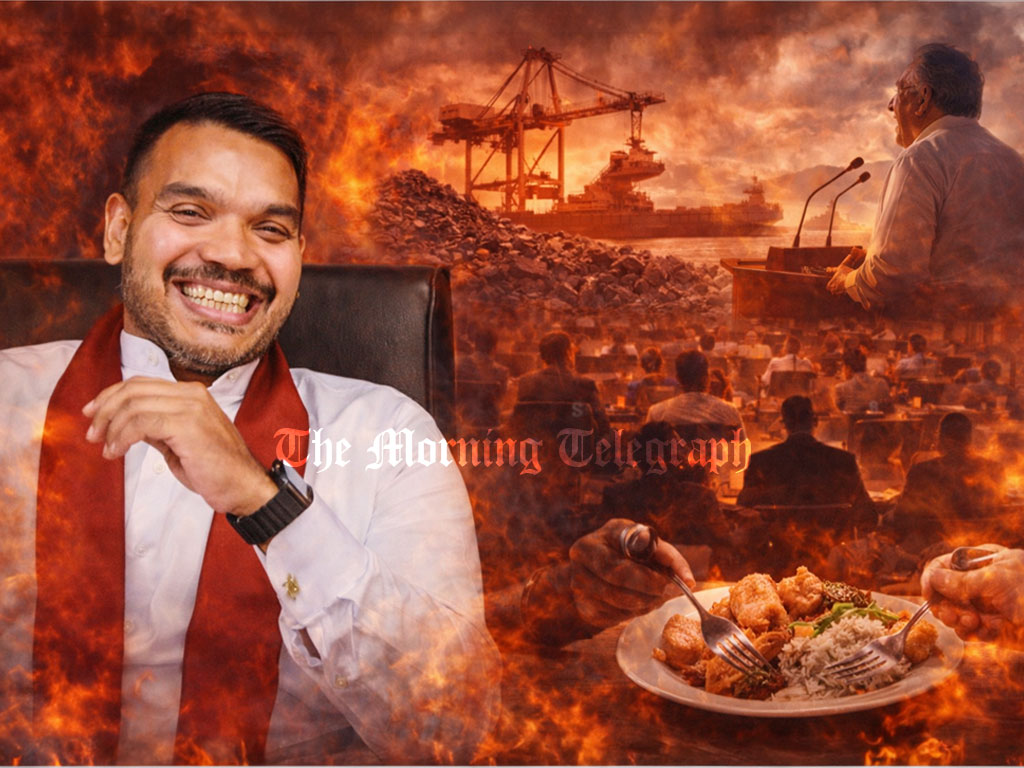
“Those who didn’t eat when the coal was being brought in are now seen eating well after the coal arrived,” said Namal Rajapaksa, National Organizer of the Sri Lanka Podujana Peramuna, while addressing Parliament.

He went on to state:
“Now they are asking people to go to the villages. But who will go to the villages? The people themselves will give the answer. So I urge all of you to go to the villages frequently. Yes, go often, and you will continuously receive answers directly from the people.
Honorable Deputy Speaker, they spoke about relief measures. Just like now, before the last provincial council election, they promised a relief package for the Sinhala New Year. After the election, there was no such relief. It was even included in the budget, yet nothing was delivered. The same happened during the time of the Diva Neguma program. The President sitting here said, ‘If a tractor goes, we will give 100,000 rupees, we will give 500,000 rupees for land, 500,000 per house.’ They even held a ceremony and handed over a check. That check later bounced for a small amount due to lack of funds.
Honorable Deputy Speaker, who are they trying to mislead? Yesterday, the President came and spoke again. He says he is providing relief. But are these benefits actually reaching the people in reality? They spoke about relief for businessmen before as well. When we reduced VAT, what did they say? They criticized us. But we reduced VAT to the maximum possible level and reduced indirect taxes. That brought relief to the common man.
But what is this government doing now? They are imposing tax after tax. Even while claiming to provide relief, they are taking away whatever little benefit the common man receives. By removing the Social Economic Stabilization tax, Honorable Deputy Speaker, small scale entrepreneurs in this country have been severely affected. Why was the SES tax introduced? To protect small businessmen. Now the government has altered that tax policy and introduced one that only protects businessmen loyal to them. You can declare that openly.
But the reality, Honorable Minister, is that your tax policy benefits only large scale millionaire businessmen. There is no relief for the small fisherman or the farmer. That relief does not reach them. That is the truth. When you go to the villages, you will have to answer to the people yourselves. The villagers are suffering. There is a serious economic crisis in rural areas. The cost of living continues to rise. Prices of some goods have increased by 300 percent. The price of rice has increased by 300 percent. If the farmer’s income had increased by even 100 percent, there might be some consolation, but that has not happened.
Look at the contradictions, Honorable Deputy Speaker. At one time they said we needed to import rice because everything was available. But now what are they saying? After 2025 they claimed imports would stop, yet now rice is being imported again. Sri Lanka has the ability to produce its own food through agriculture and small scale enterprises. Without providing necessary support or implementing a proper program, they impose taxes continuously while removing taxes on imported goods. With the removal of the SES tax and import duties, what happens to the innocent women in villages who sew at home and sell clothing? Their livelihoods are destroyed. So is this really a policy that builds villages?
Honorable Deputy Speaker, who are you trying to deceive? Some relief is being given starting in May. Is it wrong for people to celebrate the Sinhala New Year happily? Why can relief not be given during the Sinhala and Tamil New Year? Why delay it until May? Is there an issue with your astrological calculations or not? That may be your concern. But the people of this country celebrate the New Year at that time. Why not provide relief then?
The opposition, the people, and intellectuals have repeatedly raised these concerns. When the Middle East crisis emerged, what did the government say? Did they listen? They claimed there was enough oil for 45 days and that supplies would last until August. One person made that claim. Until August everything seemed fine, then suddenly complaints began. We do not need to drive people to the streets claiming hunger, cut electricity, and then seek votes as they do. That is their style of politics. Just days ago electricity was cut unfairly, yet they dismissed it with trivial explanations.
Honorable Deputy Speaker, they have systematically moved away from renewable energy and shifted towards diesel power generation. Regarding the coal issue, the President himself has made contradictory statements. Earlier he said he did not understand the issue and that there had been fraud in the tender process. Yesterday he said there was only a minor issue and that coal quality had not been checked. Even if the coal was not tested during procurement, once it arrived, it appears as though some have benefited greatly.
Now consider the Auditor General appointed by the President. You may recall how that appointment was delayed for months. Eventually, after a series of events, the appointment was finalized. Now her report reveals that the company involved was not registered. The coal supplier provided a fraudulent laboratory report, taken from an unregistered lab. Are such actions acceptable?
Honorable Deputy Speaker, that is not all. The President comes to Parliament and defends these actions. Why defend them? Those who benefited should not laugh now. Even if the coal was not tested when it was brought in, it is clear that some have gained from it after its arrival. One by one, those involved are becoming visible. In the end, the financial loss has been passed on to the people. They said the deal could not be stopped because the company might go bankrupt.
Minister D.V. Chanaka stated in Parliament in 2025 that the coal tender was deliberately delayed and that fraud was being prepared. That warning was given, yet no action was taken. They knew low quality coal would arrive. They knew the company was not properly registered. That is why a fraudulent report was obtained. That is why the deal was defended both inside and outside Parliament. They asked whether to bankrupt the company or the people. In the end, the burden was placed on the people through increased electricity costs.
Therefore, Honorable Deputy Speaker, we respectfully request the President to stop protecting such companies even now. The President himself must decide whether what has been brought into the country is acceptable or not.
Now oil prices are increasing. Government employees’ allowances remain at previous levels. Will these allowances be increased or must employees manage by tightening their belts? During the election, there were promises to increase salaries every six months. Now with the cost of living rising by 300 percent, will the government act to increase salaries? Will support be extended to private sector employees as well?
Finally, the farmer has been pushed to the brink. Fertilizer subsidies were promised. Where are they? What price is being offered for paddy? Will the government purchase it? No. Why? Because policies are designed to benefit a select few rather than the general public.
Mr. Speaker, we clearly state to the government that these practices must stop. The entire country and the world can see what is happening. It is a pattern where attention is diverted while real wrongdoing continues elsewhere.
State assets are being systematically weakened. This government, through mismanagement, inefficiency, and questionable actions, is placing the entire burden on the people. Ultimately, ordinary citizens are trapped between an economic crisis, heavy taxation, and rising living costs, while those in power continue to benefit from accumulated influence and social capital.