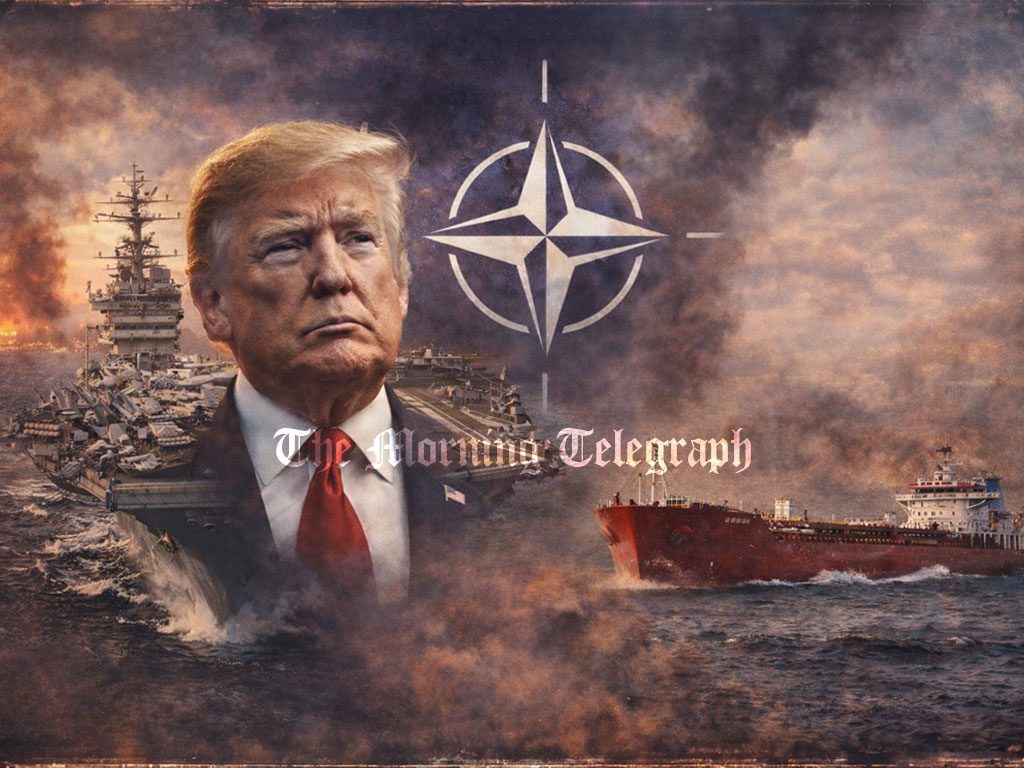
A volatile global standoff unfolds as diplomacy struggles to survive, Chinese oil tankers challenge US sanctions, NATO distances itself from Washington, and US warships close in on Iran, pushing the Middle East to the brink of conflict.
The United States and Iran are preparing for a critical second round of diplomatic talks, even as tensions escalate dangerously across the Middle East. Washington is currently working to finalize the timing and location of the negotiations, with Turkey playing a key mediating role in bridging the deep divide between the two long standing adversaries.

Although the first round of talks ended without agreement, it marked a historic moment as the first direct face to face engagement between the United States and Iran since 1979. US Vice President J.D. Vance has indicated that limited progress was made, while Iranian officials are now seeking approval from their supreme leadership before proceeding further.
The next phase of negotiations is expected to take place in a neutral location such as Pakistan or Geneva, Switzerland. However, major obstacles remain unresolved. The United States has pushed for a 20 year freeze on Iran’s uranium enrichment program, while Iran has only shown willingness to accept a five year limitation. This disagreement continues to be a central barrier to any breakthrough.
Complicating the situation further is the ongoing regional conflict, particularly in Lebanon. Iran has warned that any attack on Lebanon would be treated as a direct attack on its own territory. In parallel, Washington is planning separate diplomatic talks between Lebanese and Israeli representatives in an attempt to ease tensions, with the US Secretary of State expected to participate.
While diplomacy continues, developments at sea have intensified global concern. Two Chinese oil tankers that have been blacklisted by the United States have successfully passed through the Strait of Hormuz, openly challenging US sanctions. One vessel, the Rich Starry, is carrying approximately 250,000 metric tons of methanol and departed from the UAE port of Hamriyah. The ship’s operator, Shanghai Xuanrun Shipping Co Ltd, is already under US sanctions for its dealings with Iran.
On the same day, another sanctioned vessel, the Murlikishan, entered the strategic waterway. Previously known as the MKA, the tanker has a history of transporting both Russian and Iranian oil. Maritime tracking data suggests that the vessel is currently empty and scheduled for refueling operations. These movements highlight the growing difficulty in enforcing sanctions in one of the world’s busiest and most critical shipping lanes.
Amid these developments, US President Donald Trump has proposed a naval blockade of the Strait of Hormuz, a move that has triggered significant divisions within the NATO alliance. While Trump has stated that the blockade would soon begin with support from other nations, key NATO members including Britain and France have refused to participate in any direct military action.
Instead, European powers are working on an independent plan to secure the vital waterway and ensure the free flow of global oil supplies. British Prime Minister Keir Starmer has made it clear that the United Kingdom will not be drawn into the conflict, while French President Emmanuel Macron has proposed a defensive multilateral operation involving several countries.
A high level meeting involving around 30 nations, including India, Gulf states, Italy and the Netherlands, is expected to take place in either London or Paris to finalize this alternative strategy. However, diplomatic sources suggest uncertainty over whether the United States will accept a European led initiative, especially after declaring its own naval intentions.
Turkey has also stepped in diplomatically, with Foreign Minister Hakan Fidan emphasizing the need for a peaceful resolution to the Hormuz crisis. He has further indicated that relations with the United States could be reassessed at the upcoming NATO summit scheduled to be held in Ankara.
At the same time, military tensions are reaching a critical threshold. The US Navy’s aircraft carrier USS Abraham Lincoln has moved to within 200 kilometers of the Iranian coastline, marking the closest approach by a US carrier since the current conflict began. Stationed in the Gulf of Oman, the carrier provides the United States with the capability to launch rapid strikes against southern Iran.
In addition to the Abraham Lincoln, more than 15 US Navy warships are currently deployed across key maritime routes in the region, effectively forming a strong naval presence aimed at controlling strategic sea lanes. Further escalation is expected with reports that another aircraft carrier, the USS George H.W. Bush, is en route to reinforce US naval power in the Middle East.
With increasing military deployments, strained alliances, and fragile diplomatic efforts, the situation in the Strait of Hormuz is rapidly evolving into one of the most dangerous geopolitical flashpoints in recent years. Analysts warn that any miscalculation by regional or global powers could trigger a wider armed conflict with far reaching consequences for global energy markets and international security.