A viral salary slip exposes a startling tax gap between MPs and private sector workers, raising urgent questions about fairness, policy loopholes, and Sri Lanka’s income tax system.
At a time when ordinary citizens are grappling with rising income taxes, a fresh controversy has erupted over the surprisingly low tax payments made by Members of Parliament. The debate gained momentum after MP Archuna Ramanadan publicly shared his monthly salary slip on Facebook on April 8, drawing widespread attention and scrutiny across social and political circles.

According to the details he disclosed, the income tax deducted from his earnings appears significantly lower than what many expected, especially when compared to private sector employees earning similar amounts. This revelation has triggered discussions about inequality in Sri Lanka’s tax structure and whether certain categories of income are being treated differently.
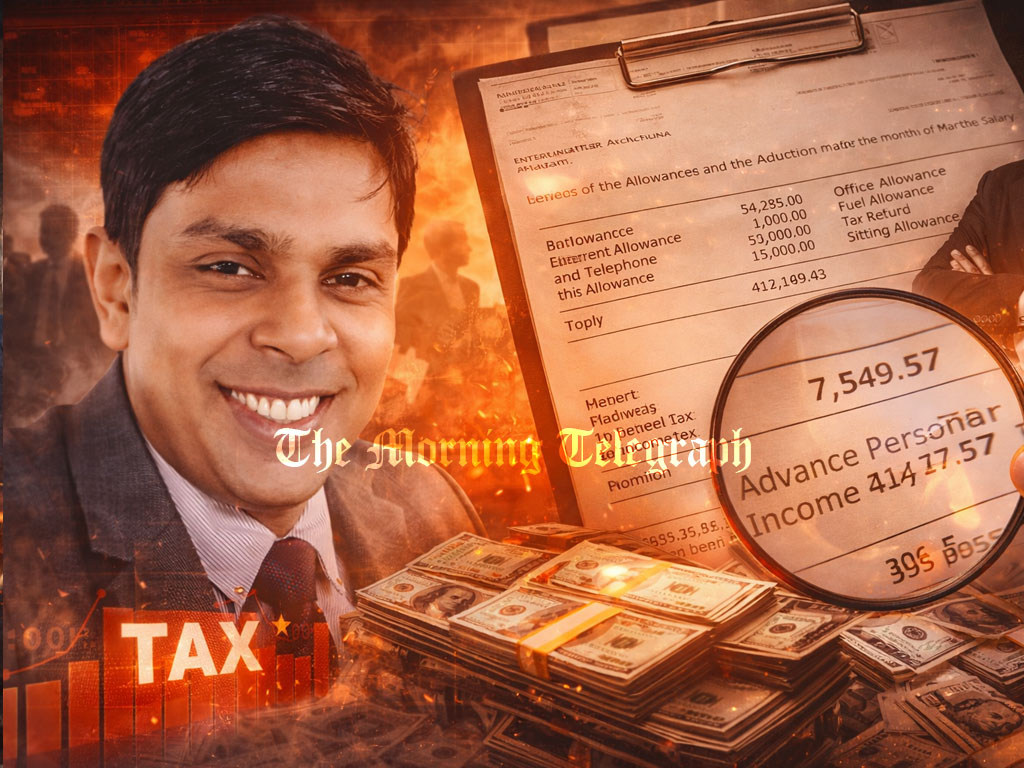
A closer look at Archuna Ramanadan’s salary breakdown reveals a total monthly gross income of Rs. 415,169.93. This figure includes several components such as a monthly allowance of Rs. 54,285.00, an entertainment allowance of Rs. 1,000.00, a telephone allowance of Rs. 50,000.00, a transport allowance of Rs. 15,000.00, an office allowance of Rs. 100,000.00, and a fuel allowance of Rs. 179,707.93. In addition, there is a tax refund of Rs. 177.00 and a parliamentary attendance allowance of Rs. 15,000.00, bringing the total to the stated amount.
Despite this relatively high income, the Advance Personal Income Tax deducted from his salary stands at only Rs. 7,549.57. This figure has raised eyebrows, particularly when compared to the tax burden faced by private sector employees. For someone earning a similar monthly income in the private sector, the expected tax deduction would be approximately Rs. 55,461.17.
This creates a striking difference of Rs. 47,911.60, meaning that a private sector worker would pay over 84 percent more in income tax than an MP earning the same amount. Such a disparity has led many to question the underlying factors contributing to this imbalance and whether the system itself is structured in a way that favors certain groups.
Addressing the issue during a television discussion, Deputy Minister of Finance Professor Anil Jayantha Fernando attempted to clarify the situation by explaining that tax calculations can vary depending on multiple factors. He emphasized that the system operates under a structured schedule and that fluctuations in deductions may occur due to variations in income sources, including primary and secondary earnings.
He further noted that there can be instances where tax is either over deducted or under deducted in specific months, but the final liability is calculated accurately at the end of the tax year. According to his explanation, the system does not intentionally differentiate between MPs and other taxpayers, and any perceived discrepancy may be due to misunderstanding or misinterpretation.
However, further clarification from the Inland Revenue Department reveals that there are indeed differences in how taxes are applied between public sector and private sector employees. A senior tax advisory officer explained that while the system is not exclusively designed for MPs, government employees are subject to a different method of tax calculation, particularly when it comes to non cash benefits.
Under existing guidelines, only 25 percent of the value of certain allowances is considered taxable for government employees. These include the fuel allowance, telephone allowance, and transport allowance. As a result, a significant portion of these benefits is excluded from taxable income, which directly reduces the overall tax liability.
In the case of MP Archuna Ramanadan, this means that only a quarter of the combined value of his telephone, fuel, and transport allowances is subjected to income tax. This calculation method plays a major role in lowering the final Advance Personal Income Tax deducted from his salary.
This approach has also been confirmed by officials within the Parliamentary Finance Department, reinforcing the argument that the difference is rooted in policy rather than administrative error. The rationale behind this exemption, according to tax authorities, is that these allowances are primarily intended to cover expenses incurred in the course of official duties.
While this explanation provides context, it has not fully settled the debate. For many observers, the issue goes beyond technical calculations and touches on broader concerns about equity, transparency, and the fairness of Sri Lanka’s tax system. As public discourse continues, the controversy highlights the need for clearer communication and possibly a re evaluation of policies that create such visible disparities.