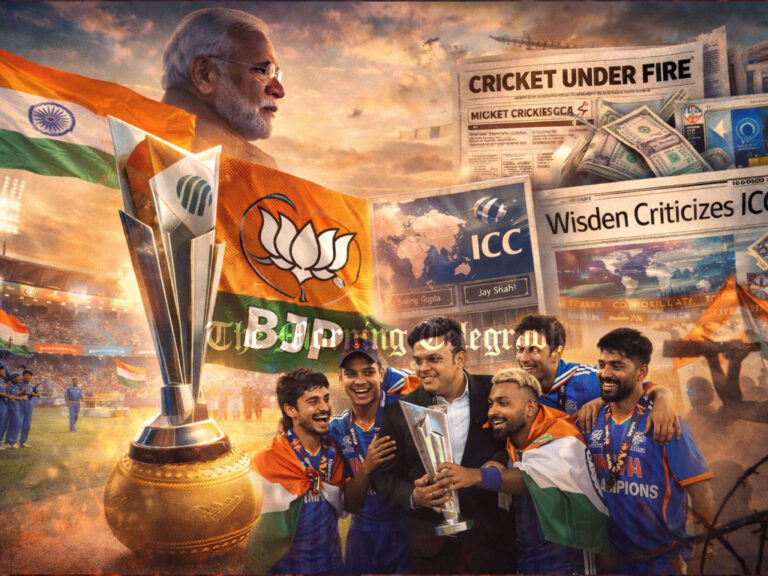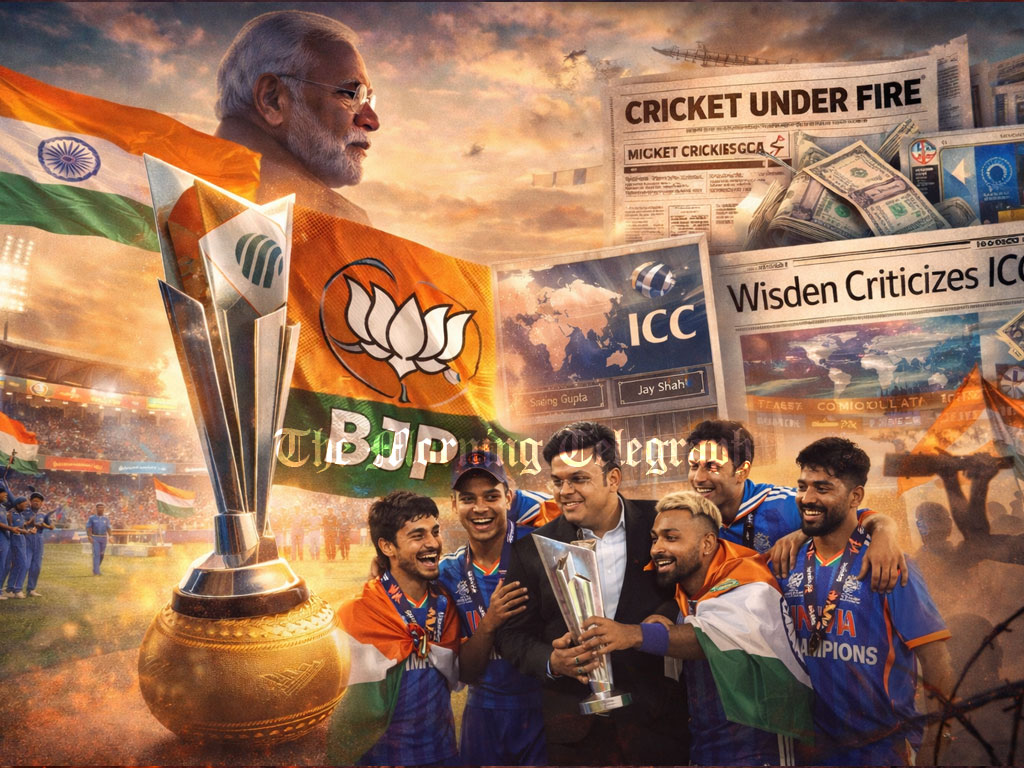
A powerful critique from cricket’s most respected voice raises alarm over political influence, governance control, and the growing dominance shaping the future of the global game.
The global cricketing landscape has come under intense scrutiny following strong remarks from Wisden Cricketers’ Almanack, widely regarded as the sport’s most authoritative publication. In its latest edition, the publication delivers a sharp critique of what it describes as growing political influence and dominance by India in international cricket governance, warning that the sport is drifting into troubling territory.

In the 163rd edition of Wisden, editor Lawrence Booth uses his opening commentary to question the increasing concentration of power within Indian cricket administration. His remarks focus particularly on the structure of the International Cricket Council, where key leadership positions are currently held by Indian figures, including chief executive Sanjog Gupta and chairman Jay Shah. The latter’s political connections have further fueled concerns about the overlap between cricket administration and state influence.
Booth highlights the role of the Board of Control for Cricket in India, describing it as closely aligned with the ruling Bharatiya Janata Party. According to the analysis, this relationship has blurred the line between sport and politics, raising serious questions about neutrality and fairness in global cricket decision-making. The issue of political interference becomes even more pronounced when examining key events that unfolded during the 2025 cricket season.
One of the most striking examples cited is the Asia Cup, which took place during a period of heightened tension between India and Pakistan. The refusal of players to engage in customary gestures such as handshakes symbolized a deeper fracture, reflecting geopolitical realities spilling directly onto the cricket field. Booth questions whether this moment represents a turning point in how governance failures are perceived within the sport.
He also points to contradictory narratives from cricket officials, noting how calls to separate politics from sport ring hollow when the same individuals hold influential political positions. The intertwining of these roles has contributed to an environment where cricket is increasingly used as a platform for national messaging and symbolic gestures rather than purely sporting competition.
The situation escalated further when public statements linked cricket victories to military achievements, reinforcing the perception that the game is being used as a proxy for broader political narratives. Booth argues that such developments demonstrate how deeply embedded political influence has become, transforming cricket into a strategic tool rather than a neutral global sport.
Additional concerns arise from decisions affecting players and international participation. The case of Bangladesh fast bowler Mustafizur Rahman, whose professional commitments were disrupted amid rising tensions, is presented as evidence of how geopolitical considerations can directly impact individual careers. This example underscores the broader implications of politicization on player mobility and professional stability.
The ripple effects extended to major tournaments, with uncertainties surrounding participation in global events such as the T20 World Cup. Tensions between nations created doubts about travel approvals and team involvement, highlighting the fragile nature of cricket’s financial and organizational structures. Booth notes that while crises were temporarily avoided, the underlying vulnerabilities remain unresolved.
The broader critique suggests that cricket governance is evolving into a system where power dynamics are increasingly uneven. Booth characterizes this trend as resembling an environment where dominant interests shape outcomes while accountability diminishes. He argues that this imbalance risks undermining the integrity of the sport and alienating stakeholders across different cricketing nations.
Beyond governance issues, Wisden also critiques decisions made by other cricket boards, including Australia’s approach to commemorating Test cricket milestones and England’s recent Ashes strategy. These observations reinforce the idea that cricket faces multiple challenges, both structural and competitive, that require careful reflection and reform.
Despite these concerns, the achievements of players continue to stand out. Indian cricketers feature prominently in Wisden’s annual honors, reflecting their strong performances on the field. Names such as Shubman Gill, Rishabh Pant, Ravindra Jadeja, and Mohammed Siraj are recognized among the year’s top performers, alongside Nottinghamshire captain Haseeb Hameed. Mitchell Starc earns recognition as the leading men’s cricketer, while Deepti Sharma and Abhishek Sharma are honored in their respective categories.
Ultimately, Wisden’s critique serves as a warning about the direction in which global cricket is heading. The growing intersection of politics and sport, combined with concentrated administrative power, presents a challenge that the cricketing world can no longer ignore. The future of the game may depend on how these issues are addressed and whether governance structures can evolve to preserve fairness, independence, and the true spirit of cricket.