
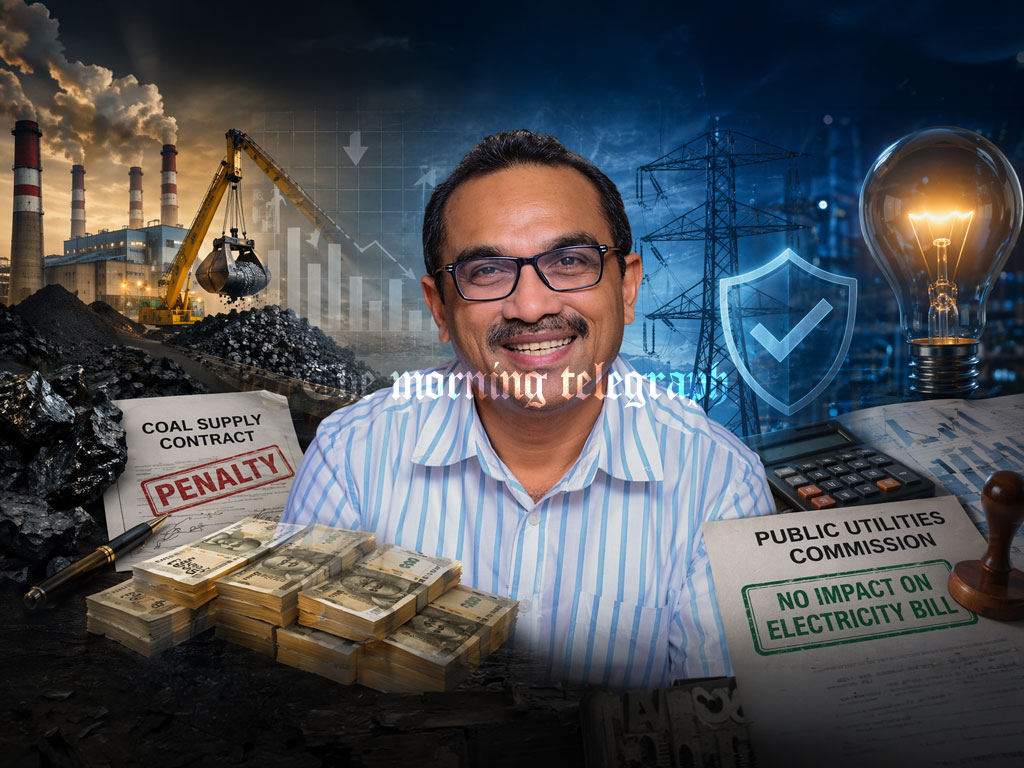
Government withholds millions from coal supplier, insisting the financial damage from substandard imports will not be passed on to electricity consumers amid growing scrutiny over Sri Lanka’s energy crisis.
A significant shortfall in energy generated from imported coal has resulted in financial losses, but authorities insist that this burden will not be transferred to the public through electricity tariffs, according to Minister Bimal Ratnayake.
The Ministry of Power has already withheld nearly Rs. 915 million from the company responsible for importing the coal, the Minister of Transport, Highways and Urban Development stated, emphasizing that the financial responsibility lies with the supplier rather than the government.

He made these remarks during a special media briefing held at the Government Information Department on the 17th, which focused on the resignation of Energy Minister Kumara Jayakody and the ongoing coal procurement controversy.
Providing further clarification, the Minister noted that although payments exceeding Rs. 500 million were initially due for three coal shipments, these payments will not be released because the consignments failed required inspection standards.
He added that an additional Rs. 450 million remains secured under a performance bond agreement with the supplier, bringing the total recoverable amount within Sri Lanka to approximately Rs. 960 million.
Minister Bimal Ratnayake elaborated further on the issue.
“There is a shortage in energy generation from imported coal, and this creates a financial loss. However, the Public Utilities Commission has clearly stated that when calculating electricity tariffs, this loss will not be passed on to consumers.
The Ministry of Electricity has withheld around Rs. 915 million from the supplier. It has been estimated that the total loss from substandard coal could reach nearly Rs. 8,000 million. However, with Rs. 915 million already withheld, the public will not bear any financial burden.
The Public Utilities Commission has the authority to determine electricity tariffs, and they have confirmed that this loss will not be included in consumer bills.
Therefore, while there has been a financial impact, it is a loss borne by the supplier. The penalties have been enforced, and neither the public nor the government will absorb this cost,” he stated.
Minister Ratnayake further explained the payment structure involved in coal procurement contracts.
“If a supplier fails quality testing at the loading port laboratory, no payment is made. If the shipment passes, up to 80 percent of the payment is typically released. However, in certain cases, even that threshold has not been met, and payments have been withheld accordingly.
In addition, similar to the construction sector, a performance bond is required. In this case, it amounts to approximately 15 million US dollars, or Rs. 450 million. We have already paid less than 80 percent, and there remains an additional Rs. 500 million that has not been settled.”
Deputy Minister of Energy Muhammad Ilyas Muhammad Arkam, who also addressed the media, highlighted the logistical limitations once coal shipments arrive in the country.
He stated that it is not feasible to reload or return coal once it has been imported, and therefore financial penalties are imposed to compensate for any losses incurred due to substandard quality.
“The losses from the three shipments, combined with the performance bond, total around Rs. 960 million. This figure is based on the confirmed test reports currently available,” he explained.
In response to a question on how fines can be imposed on already utilized coal, the Deputy Minister clarified that this practice is not new.
“Fines have been imposed not only during our administration but also under previous governments. Even if the coal has already been used, penalties are applied when it fails to meet required specifications.
There are around ten quality parameters that must be satisfied. If those standards are not met, fines are charged accordingly. Since there is no practical way to reload coal once it is delivered, enforcing financial penalties is the only viable solution,” he added.


Mninister Ratnayake, it’s not the consumer who will bear the loss but the govt. and taxpayer.
It’s a shame the minister is underplaying the fraudulent tender process.
Shame indeed.