A political déjà vu unfolds in Sri Lanka as past corruption narratives collide with present power struggles, raising one critical question: is the country about to relive one of its most defining political turning points?
“He can’t win an election… but he’s not a thief.”
That was the phrase that followed Ranil Wickremesinghe when he stepped into office as Prime Minister in 2013.
“They called Ranil a traitor. They called him a Tiger sympathizer. But no one ever called him a thief. Even his harshest critics admitted that.”
That was the narrative echoed by international observers when Ranil assumed power again in 2015.

“Mr. Clean.”
A label widely circulated and reinforced by media circles, and one that few openly challenged at the time.
In 2015, Ranil Wickremesinghe built his political comeback by contrasting himself against the Rajapaksa family, who were widely portrayed as corrupt. The campaign was simple yet powerful. The Rajapaksas were thieves. Ranil was clean. That framing shaped voter sentiment and ultimately influenced the outcome of the election.
However, political branding can be fragile. Once the label of corruption is attached, it rarely fades easily. The Rajapaksas understood this reality better than most. Their strategy evolved into discrediting either Maithripala Sirisena or Ranil, knowing that weakening one could neutralize the accusations against them.
The question they faced was simple but strategic. How do you turn a man known as “Mr. Clean” into a symbol of corruption?
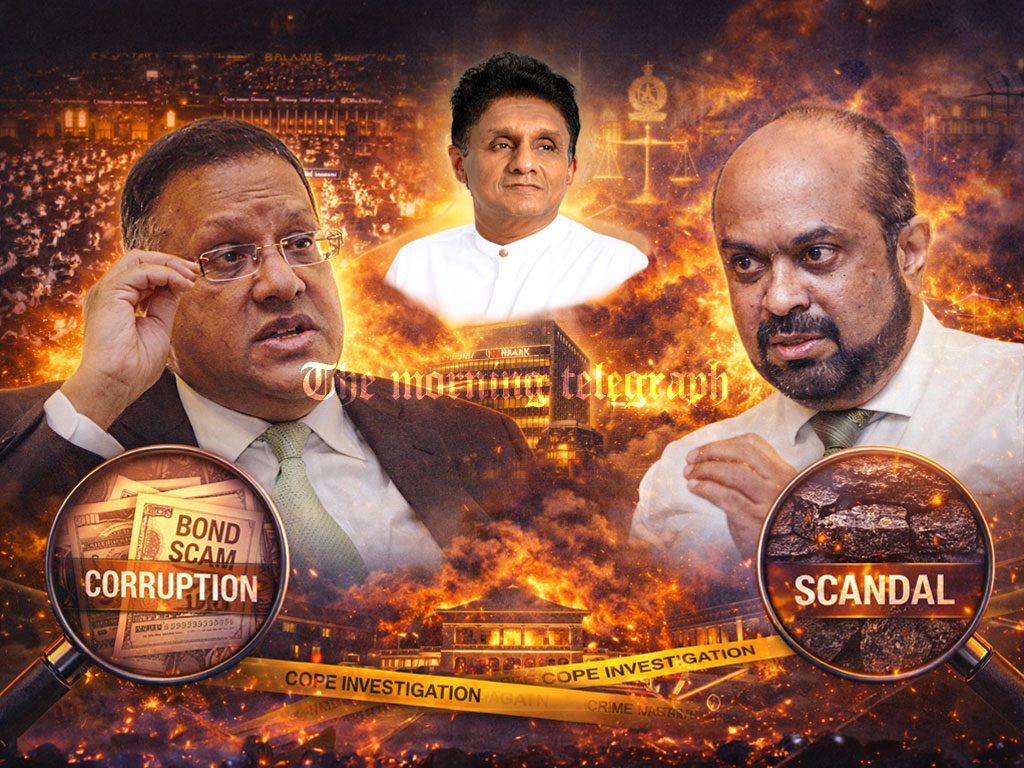
The answer came swiftly with the Central Bank bond scandal.
With the backing of President Maithripala Sirisena, elements within Ranil’s own coalition, and the influence of the COPE committee, the Rajapaksas successfully reshaped public perception. Ranil was no longer seen as clean. He was recast as the central figure in a financial scandal.
Civil society groups and artists who had supported the 2015 political shift found themselves in an uncomfortable position. The man who promised accountability was now facing accusations of financial misconduct.
When the crisis escalated, Maithripala summoned Ranil. Malik Samarawickrama was present.
“If we are to protect our mandate and this government, you must ask your friend Arjuna Mahendran to step down,” Maithripala insisted.
“I’ll resolve this,” Ranil responded.
Arjuna Mahendran, a close ally of Ranil, had been appointed as Central Bank Governor based on trust. That relationship made it difficult for Ranil to distance himself. Instead of immediate action, he initiated legal defenses and attempted to shift attention to past bond transactions.
But Maithripala chose a different path. Aligning more closely with the Rajapaksa strategy, he appointed a commission of inquiry and publicly cautioned against protecting those involved. The COPE findings reinforced allegations of large-scale financial misconduct. Pressure mounted within the coalition, with calls for Ranil’s removal intensifying.
Within months of taking office in 2015 on an anti-corruption mandate, Ranil’s image had dramatically shifted. By mid-year, he was perceived by many as the very figure he had campaigned against.
This transformation did not happen in isolation. It was driven by coordinated political maneuvering, institutional backing, and investigative reports, including findings from the Auditor General. By the time of the 2018 local government elections, the damage was clear. Ranil’s administration faced a decisive electoral setback.
Fast forward to the present political landscape. Sajith Premadasa, often dismissed by both government and opposition voices as ineffective, has adopted a strategy that mirrors past political playbooks while attempting to refine them.
He has turned his focus toward the JVP-led administration, which came into power with a strong anti-corruption mandate. By highlighting the coal procurement controversy, Sajith is attempting to reshape public perception in a similar fashion.
Yet the challenge he faces is far greater than what the Rajapaksas encountered in 2015. The current government commands a broader and more unified mandate. Unlike the fragmented political environment of the past, today’s leadership operates with stronger institutional alignment.
In 2015, Mahinda Rajapaksa retained significant support within key voter bases. In contrast, the current administration has secured backing across a wider national spectrum, making any attempt to destabilize it significantly more complex.
Additionally, Sajith lacks the internal fractures that once weakened Ranil’s government. He faces a President, Prime Minister, Cabinet, and parliamentary structures that appear unified in defending the accused minister, Kumara Jayakody.
Despite these challenges, Sajith has pressed forward. His exposure of the coal procurement issue has led to a no-confidence motion, signaling his intent to challenge the government narrative directly.
Critics have been quick to dismiss his strategy.
“Keep bringing no-confidence motions. You are only strengthening the government,” some opposition factions argue.
This criticism is not new. In 2023, when Sajith moved a similar motion against Keheliya Rambukwella, he faced ridicule from multiple fronts, including from those who are now in power.
At the time, many believed his actions were politically misguided. Yet the narrative he initiated gained traction. It created sustained pressure, ultimately contributing to Keheliya’s removal and legal consequences.
That experience appears to have shaped Sajith’s current approach. Rather than retreating in the face of criticism, he is doubling down on narrative-building.
His support for the appointment of Auditor General Samudrika Jayaratne was also viewed with suspicion by some, who speculated about political deals. However, Sajith’s calculation was based on professional credibility rather than political convenience. The outcome reinforced his position, as the Auditor General’s office did not suppress the coal controversy but brought it into focus.
The parallels between past and present are becoming increasingly difficult to ignore.
In 2015, Ranil Wickremesinghe stood accused of protecting Arjuna Mahendran. Today, the JVP-led government faces accusations of shielding Kumara Jayakody.
Then, efforts were made to redirect attention toward previous bond issues. Now, attention is being shifted toward earlier coal transactions.
History does not repeat itself in identical form, but its patterns are often unmistakable.
Just as civil activists who supported the 2015 government were left disillusioned, there is growing speculation that current supporters of the Aragalaya movement may face similar questions in the months ahead.
A former JVP member captured the moment with a striking observation.
“Sajith Premadasa has lit the fuse of an explosive that will detonate in a few months.”
Whether that prediction holds true remains uncertain. But one thing is clear. The battle for public perception, once again, is at the heart of Sri Lanka’s political landscape.
SOURCE :- MAWRATA.LK