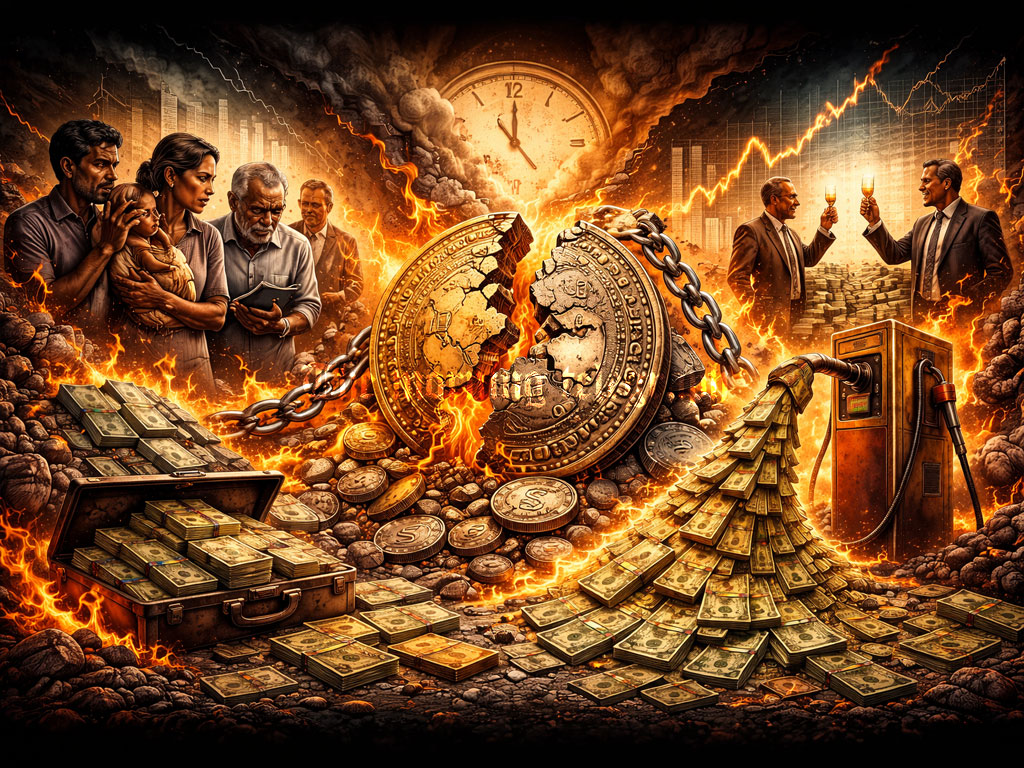
A deeply critical look at how rising inflation, currency depreciation, and policy narratives are being framed as success, while ordinary Sri Lankans continue to struggle under mounting financial pressure and declining living standards.
Rejoicing over the return of inflation and currency depreciation at a time when Sri Lanka’s most vulnerable citizens are grappling with rising living costs is not only insensitive but profoundly troubling. The tone adopted by certain macroeconomic narratives, particularly those that welcome inflation moving toward a central bank target, appears detached from the daily realities faced by the public.
Inflation, in its essence, is not merely a statistical outcome but a lived experience. It reflects a steady erosion of purchasing power and a silent tax on savings. The philosophy underpinning modern inflation targeting, largely shaped by post-1960s macroeconomic thinking, represents a departure from classical economic principles. This shift has had far-reaching consequences, often placing undue burdens on ordinary populations.
The recent depreciation of the Sri Lankan rupee, coupled with rising prices, is already impacting consumption patterns, weakening household resilience, and distorting investment planning. While some sectors may experience short-term gains, the broader economic trajectory is one of uncertainty and constrained growth. Increased costs ripple through infrastructure projects, utility pricing, and public expenditure, undermining long-term stability.

Gloating over the rising cost of living?
Statements suggesting that there is “space” to accommodate higher inflation raise serious concerns. When inflation stood at 1.6 percent in early 2026, policymakers argued that this provided room to absorb future price increases. Yet such assertions overlook the cumulative damage inflicted over previous years, when the rupee depreciated sharply and real incomes collapsed.
The question remains, where exactly is this “space” within household budgets? For many families, the erosion of wages, pensions, and savings has left little margin for additional financial strain. The depreciation from 184 to 300 against the dollar within a short span devastated economic stability, pushing many into poverty and forcing difficult choices such as reducing food intake or foregoing essential services.
Framing these hardships as manageable or even positive reflects a disconnect between policy discourse and lived reality. It also raises ethical questions about how institutions communicate economic developments, particularly when those developments impose significant hardship on the public.
Even international institutions have contributed to this narrative. Growth figures and inflation rebounds are often presented as signs of recovery, yet such metrics do not capture the underlying distress caused by rising costs and declining real wages. Economic growth in recent years has been driven more by stability and reduced inflationary pressure than by inflation itself.
Recovery from Say’s law not inflation and stimulus
The recovery observed in Sri Lanka’s economy cannot be attributed to inflationary stimulus. Instead, it aligns more closely with classical economic principles, particularly those associated with Say’s Law, where production and real economic activity drive growth.
Stability in prices and exchange rates allowed businesses and households to plan more effectively, leading to gradual improvements in economic conditions. The strengthening of the rupee at certain points helped contain costs in key sectors such as housing, education, and healthcare, even as lingering effects of earlier depreciation continued to influence service prices.
The idea of a wage spiral driving inflation is also questionable. Workers demand higher wages not as a cause of inflation but as a response to it. Rising food and energy prices, which react quickly to monetary expansion and currency depreciation, place immediate pressure on households, prompting calls for wage adjustments.
Effects of Inflation
Inflation is not a singular phenomenon but a chain reaction. It begins with monetary expansion beyond sustainable limits and manifests in multiple ways. Price increases are only the most visible outcome. Currency depreciation, foreign exchange shortages, and asset bubbles are equally significant consequences.
In Sri Lanka’s context, the use of financial instruments such as swaps has contributed to liquidity expansion, further complicating the monetary landscape. These mechanisms have introduced additional risks, including exposure to foreign exchange volatility and increased debt burdens.
While certain segments of the economy, particularly those with direct access to financial systems, may benefit temporarily, the broader impact is negative. Wage earners and small businesses bear the brunt of inflationary policies, often without adequate safeguards.
The disparity becomes more evident when examining salary trends. Despite nominal increases, real wages remain below pre-crisis levels when measured in dollar terms. This stagnation underscores the long-term damage caused by repeated cycles of inflation and depreciation.
Monetary Depreciation and Coin Clipping
Historically, the deliberate reduction in the value of currency was considered a serious offense. Practices such as coin clipping were criminalized due to their impact on economic stability. In contrast, modern monetary systems allow for currency depreciation under certain frameworks, often justified as policy tools.
The evolution toward fiat currency systems and the relaxation of strict exchange rate controls have enabled greater flexibility but also introduced vulnerabilities. In many developing economies, including Sri Lanka, these changes have led to repeated cycles of instability.
The experience of countries that maintained stronger monetary discipline highlights the importance of sound currency management. Stable exchange rates and controlled inflation have supported long-term growth and investment, while inconsistent policies have produced the opposite effect.
An Immoral Philosophy
At its core, the acceptance of inflation as a policy objective raises fundamental ethical questions. A central bank’s primary responsibility is to preserve the value of the currency. When policies result in its systematic erosion, the consequences extend beyond economics into the realm of social justice.
The notion that inflation-driven growth can benefit an economy is contentious. It often relies on redistributing wealth in ways that disadvantage wage earners and those with limited financial assets. This dynamic, known as the Cantillon effect, highlights the unequal impact of monetary expansion.
Public frustration with economic conditions frequently manifests as political change. However, the underlying causes, particularly monetary policies, are less visible and often misunderstood. This disconnect complicates efforts to address systemic issues.
Sri Lanka’s experience illustrates the need for a more disciplined approach to monetary policy. Ensuring accountability, maintaining currency stability, and aligning economic strategies with the needs of the population are essential for sustainable development.
Ultimately, the celebration of inflation and depreciation as indicators of success fails to acknowledge the human cost. Economic policy must be grounded in both sound theory and ethical consideration, recognizing that behind every statistic are individuals and families striving to maintain their livelihoods.