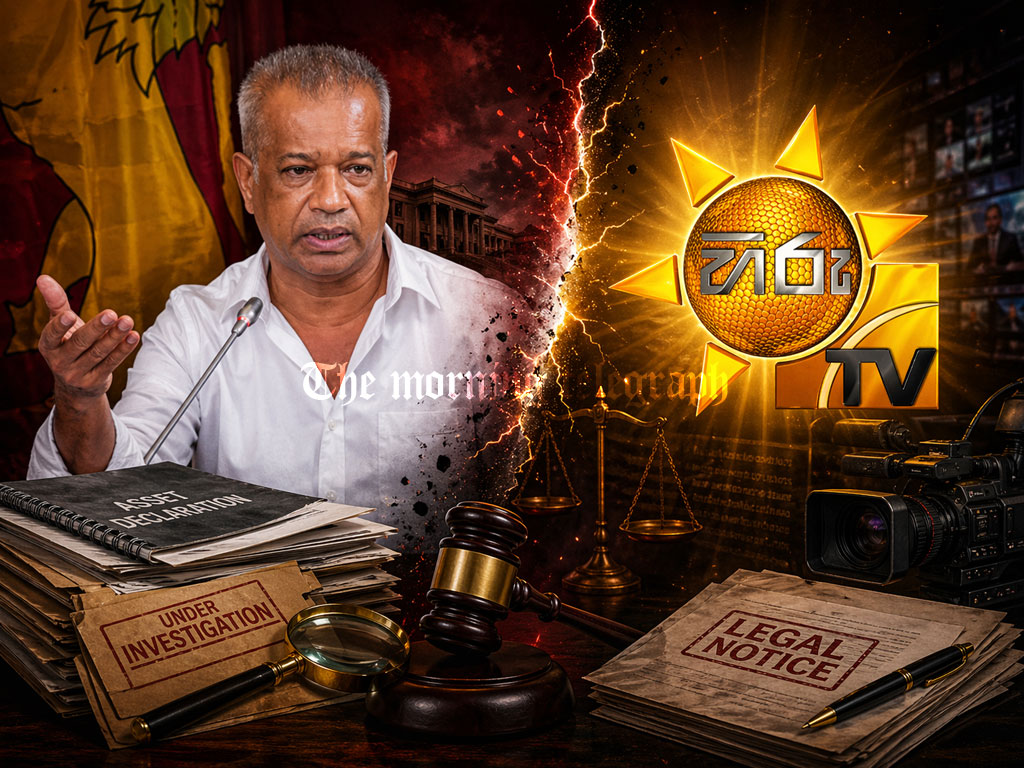
A high-stakes defamation battle against Hiru TV may expose more than it protects, as legal experts warn that Lal Kantha’s aggressive demand could trigger deeper scrutiny into his assets under Sri Lanka’s Anti-Corruption laws.
Lal Kantha has reportedly issued a letter of demand to Hiru TV seeking massive compensation, escalating a media dispute into a potentially complex legal and political confrontation. While the television network has already corrected the alleged error relating to Lal’s asset declaration, the minister appears determined to proceed, raising questions about strategy, intent, and possible consequences.

Observers note that this is not the first time Lal has taken such a path. In previous internal political disputes, he was seen aligning with party figures before eventually stepping back from confrontation. This time, however, he appears to be acting independently, pushing forward with a demand that could have far-reaching implications.
There is also growing discussion about whether Lal fully understood the legal framework when submitting his asset and liability declaration, particularly under the Anti-Corruption Act No. 09 of 2023. Similarly, questions are being raised about whether proper legal advice was obtained before initiating action against the media institution.
To understand the situation clearly, it is important to examine how defamation law operates in Sri Lanka.
One – Civil Defamation:
Defamation in Sri Lanka is strictly a civil matter following the abolition of criminal defamation in 2002. It is treated as a tort, meaning that a person must seek damages through civil courts rather than criminal prosecution. For Lal to succeed in such a case, he must prove that the published statements harmed his reputation in the eyes of the public, that the statements directly referred to him, and that they were communicated to third parties in a way that caused reputational damage.
On the other hand, the defendant in such a case, in this instance the media organisation, can rely on several well established defenses. These include proving that the information published was true and in the public interest, that it represented fair comment on a matter of public concern, or that it was based on official records or statements.
Although Lal’s demand reportedly involves billions in compensation, it is ultimately the court that determines the appropriate damages. Factors such as the plaintiff’s public standing, the severity of the alleged harm, and the extent of publication are all taken into account when deciding compensation.
The legal process begins with the issuance of a letter of demand, which gives the recipient a specified period to respond. If no settlement or apology is reached, the matter can proceed to the District Court. However, such cases are typically lengthy and depend heavily on the strength of evidence presented by both sides.
Beyond defamation law, the situation becomes more complex when viewed through the lens of Sri Lanka’s Anti-Corruption Act No. 09 of 2023. This legislation has introduced new standards regarding transparency and public access to asset declarations of public officials.
Under the current framework, redacted versions of asset and liability declarations of key public figures including ministers are made available through the Commission to Investigate Allegations of Bribery or Corruption. This allows the public to review information relating to property, investments, and financial interests without disclosing sensitive personal details.
If there is reasonable suspicion of unexplained wealth, multiple state agencies have the authority to initiate investigations. Complaints supported by evidence can be filed with CIABOC, which will then assess whether assets have been acquired beyond lawful income. The Financial Intelligence Unit also plays a role in monitoring suspicious financial activity within the banking system.
In Lal’s case, pursuing a defamation lawsuit may carry significant risks. The defending party could request discovery orders from court to obtain detailed asset records in order to prove the accuracy of their reporting. This would bring Lal’s financial declarations under direct judicial scrutiny in an open legal forum.
If it is demonstrated that his assets significantly exceed his declared income and cannot be adequately explained, serious legal consequences could follow under the Anti-Corruption Act, including asset confiscation, financial penalties, and possible imprisonment.
The situation becomes even more sensitive given the likelihood that complaints may already have been filed with the Bribery Commission regarding Lal’s assets. Such complaints can be submitted through multiple channels including in person, by post, online platforms, or through official hotlines, provided there is sufficient supporting evidence.
For any investigation to proceed, the complaint must present a reasonable basis. Detailed information about properties, business interests, or financial holdings, along with indications that these exceed known income sources, is essential for authorities to initiate formal inquiries.
Once a complaint is accepted, the Commission conducts a preliminary investigation to verify its credibility. This includes comparing declared assets with actual holdings, and where necessary, obtaining bank records and land registration details through court orders.
A key strength of the Anti-Corruption Act is its provision allowing courts to confiscate assets that cannot be legally justified. In addition to asset seizure, individuals found guilty may face substantial fines and prison sentences.
If such an investigation unfolds alongside Lal’s defamation case, it could weaken his legal position significantly. Courts would need to first determine whether the claims made about his assets are true before ruling on defamation, placing the burden of proof squarely on him.
As a result, many legal observers believe that filing a high value defamation claim against a media organisation could inadvertently trigger a deeper public and legal examination of Lal’s financial affairs.
In the current climate, where transparency and accountability are increasingly demanded by the public, such legal battles are not merely about reputation but also about credibility, governance, and trust in public office.