
By Marlon Dale Ferreira
What happens when icons begin to act like outcasts, and honor turns into spectacle? Beneath the surface of nostalgia and old-boy loyalty lies a disturbing chain of events that has shaken the very foundations of a proud Trinity legacy. This is not just a story of controversy, it is a confrontation between values once taught and actions now displayed. And as the lines between respect and rebellion blur, the question remains: has a celebrated past been recklessly traded for fleeting attention?
“Slaves, obey your earthly masters with respect and fear, and with sincerity of heart, just as you would obey Christ.” — Ephesians 6:5
Once celebrated as one of the finest rugby outfits to emerge from Trinity College, the unbeaten First XV team of 1987 stood as a symbol of excellence, discipline, and pride. Led by Tyrell Rajapaksa, the team produced several distinguished players, many earning the coveted Trinity Lion, while others such as Shah Dole and Imthie Marikkar went on to represent Sri Lanka on the national stage.
But today, that legacy lies in tatters, and the man who once led that pride of lions now stands stripped of the honour he once commanded.

What was once a story of sporting greatness has descended into a troubling spectacle, one marked by behavior that many would argue is unbecoming not just of old boys, but of men shaped by one of Sri Lanka’s most respected Christian institutions.
Tyrell Rajapaksa, once admired as a leader, has in recent times drawn widespread criticism following a series of incidents that have shocked both the Trinity community and the wider public. In one instance, he was seen on video forcibly tearing off his Trinity Lion from his blazer, an act many viewed as symbolic disrespect toward the very institution that honored him. In another, he was filmed consuming alcohol at the graveside of a former 1987 teammate, an act that many found deeply inappropriate and insensitive. Both incidents, reportedly recorded at his own insistence and circulated on social media, have only added fuel to the controversy.
Matters escalated further when Rajapaksa allegedly forced his way onto Trinity College premises, confronting security staff and walking through school corridors without authorization. The school administration, understandably, responded with strong disapproval, issuing warnings and taking steps to address what they viewed as unacceptable conduct.
The fallout has been swift. What was once speculation that Rajapaksa would be invited as Chief Guest for the prestigious Bradby Shield encounter against Royal College now appears to have been firmly set aside by the school’s management.
Yet, instead of de-escalation, the situation has spiraled further.
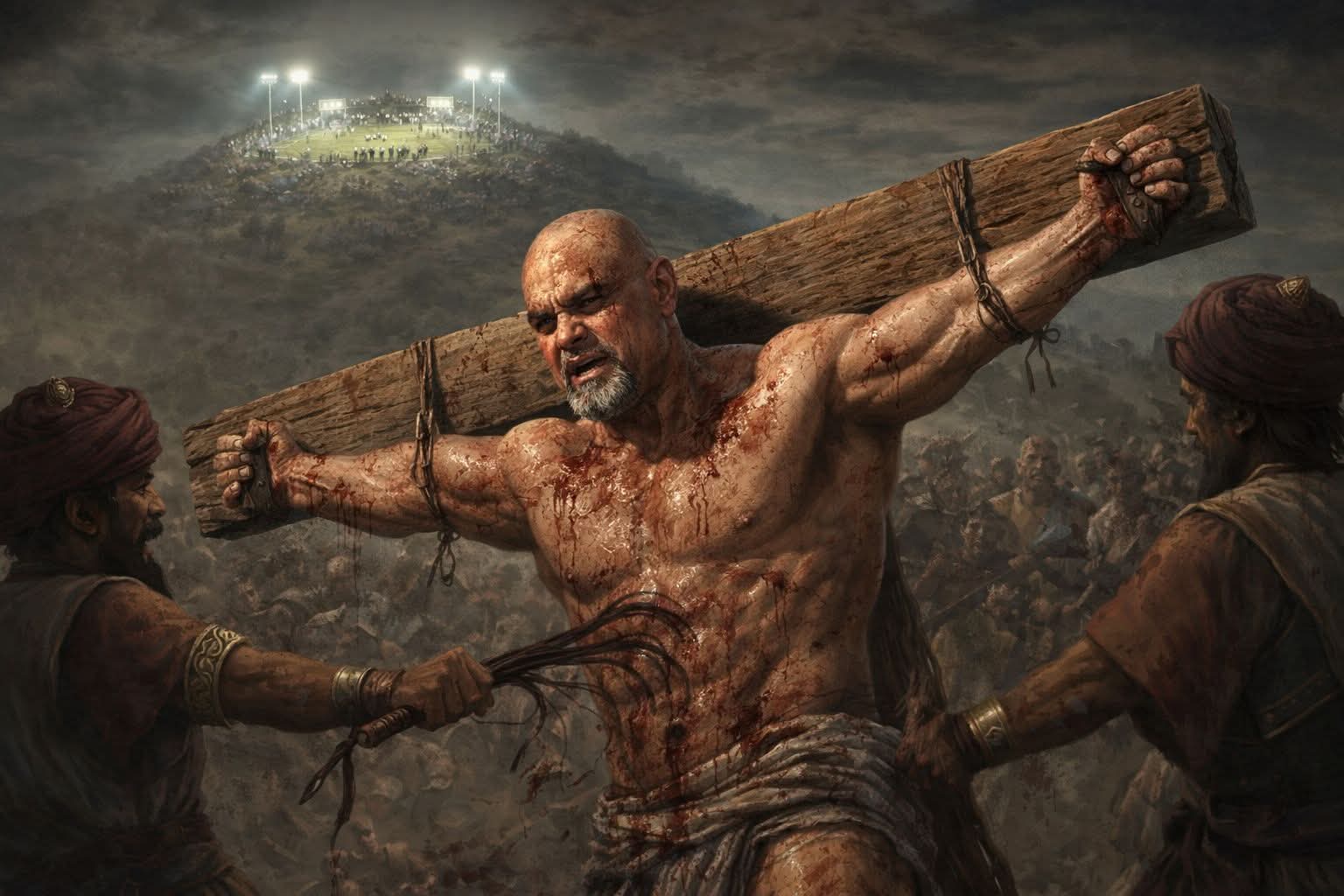
Enter Bimal Fernando, a fellow member of the 1987 team, who has now launched a public campaign that has dragged the name of Trinity College into even deeper controversy. Among his actions was the posting of a provocative image depicting Rajapaksa in a crucifixion-like pose, mounted not on a cross, but on a structure resembling the letter “T.” Responding to criticism online, Fernando defended the image by stating that it symbolized the “killing of the spirit” rather than a religious act, even drawing parallels between Rajapaksa’s physical appearance and that of Christ.
Such explanations have done little to quell outrage.
For many, the issue goes beyond symbolism. Whether interpreted as a cross or the letter “T” representing Trinity, the imagery has been widely condemned as insensitive and offensive, particularly within a Christian context. The perceived trivialization of deeply sacred symbols has struck a nerve among believers and alumni alike, raising serious questions about judgment, respect, and accountability.
Amid this unfolding drama, a deeper concern lingers.
Is this truly about Tyrell Rajapaksa seeking to be Chief Guest? Or is it a campaign driven by a circle of loyalists with unresolved grievances against the school’s administration? Whatever the motive, the consequences are undeniable. A once-revered figure is now facing a steady erosion of credibility, with public perception shifting rapidly, from respected leader to a figure increasingly associated with controversy.
The irony is stark.
A school that has long upheld Christian values, discipline, and humility now finds itself at the center of a narrative that appears to contradict those very teachings. Ephesians 6:5–8 speaks not only of obedience, but of sincerity, humility, and service, principles that extend far beyond scripture into everyday conduct.
A Chief Guest, after all, is not a title to be demanded, it is an honor bestowed.
It reflects not only past achievements, but the character one continues to embody long after leaving the school gates. Legacy is not frozen in time; it is lived, daily.
What was once a team remembered as lions of Trinity now risks being remembered for something far less noble. The transformation, from champions to controversy, has been both rapid and deeply disappointing.
In many ways, this unfolding episode draws a sobering parallel to the biblical account of King Saul. Once chosen, anointed, and celebrated, Saul’s rise was marked by promise, but it was his pride, disobedience, and refusal to heed correction that led to his downfall. Scripture reminds us that when a man repeatedly turns away from truth, God may give him over to a reprobate mind (Romans 1:28), allowing his own actions to become the instrument of his undoing. What began as honour can quickly unravel into disgrace when humility is replaced by ego. The comparison is not made lightly, but it serves as a cautionary reflection: that no matter how great one’s past achievements may be, unchecked pride and misguided conduct can erode even the most revered legacy.
And perhaps the most biting irony of all lies in a simple question now circulating quietly among observers:
In our wildest imagination, who would have thought that a can of Carlsberg could dethrone a Lion?
Who sponsored you Royal
What does Royal have to do with this? Let’s avoid unnecessary drama and focus on putting our own house in order instead of pointing fingers at others.
The image used depicts the meaning of how injustice and manipulation riddled with fabricated stories is punishing an innocent man! All this is done under the Name os Trinity college.
The article is full of distorted facts fed by the very manipulators. It’s sad the telegraph has to reach such low levels in order to generate revenue.
Please get some quality writers who will be able to asses a situation better and then present it to the public.
This article is Soo biased one wonder if this is paid advert.
Haven’t we seen this happening over and over again in history, the “non conformist ” put to the sword.
Tyrel Rajapakse, todate enjoys the admiration of all who new him. You cannot take away the glory of TR and that 87 TCK rugby team. A true leader, who inspires, and calls a spade a spade. And above all TR was big enough to apologise.
But, some small persons, in small places, are trying to play God. And worse, giving it a religious flavour, which s absolutely deplorable..
I wonder how these writers manupalete everything and try to be heros I would call then keyboard hero’s who have never done anything significant in their pathetic life, just been paid by someone to do a writeup…. if your been paid to do ot at leat get some sense into the number of worlds you put in the article.