The following is a statement issued by Mr. Rajitha Keerthi Tennakoon, a former Governor.
The only person who can authorize a payment related to a ‘Term Loan’ from the Treasury is the ST, i.e., the Secretary to the Treasury. The Secretary to the Treasury is Mr. Harshana Suriyapperuma, who was appointed to that seat after being removed from his parliamentary seat, following Mr. Siriwardena, who served as the Secretary to the Ministry of Finance during the period when the country was rescued from bankruptcy.

With the approval of the Secretary to the Ministry of Finance, Mr. Harshana Suriyapperuma, authorization for debt repayment must be obtained from the Director General of the Department of External Resources. Next, it must be approved by the Additional Director General (ADG) of the relevant division. Then, it must be approved by the Director of that division.
Next, it goes to the Assistant Director (AD) of the division for further action. From there, it goes to the Development Officer (DO) or the MSO, who is the subject clerk responsible for the matter. The subject clerk, a Development Officer (DO) or an MSO, writes the email to the State Debt Management Department regarding the payment.
As the seventh step of a term loan repayment, that letter is received by an ADG of the State Debt Management Department. The eighth step: it is received by the Director of the State Debt Management Department (ERD). She then forwards it back to a Development Officer (DO) or a Management Assistant (MA).
For the State Debt Management Department of the Treasury to repay a term loan, this procedure/steps must be completed.
As usual, water is meant to flow downwards, overriding numerous state officials. However, the responsibility that falls on the Secretary to the Ministry of Finance for ‘criminal negligence’ cannot be avoided under any circumstances. If a ‘business email’ was compromised and, through 13 steps, recommendations, approvals, and payments were made from top to bottom without the approval of the Secretary to the Ministry, then a Treasury cannot exist in this country. The administration of the Treasury cannot exist!
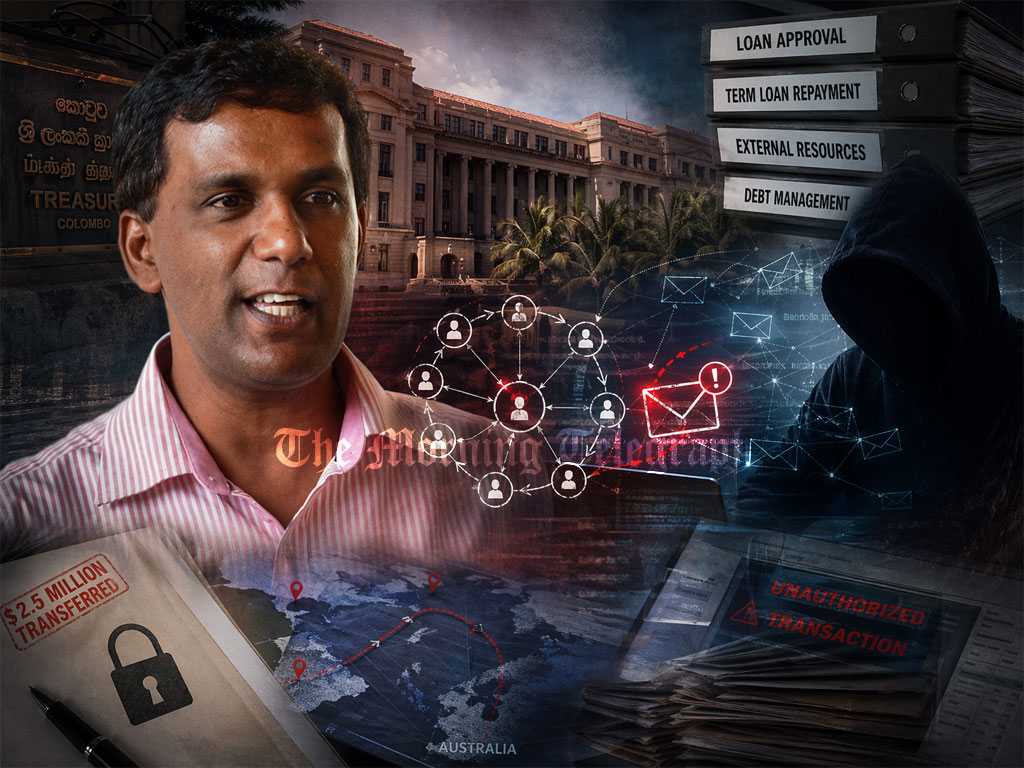
It must be revealed through an investigation whether the transfer of $2.5 million to a different account, claiming it was for Australia, occurred based on a single email. Investigators must also look into whether, since the ‘Dithwa’ storm season, there have been email exchanges between this hacker and top Treasury officials, like love letters.
Payments under a loan agreement are made to a contracted account number, not based on an email message resembling a love letter. The wonder is, given that the relevant bank account number exists in the agreement, how was it changed at some point within these 13 management steps?
After this incident was uncovered, a complaint was lodged with the Criminal Investigation Department by a Director of the Department of External Resources. He was first transferred and later suspended from work.
On the other hand, investigators must also determine whether this payment was a direct government-to-government payment to the Australian government. After debt restructuring, payments are still not being made to private creditors. That is, debt is being repaid only to ‘multilateral creditors.’ If so, the process relating to this payment must be traced back to its origin.
The current Minister of Finance has very little practical knowledge of ‘public finance.’ The Secretary to the Ministry of Finance, Harshana Suriyapperuma, has lifelong professional experience with Australia and several other countries in the private sector. He has no practical or hands-on experience in public administration. Because of this, he has had to rely on a range of officers, from the Deputy Director General of the Treasury down to Development Officers.
To identify this hacker and his methods, investigators must also find out whether similar incidents or attempts have been reported before. They must also investigate whether a similar confusion occurred a few weeks ago in a transaction involving a very large sum of money due for payment to India. Investigators must confirm that it was not the top officials but the lowest-level officials on the ladder who prevented such attempts. This fraud was uncovered because of one such vigilant low-level officer.
When one examines Financial Regulation 135 regarding the division of financial authority, an experienced public service officer will understand how the process went wrong. Is this an error committed by an individual? Or is it a situation arising from a recent change to the system? An accountant or a majority of Special Grade Administrative Service officers could guess.
The first person currently suspended is an Assistant Director. Her time at her post is only a few months.
The second officer is the Director of the Debt Management Department who filed the complaint regarding this matter.
The third officer is a Director who is extremely fond of his duties in the Planning Service. His strong political loyalty is to the current government.
The fourth officer is an Assistant Director of the Department of External Resources.
The Treasury is the heart of public financial management. The majority of its staff were highly qualified professionals. Investigators must find out in what manner that practice has changed very recently.
Specifically, investigators must find out whether the power to recommend names even for the position of subject clerk at the Treasury has been in the hands of a single individual all this time, and who that person is. This may help identify the real hacker.
To uncover all these facts, there is no need to appoint a commission to investigate payments at the Treasury over a period of 72 years.
The majority of officers in the public service are competent. When ‘loyalty’ becomes the primary qualification instead of that competence, the resulting disaster is the Treasury falling into the hands of hackers.
Sri Lanka has to repay term loans to fewer than a hundred states and institutions. In the past, those institutions were staffed by people who could address the officer in the other country or institution making the payments by name, people who had studied together, trained together, and had a practice of working as equals.
The real hacker is the ‘mastermind’ who made loyalty the primary qualification instead of competence.
Rajitha Keerthi Tennakoon