By Roshan Jayasinghe
A reflection on politics, thought, writing, music, motorcycles, parents, age, social media, duality, and the quiet return to humanness.
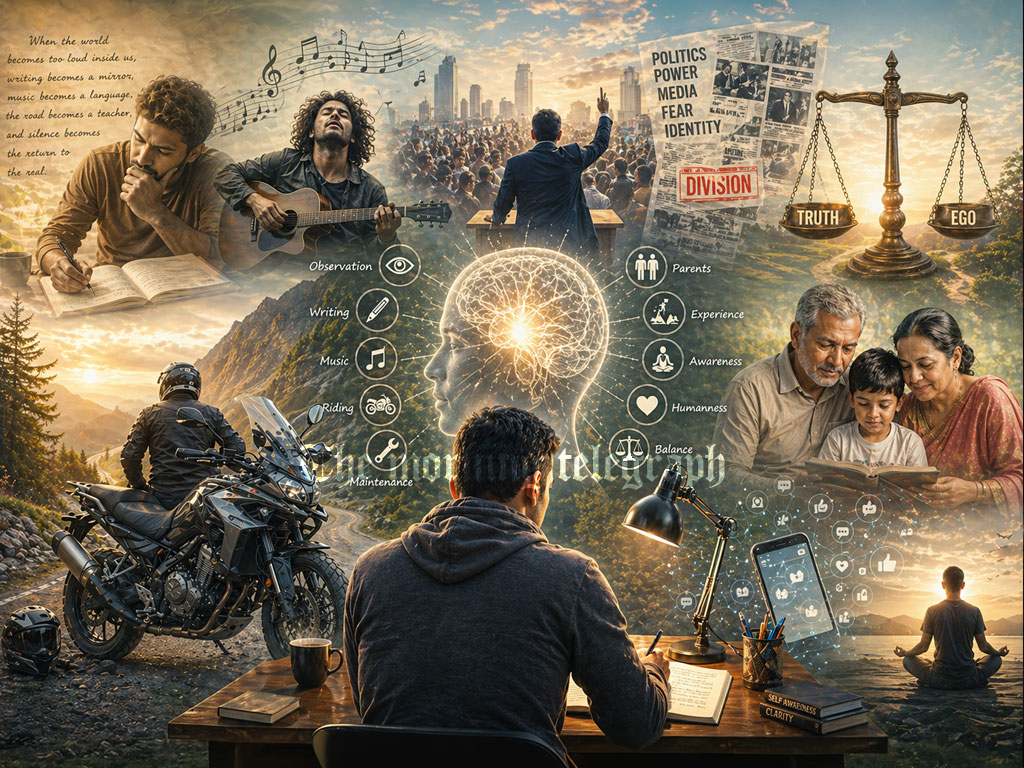
There are times when the outer world becomes so loud, manipulative, and complicated that it begins to enter the inner world without us noticing. Politics, power, media, fear, identity, and public performance can make life feel like a problem that must be solved all at once. Yet I have also come to see that not everything needs to be overthought; some things need to be quietly known, observed, and allowed to become clear. Through writing, observation, music, motorcycle riding, maintenance, the influence of my parents, and ordinary human encounters, I have begun to see something within myself. The world may be noisy, but the greater danger is when that noise becomes the shape of our own thought.

I want to begin this reflection by commending myself, not from pride, but from honest recognition. I have written a great deal over these past months, and through that writing I have not only expressed my thoughts, I have come to know them more clearly. Writing has become more than words on a page. It has become a mirror. It has shown me where I am clear, where I am disturbed, where I am reacting, and where I am slowly returning to myself.
Much of this recent movement in me arose from my strong analysis of the political world we are living in. I found myself watching what is happening across the world with deep concern. The manipulation, the vulgarity, the abuse of power, the false performance, the use of fear, religion, media, identity, and division, all of it began to press into my mind. I was not only observing politics anymore. I was feeling it. I was carrying it. I was running behind it in thought, trying to understand it, name it, expose it, and find some way of fixing what seemed to be going terribly wrong in front of us.
Yet I also understand that this darker side of human behavior has something to show us when we observe it with clarity. The vulgarity, manipulation, greed, and hunger for power are not only disturbing; they also reveal the opposite side of life more clearly. From a younger age, I have understood something about this duality. We often come to see truth more deeply because we have also seen falsehood. We come to value decency because we have seen the damage of indecency. We come to recognize care because we have seen what happens when care is absent. In that way, the other side of human behavior, however uncomfortable, can become part of our learning when we do not get lost inside it.
Then I began to observe something more personal. I began to see my own behavior inside that political analysis. I saw how easily outer disorder can become inner disorder. The vulgarity of the world can create a heaviness inside us, not because we agree with it, but because we keep giving it our full attention. The mind begins to chase one event after another, one leader after another, one injustice after another, until the whole inner life becomes occupied by the very thing it is trying to resist.
This is where the reflection became important to me. I began to see that the political world was not only showing me the condition of humanity. It was also showing me the condition of my own thought. I was watching the world become complicated, but I was also watching myself become complicated by watching it. I was seeing how thought can create urgency, fear, anger, judgment, and the feeling that everything must be solved at once. Beneath all of that movement, there was a quieter intelligence asking me to pause.
Human beings have made life overly complicated. We have built systems, ambitions, identities, arguments, careers, political loyalties, religious positions, financial goals, and social expectations until the simple act of living has become buried under layers of thought. Many of us are running behind abundance, but not always the kind of abundance that brings true fullness. It is often a search for more that has abandoned the depth of life itself. In that search, thought becomes narrow. It becomes tied to one or two objectives, and we begin to look at life through a magnifying glass that only enlarges what we are already preoccupied with.
I speak of this in plurality because I see it around me, but I must also speak of it through myself. I was like this too. I have lived with objectives, ambitions, concerns, worries, and mental patterns that narrowed my own perception. I have known what it means to be caught inside thought and mistake that thought for reality. I have known what it means to believe the story the mind is telling, only to later see that the story was not life itself. It was an illusion created by thought, strengthened by attention, and made heavier by repetition.
The understanding I have today did not appear from nowhere. Its foundation was shaped, in many ways, through the influence of my parents. As I have grown older, I have begun to see my father and mother with a different kind of clarity. There were things I could not fully understand when I was younger. I could not fully see the weight they carried, the choices they made, the sacrifices they offered, or the quiet ways they shaped my life without always needing to explain themselves.
My experience of being with my father and my mother has become part of the way I now look at responsibility, family, care, patience, and the contribution one human being makes to another. Their influence lives not only in memory, but in the foundation of how I observe life today. As I mature, I see that some understandings do not arrive all at once. They gather slowly, through living, through remembering, and through seeing the people who shaped us with a softer and more honest eye.
This understanding is not only about my parents. It is about all of us. Every person we meet carries a history that is not fully visible. Every harsh word may have a root. Every silence may have a story. Every form of pride may be protecting some old fear. Every reaction may be coming from a place that has not yet found peace. When we begin to see this, we do not become passive. We become more awake. We begin to respond with more care, more clarity, and more responsibility.
Human beings do not always act from wisdom. Many times, we act from pain, confusion, conditioning, survival, and the limited understanding available to us in that moment. This does not excuse harm, cruelty, or irresponsibility, but it can soften the way we see the human being beneath the behavior. A person is not only one action, one mistake, one belief, one title, one social position, or one political identity. A human being is a moving life, shaped by what they have seen, what they have feared, what they have loved, what they have lost, and what they have not yet understood.
To me, this is where real maturity begins. It begins when life teaches us that understanding is not weakness. It begins when we stop needing to prove that we are better than another person and begin asking what life has taught them, what life has not yet taught them, and what life is still teaching us. We can protect what is right without losing our own humanness. We can speak truth without needing to destroy the person. We can hold boundaries without hatred. We can see clearly without becoming cold. Compassion does not remove accountability; it only keeps our response from becoming another form of blindness.
This is why writing has become meaningful to me. It has allowed me to pause long enough to see the structure of my own thinking. It has allowed me to take what felt chaotic inside me and place it in front of me. Once it is placed in front of me, I can look at it. I can question it. I can see whether it belongs to truth or whether it belongs only to fear, habit, memory, or reaction. This is where sanity begins to return, not by denying the world, and not by pretending the disorder is harmless, but by seeing clearly that my own thought must not become another form of disorder.
Music has also played a deep part in this understanding. Certain songs have reached places in me that ordinary explanation cannot reach. They have carried meaning, memory, sorrow, joy, rebellion, tenderness, and truth in a way that helped me feel life more deeply. I often feel great admiration for the people who wrote those songs. Many of them must have been thinkers too, not only entertainers, but human beings who looked at life with depth, who felt the strange beauty and pain of being alive, and who found a way to turn observation into sound.
There is joy in that recognition. It makes me feel less alone in the search for meaning. When a song touches something true inside me, I feel connected to the mind and heart that created it. Someone else also stood somewhere in life and asked what this all means. Someone else also looked at love, loss, power, time, death, hope, and the mystery of being human. Through music, that understanding enters us without argument. It does not force us to agree. It simply opens a door.
Motorcycle riding and maintenance have also become part of this same path for me. Riding is not only a hobby or a machine moving through the road. It is structure, attention, discipline, environment, and relationship all happening at once. The different forms of riding I enjoy street riding, canyon riding, adventure riding, sport riding, and off-road riding, have all taught me something about presence. Each discipline carries its own rhythm and its own demand. Off-road riding especially brings me into direct contact with the earth, the terrain, the unexpected, and the need to remain awake in the moment. Gravel, dirt, hills, loose surfaces, balance, body position, traction, and the feel of the machine beneath me all require full attention.
A motorcycle, whether on the street or off-road, does not allow the mind to drift too far. The road, the trail, the weather, the tires, the engine, the brakes, the sound, the movement of the body, and the condition of the machine all ask for awareness. In that awareness, thought becomes practical. It cannot wander endlessly into fear, anger, or imagination. It must meet what is directly in front of it.
Maintenance has brought another kind of learning. When I work on a motorcycle, I am not only fixing a part. I am learning patience, sequence, detail, humility, and respect for how things are built. A loose bolt, a worn gasket, a fuel issue, a timing mark, a chain tension, a tire change, or a small sound from the engine, all of it teaches me to slow down and look properly. There is a truthfulness in mechanical work. The machine does not respond to opinion. It responds to understanding, care, and correct action. In that way, motorcycle maintenance has become another mirror for life. It shows me that many problems become clearer when I stop rushing, observe carefully, and follow the structure of what is actually there.
Even the environment around riding has opened something in me. The roads, the trails, the canyons, the open air, the changing light, the natural surroundings, and the conversations with other riders have all become part of my observation. The people I meet, the shops I visit, the parts counters, the riding gear, the tools, the supplies, and the shared knowledge that passes between riders all become part of life’s texture. A simple ride can become a reflection. A conversation about tires, tools, routes, suspension, repairs, or riding conditions can open into something larger about human nature, patience, trust, discipline, and shared interest. Motorcycling has not taken me away from writing. It has brought more life into the writing.
This is why I now see writing, music, and motorcycle riding as companions in my own return to clarity. Politics pulled my attention outward. Writing brought the movement inward. Music softened the hard edges of thought. Motorcycling brought me back into the body, into the road, into the trail, into the machine, into the environment, and into the living moment itself. Together, they have reminded me that understanding does not come only through thinking. It also comes through listening, doing, observing, repairing, riding, feeling, and meeting life directly.
I do not want to lose concern for the world. That is not what I am saying. To be human is to care. To see manipulation and remain silent within ourselves would also be a kind of unconsciousness. But I am learning that care must not become entanglement. Awareness must not become obsession. Analysis must not become self-punishment. A person can see the ugliness of power without allowing that ugliness to occupy the whole mind.
The political world will continue to present its dramas. Leaders will continue to perform. Systems will continue to protect themselves. Media will continue to magnify conflict. People will continue to be pulled into sides, identities, arguments, and fears. But somewhere inside all of this, a human being still has the responsibility to ask: What is happening inside me as I watch all this?
That question matters.
And this is where I want to invite the reader into their own reflection. Not to agree with me, not to follow my thought, and not to adopt my conclusions, but to have their own interview with their own thought process. Sit with your own mind. Ask what it is running behind. Ask what it is afraid of. Ask what it is trying to protect. Ask what it has made too complicated. Ask what it has mistaken for life itself. We do not need to interrogate ourselves with cruelty. We can interview ourselves with honesty.
Each human being can begin to build their own wheel of understanding. The hub of that wheel may be awareness. The spokes may be our experiences, memories, relationships, skills, work, family, community, faith, questions, failures, joys, and observations. The tire may be the way that understanding touches the road of life. Without a hub, the wheel has no center. Without spokes, the wheel has no structure. Without the tire, the wheel cannot meet the ground. In the same way, human life needs center, structure, and contact with reality.
When we build that inner wheel, we begin to see more than ourselves. We begin to see another human being. We begin to understand that the person across from us is also carrying thoughts, fears, memories, hopes, wounds, responsibilities, and confusion. That recognition creates the plural between human beings. It moves us from “me” into “we.” It reminds us that we are not only talking about ourselves. We are talking about everyone.
This matters because much of what human beings have constructed has not always served the plural of society. We have built systems, institutions, markets, technologies, political structures, religious structures, legal structures, and social hierarchies that often benefit a few while the many are asked to adjust, obey, compete, or survive within them. That is not true movement forward. That is not humanity moving together. That is only a portion of humanity advancing while the rest are made to carry the weight of that advancement.
When we say we are moving forward, we must ask what we really mean by that. Are we only moving forward toward more money, more recognition, more power, more technology, more ownership, and more advantage for a few? Or are we also moving forward in awareness, decency, compassion, fairness, patience, and understanding? A society cannot call itself truly advanced if its construction continues to serve the advantage of a few while calling that imbalance success.
The movement of life itself is not built for only a few. The sun does not shine for a class. The air does not belong to a party. The earth does not grow only for the powerful. Nature moves in relationship, not in exclusion. So when human systems move away from that relationship, we must be honest enough to ask whether we are really progressing or only perfecting the machinery of separation.
Age, when written on a page, does not say everything. It may tell us how many years a person has lived, but it does not fully tell us what life has gathered within that person. In one sense, our age is personal. In another sense, it is universal. We are not aging separately from the world. We are aging within the same movement as the earth, nature, humanity, time, memory, history, and the universe itself.
At any given moment, everything is meeting everything. A human being is not standing apart from life. The body has its age, the mind has its memories, the heart has its experiences, the earth has its conditions, society has its pressures, and the universe continues its movement. So when we speak of age, we are not only speaking about a number. We are speaking about the condition of life gathered into one being at that moment.
This is why I feel age should not be reduced to a simple measurement. A person’s age is not only the passing of years. It is also the accumulation of observation, wounds, learning, love, mistakes, patience, responsibility, and awareness. It is the universe expressing itself through one living human being, under the conditions of that moment.
When seen this way, age becomes part of the same larger reflection. We are not separate fragments moving alone. We are part of one movement of life, each carrying our own condition, each shaped by our own experiences, yet all living within the same earth, the same time, and the same universal unfolding. This understanding can soften the way we see one another. It reminds us that every person we meet is not only a name, an opinion, a political position, or a social identity. They are a life gathered through time.
This is important for society, for community, for family, and for the ordinary day. A better humanity will not be built only by louder opinions. It will be built by human beings who understand the movement of thought in themselves and then meet others with more clarity. When I can see my own thought, I become less quick to attack another person for theirs. When I can understand my own confusion, I become less arrogant about another person’s confusion. When I can see how I have been conditioned, frightened, influenced, or narrowed, I become more capable of seeing another human being with decency.
We now live in a time where social media gives us access to one another in ways no earlier generation had. That access can easily become a place of insult, division, ego, comparison, and performance. But it can also be used in another way. It can become a space where we begin to understand one universal truth of being human, that beneath our opinions, politics, religions, races, cultures, titles, and personal ambitions, we are all moving within the same life.
That does not mean we will all think the same way. It does not mean we will all agree. It means we can begin from a deeper recognition. We can interact without turning every difference into war. We can question without humiliating. We can disagree without destroying. We can use the same tools that often divide us to begin building a more human narrative.
That human narrative will not come from one person alone. It will not come from one article, one leader, one political party, one religion, one nation, or one platform. It will come through participation. It will come through many people becoming aware of their thought process, their reactions, their fears, their inherited beliefs, their ambitions, and their relationship to others. It will come when we stop only asking what is wrong with the world and begin also asking what is happening inside the human being who is looking at the world.
Because the world does not only change through the opinions we hold. It changes through the quality of consciousness from which we live. If our thoughts become as violent, divided, fearful, and complicated as the systems we criticize, then we are only carrying the same disorder in another form. But if we can observe clearly, feel deeply, write truthfully, listen carefully, ride with awareness, repair with patience, speak with decency, and return again and again to inner sanity, then we are no longer only reacting to the world. We are beginning to live from a different place.
This is the understanding I am grateful for. I am grateful that my writing has shown me myself. I am grateful that my political concern did not only leave me angry, but brought me to a deeper observation of thought. I am grateful that music continues to remind me that meaning is not always found through argument, but sometimes through a note, a lyric, a silence, or a feeling that rises before words arrive. I am grateful that motorcycles, roads, trails, tools, machines, and the people I meet through them have brought structure, discipline, environment, and joy into my path.
In the end, the world may remain complicated, but life itself may not be as complicated as thought has made it. The human being may not need to run behind every noise in order to be awake. There may be a simpler intelligence available when we pause, when we observe, when we write honestly, when we listen deeply, when we ride with presence, when we care for what is in front of us, and when we stop allowing the disorder outside us to become the disorder inside us.
That, for me, is where sanity begins again.
Author’s Note
This reflection is offered as a simple point of pondering.
I do not come to this work as a trained writer, but as a human being who has spent time observing his own thoughts. I have tried to look honestly at what each thought is doing within me, what is relevant, what is not, what brings clarity, and what only creates noise. With the help of this new form of technology, I found a way to trust my thoughts enough to let them be shaped into words, so they can be shared with my fellow human beings, my family, my friends, and anyone who wishes to read or participate in this kind of understanding. For that opportunity, I feel deeply thankful.
In the noise of the world, it may be helpful for each of us to pause and notice how we are carrying that noise within ourselves. Not with judgment, but with honesty.
When we look at another human being, are we only seeing their reaction, or are we also willing to see the understanding they are living from? And when we look at ourselves, can we see the same thing with honesty?
This may be where humanness begins, not in being perfect, but in becoming aware enough to live with less judgment, more responsibility, and a deeper care for the life within each other.