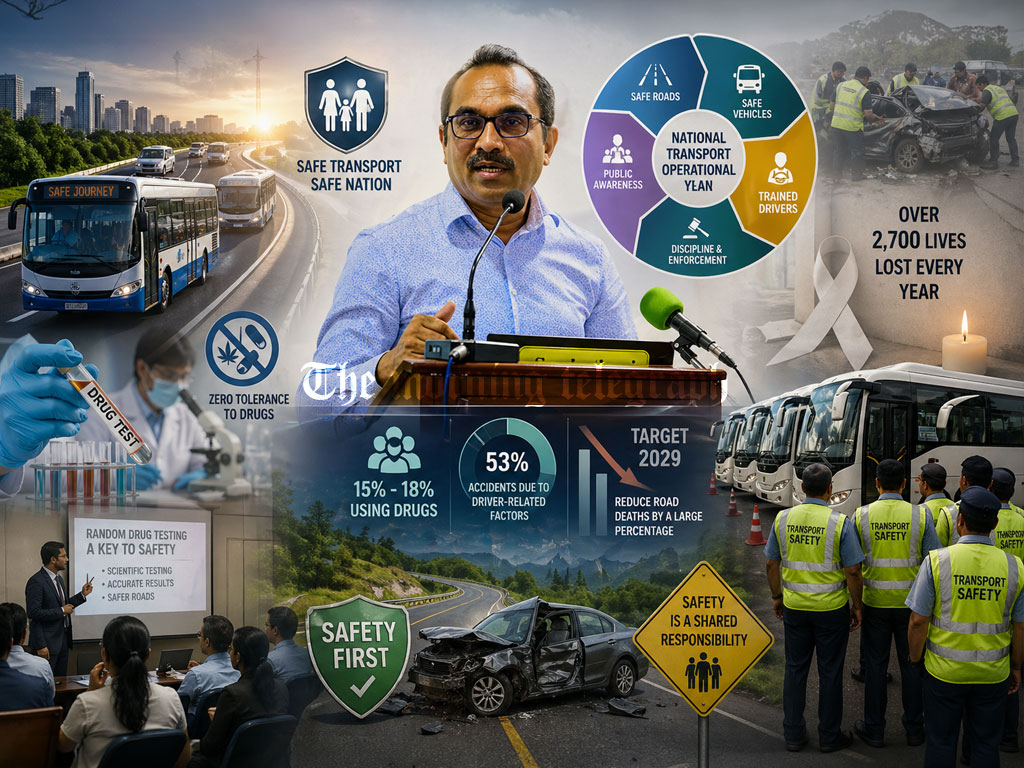
With over 2,700 lives lost annually on Sri Lankan roads, the government is rolling out aggressive safety reforms, drug testing measures, and national transport policies to curb fatalities and transform public transport safety.
Minister of Transport, Highways and Urban Development and Leader of the House Bimal Rathnayake stated that the current government, elected just eighteen months ago, has already implemented several sustainable transport programs aimed at improving public transport safety across Sri Lanka. He emphasized that further measures will be introduced in line with the National Transport Operational Plan to reduce road accident deaths and strengthen overall transport safety systems.

The Minister made these remarks while attending a one day special workshop organized by the National Institute of Transport Medicine under the Ministry of Transport. The program, held at the Sri Lanka Institute of Development Administration in Colombo 07, focused on the theme Principles and Practice of Random Drug Testing and aimed to educate institutional level officials on modern transport safety practices.
The workshop was designed to enhance knowledge and understanding of scientific methods used in drug testing through biological samples. It was conducted with the support of the Government Analyst’s Department and brought together a wide range of professionals, including doctors from the National Institute of Transport Medicine, laboratory technologists, Chief Judicial Medical Officers from hospitals under the Ministry of Health, and postgraduate trainees in judicial medicine.
Addressing the gathering, Minister Bimal Rathnayake stressed that ensuring transport safety requires more than infrastructure development. He noted that even with improved roads, modern vehicles, and upgraded systems, safety cannot be achieved without proper discipline, training, and enforcement. He pointed out that Sri Lanka continues to record over 2,700 road fatalities annually, and reducing this number significantly by 2029 remains a key national target.
He further revealed that current data indicates that between 15 percent and 18 percent of individuals are using drugs, while driver related factors contribute to nearly 53 percent of road accidents. According to the Minister, unsafe practices and lack of discipline continue to play a major role in accidents, highlighting the urgent need for stricter enforcement and behavioral change.
The government, he said, has moved beyond policy discussions and is now actively implementing reforms to improve transport safety. These include importing standardized buses and vehicles suitable for Sri Lankan conditions, ensuring manufacturing warranties, and introducing safety focused regulations to protect passengers and road users.
Minister Rathnayake emphasized that transport safety must be treated as a national responsibility and a collective social effort. He stated that the success of these reforms depends on coordinated action, awareness, and adherence to safety standards across all sectors of society.