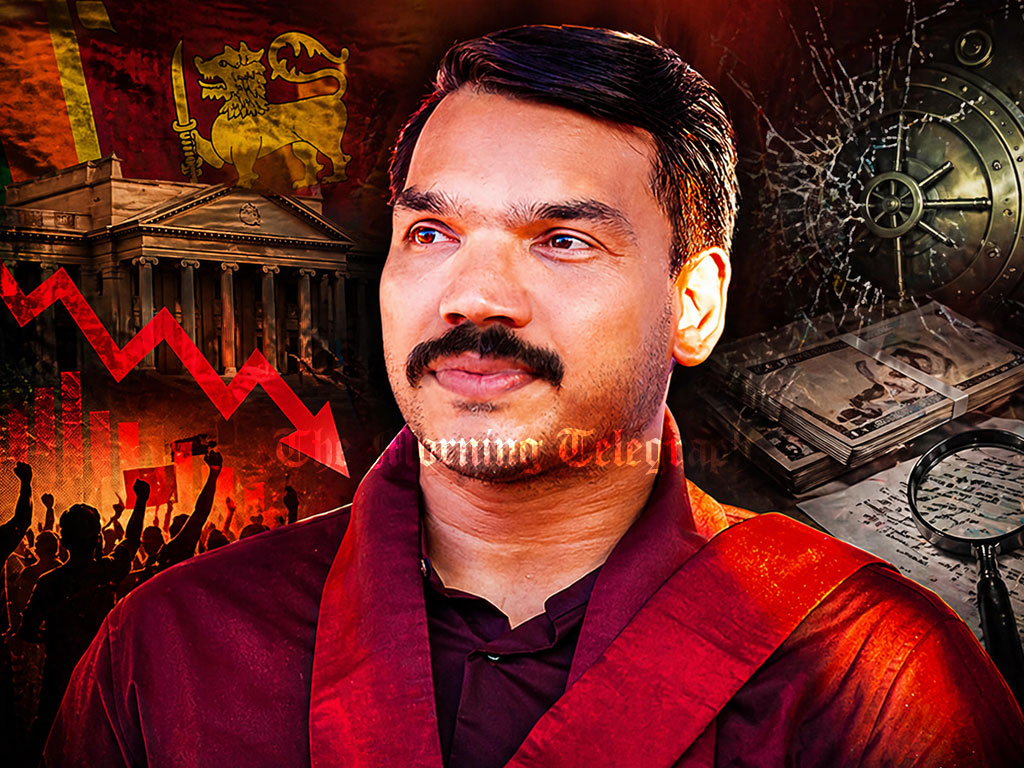
Sri Lanka treasury funds scandal deepened as fresh allegations of stolen funds, misdirected payments, and financial mismanagement triggered sharp criticism from opposition MP Namal Rajapaksa, raising urgent concerns about accountability, governance failures, and public trust.
Sri Lanka Podujana Peramuna National Organizer and Member of Parliament Namal Rajapaksa has launched a blistering attack on the government, accusing it of failing workers while presiding over a series of financial irregularities involving Treasury funds, Postal Department payments, and alleged duplicate contractor payouts.
Addressing the media at Nelum Mawatha, Rajapaksa said the current administration, which came to power through trade union support, has now turned against the very workers it once championed. He claimed trade unions have been suppressed and mistreated, describing the government’s conduct as historically unjust.

He announced that a commemorative event would be held to honor the late T.B. Ilangaratne, highlighting the party’s continued connection to worker rights. He also noted that religious observances would take precedence this year due to May Day coinciding with a Poya day, reflecting the country’s cultural priorities.
However, the focus quickly shifted to what Rajapaksa described as a pattern of financial misconduct. He alleged that billions had been mishandled without proper scrutiny, pointing to incidents where large sums were transferred without adequate oversight. He questioned how authorities failed to detect or prevent the misdirection of $2.5 million from the Treasury and $600,000 from the Postal Department.
Rajapaksa further claimed that contractors had been paid twice in some instances, raising serious questions about internal controls within state institutions. He contrasted this with the scrutiny faced by ordinary citizens, who are questioned over even minor financial transactions, arguing that such disparity exposes systemic weaknesses.
The MP emphasized that responsibility ultimately lies with the Minister of Finance, who is also the President, and the Secretary to the Ministry of Finance. He criticized the response from officials, stating that repeated claims of “not knowing” how funds were transferred were unacceptable given the scale of the transactions involved.
He also pointed out that the Treasury Secretary is a political appointee, arguing that such appointments must be held accountable for failures within their institutions. According to Rajapaksa, the current situation reflects not just administrative lapses but deeper issues in governance and oversight.
The remarks also touched on broader political conduct, with Rajapaksa accusing the government of hypocrisy and double standards. He alleged that those who once accused others of wrongdoing are now facing similar allegations, raising questions about credibility and integrity in public office.
Concerns were also raised regarding transparency in financial reporting and whether proper mechanisms were in place to prevent such incidents. Rajapaksa suggested that the lack of immediate accountability has eroded public confidence in the country’s financial institutions.
However, questions remain about how multiple high-value transactions could occur without detection and whether existing safeguards are sufficient to protect public funds. This raises concerns about systemic vulnerabilities and the effectiveness of oversight bodies.
What happens next could be critical as investigations continue and pressure mounts on authorities to provide clear answers. The unfolding situation is likely to test both institutional accountability and public trust in the government’s ability to manage the nation’s finances responsibly.