Treasury Secretary dual citizenship claim raises legal and political questions over Harshana Suriyapperuma, Article 91, and Treasury control.
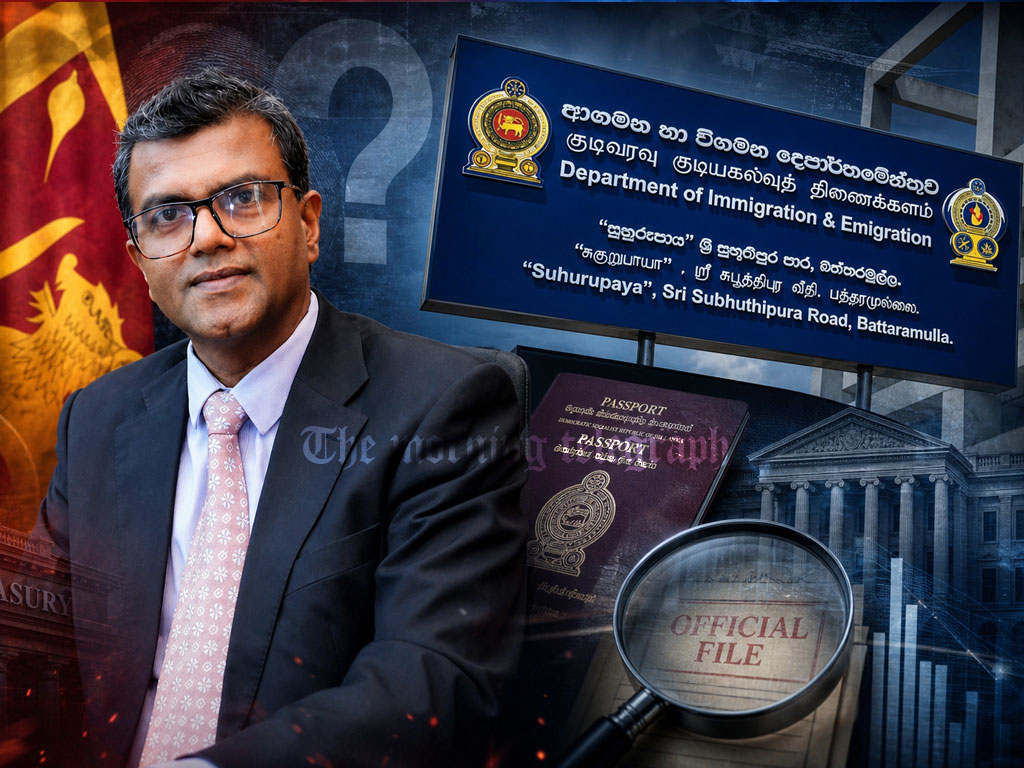
Treasury Secretary dual citizenship claims have triggered fresh political controversy after information said to be obtained from the Controller of Immigration and Emigration in Sri Lanka identified Dr. Harshana Suriyapperuma as a dual citizen.
According to the information cited, a dual citizenship certificate bearing the number C19090060828, dated 03/02/2010, had been issued to an Australian citizen named Harshana Pieris Suriyapperuma.
The revelation has now raised serious questions about whether Dr. Harshana Suriyapperuma should be allowed to continue holding one of the most powerful financial positions in the country.

The Secretary to the Treasury holds enormous responsibility over Sri Lanka’s public finances, fiscal management, state expenditure, and national economic direction.
That is why the alleged confirmation of dual citizenship has become politically explosive, especially at a time when the Treasury is already under intense scrutiny.
The central question now being raised is whether the President and the Government of Sri Lanka can continue to trust a person facing such allegations with control over the country’s Treasury.
Critics argue that if the dual citizenship claim is accurate, it raises questions about whether Suriyapperuma deceived the country before becoming Deputy Minister of Finance in 2025.
The controversy also brings Article 91 of the Constitution of Sri Lanka into focus.
The allegation being made is that Suriyapperuma’s appointment as Deputy Minister of Finance in 2025 may have violated Article 91, if he was legally disqualified due to dual citizenship.
This raises concerns about whether proper background checks were conducted before he entered Parliament, became Deputy Minister of Finance, and was later appointed Secretary to the Treasury.
However, questions remain over who knew about the alleged dual citizenship issue, when they knew it, and whether any authority ignored or failed to act on the matter.
The matter becomes even more serious because the Treasury Secretary is not an ordinary administrative position.
It is a key office that directly affects the country’s financial stability, debt management, public revenue, expenditure control, and dealings with international institutions.
If the allegation is proven, critics say the government must explain why such a person was brought into a position that controls the financial nerve centre of the state.
The issue also places pressure on the President and the Government of Sri Lanka to clarify whether they were aware of the dual citizenship certificate before Suriyapperuma was appointed to the Treasury.
If they were unaware, the question becomes how such a major matter escaped official attention.
If they were aware, the controversy becomes even more serious, because it raises concerns about whether the appointment was allowed despite possible constitutional and public trust implications.
The strongest allegation now being raised is whether the government was complicit in a cover-up or whether it condoned illegal conduct in order to bring Suriyapperuma in as Secretary to the Treasury.
Such a claim requires formal investigation, documentary verification, and a clear public response from the relevant authorities.
What happens next could be critical.
The government must now address whether the dual citizenship certificate is authentic, whether Article 91 applies in this case, and whether Suriyapperuma was legally qualified to serve as Deputy Minister of Finance and later as Secretary to the Treasury.
Until those questions are answered, the controversy will continue to cast a shadow over the Treasury, the Finance Ministry, and the credibility of the government’s appointments to the country’s most sensitive financial offices.