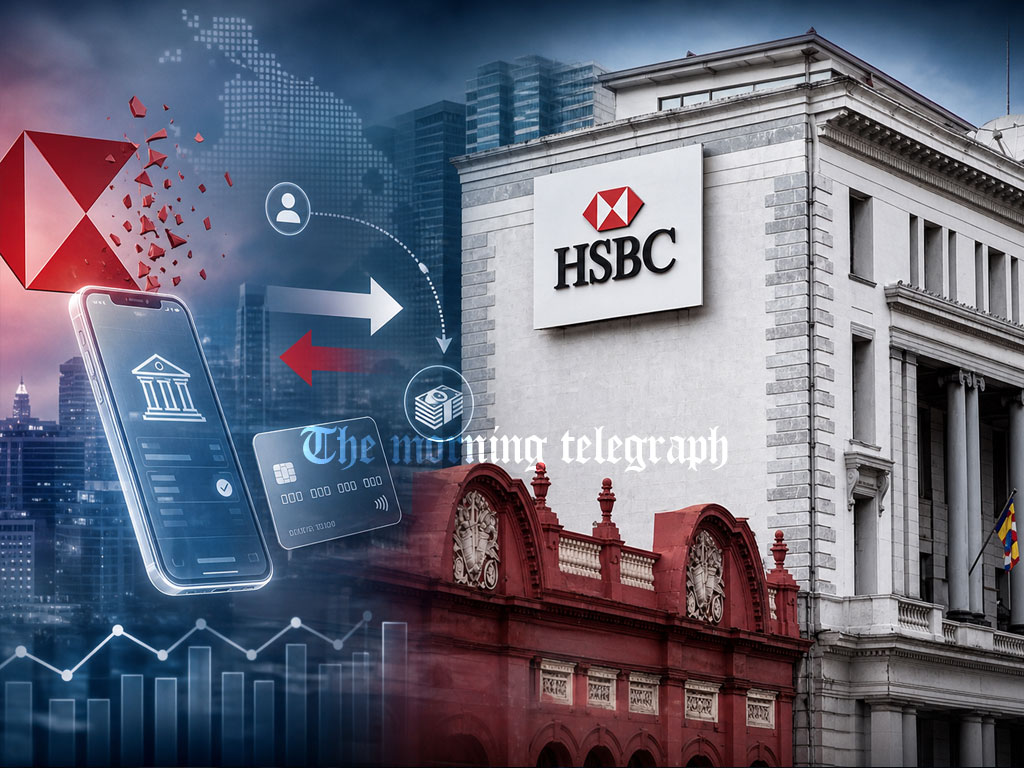
HSBC Sri Lanka retail banking ends after 130 years, with 200,000 accounts, credit cards and personal loans transferred to Nations Trust Bank.
What changes for HSBC customers now?
HSBC Sri Lanka has officially ended its retail banking operations, marking a major shift in the country’s banking sector after more than 130 years of service.
The decision took effect yesterday, April 30, following the completion of the transfer of HSBC’s local retail banking business to Nations Trust Bank.
The move comes after the Central Bank of Sri Lanka granted approval in December 2025 for the Hong Kong and Shanghai Banking Corporation, commonly known as HSBC, to transfer its retail banking operations in Sri Lanka to Nations Trust Bank.
HSBC Bank announced that the binding sale and purchase agreement signed between Nations Trust Bank and HSBC in September 2025 has now been completed.
Accordingly, from May 1, 2026, approximately 200,000 customer accounts will officially move to Nations Trust Bank.
These include HSBC’s premier banking customers, credit card holders and personal loan customers.
This raises concerns among many customers about how the transfer will affect their banking experience, access to accounts, credit facilities, card services and digital banking arrangements.
HSBC branches and express banking centres, including HSBC ATMs, were closed yesterday, April 30, at 3:00 pm.
HSBC stated that customers were able to use HSBC accounts, credit cards, debit cards, internet banking and mobile banking until 7:00 pm that evening.
After that time, all those online banking services became inactive.
The official HSBC Sri Lanka Facebook page was also scheduled to cease operation after April 30.
For customers, the most immediate change is that retail banking relationships previously handled by HSBC will now fall under Nations Trust Bank.
What happens next could be critical for account holders, especially premier banking customers and those with credit cards or personal loans, as they adjust to new systems, service channels and customer support arrangements.

HSBC Bank’s long history in Sri Lanka
According to information on the bank’s website, HSBC Bank has operated in Sri Lanka for more than 130 years.
The bank states that 27 years after establishing its first branch in Hong Kong and Shanghai, HSBC officially commenced banking operations in Sri Lanka on Friday, July 1, 1892.
In 1892, HSBC appointed Delmege Reid & Company, the predecessor of the present-day Delmege Forsyth & Company, as its representative agency for banking operations in Sri Lanka.
Two years later, in 1894, Sri Lanka’s economy suffered a severe setback when disease spread through coffee cultivation, then a popular crop across the island.
The crop was completely destroyed, and the crisis contributed to the closure of the Orient Bank, which had been operating in the country.
Against this backdrop, in the early 1920s, HSBC purchased land adjacent to the Madras Bank and began constructing its own bank building.
HSBC then established its first bank branch in the building located at No. 24, Sir Baron Jayathilaka Mawatha.
The bank’s history also records that during the “Chetti Crisis” that began in 1927, HSBC came forward to support the country’s business community.
During the Second World War, when the British Royal Air Force was stationed in certain parts of Sri Lanka, HSBC became a hub of activity.
The bank’s website states that during this period, and until 1956, the Government of Ceylon maintained a significant revenue account with HSBC.
That long history makes the end of HSBC’s retail banking operations a symbolic moment in Sri Lanka’s financial sector.
However, questions remain over how customers will view the transition from an international banking brand to a local banking institution.
HSBC’s contribution to Sri Lanka’s banking sector
HSBC is widely regarded as one of the banks that introduced major technological changes to Sri Lanka’s banking industry.
In 1986, HSBC introduced the first Automated Teller Machine, or ATM, to Sri Lanka.
The bank is also considered a pioneer in introducing computerised banking operations, a system that later became essential across the country’s banking sector.
Furthermore, in 1994, HSBC helped change consumer banking in Sri Lanka by issuing the country’s first credit card.
These developments helped transform how Sri Lankans accessed money, conducted transactions and used modern banking services.
The end of HSBC’s retail banking operations therefore marks more than a business transfer. It closes a chapter in the evolution of Sri Lanka’s modern banking landscape.
For Nations Trust Bank, the transfer brings a major new customer base and a significant opportunity to expand its retail banking presence.
For HSBC, the move signals a shift away from local retail banking while ending a public-facing chapter that shaped generations of banking customers.
What happens next could be critical as approximately 200,000 customers begin operating under Nations Trust Bank, while Sri Lanka’s banking sector adjusts to the departure of one of its most historically significant international retail banking brands.