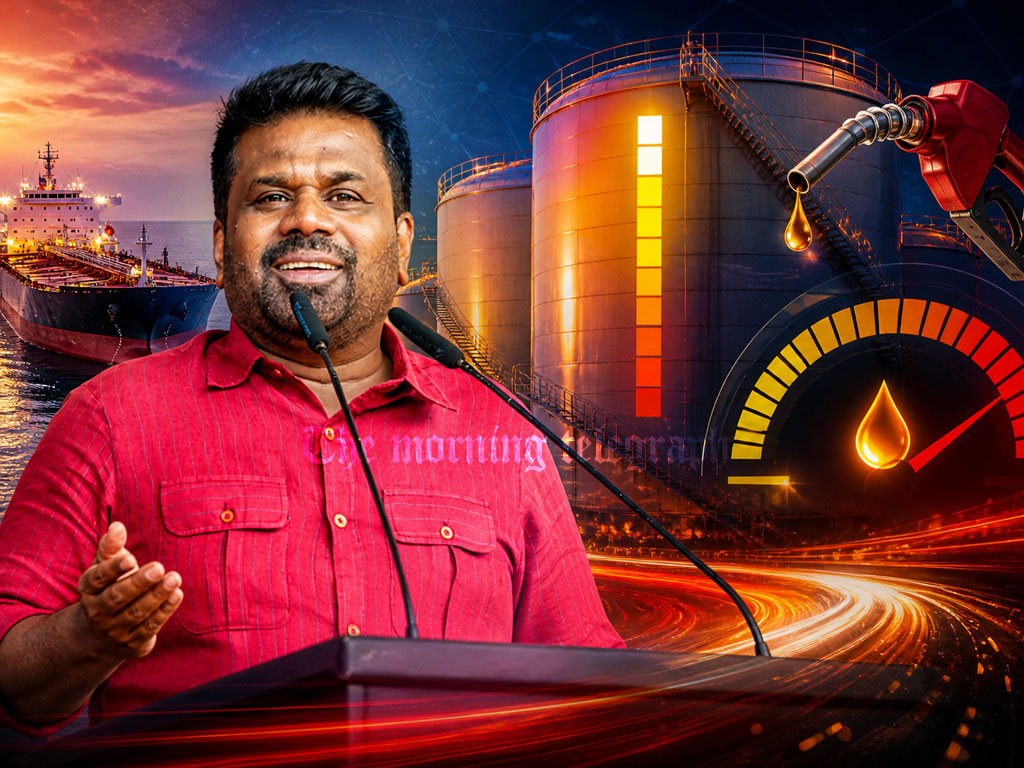
Fuel storage crisis emerges as President Anura says petrol ships are arriving, QR limits were raised, and price changes may follow.
Fuel storage crisis concerns have emerged after President Anura Kumara Dissanayake said petrol ships are arriving in Sri Lanka, but available storage capacity remains limited.
The President made the remarks while addressing the National People’s Power May Day rally held in Maharagama, where he explained the government’s position on fuel supply, distribution, and possible price movements.
President Anura Kumara Dissanayake said Sri Lanka is not an oil-producing country and does not own oil wells.

However, he stated that despite those limitations, the government has managed to maintain a continuous fuel supply without allowing the existing distribution network to collapse.
The President said the government’s priority has been to ensure that people can obtain fuel without facing the type of severe disruption experienced during past crises.
He explained that the petrol QR code limit had been increased in order to create storage space for incoming fuel shipments.
According to the President, petrol ships have already arrived in the country, and existing storage facilities are limited.
Because of that, fuel tanks need to be partially emptied before the next ship arrives.
This raises concerns about whether Sri Lanka’s fuel storage infrastructure is adequate to handle steady import arrivals, especially when the country depends heavily on imported petroleum products.
The President’s comments suggest that the increase in QR limits was not simply a consumer relief measure, but also part of a logistical response to storage pressure.
By allowing more petrol to move through the distribution network, authorities are attempting to make room inside storage tanks for upcoming shipments.
However, questions remain over whether this situation reflects a temporary coordination issue or a deeper weakness in fuel storage planning.
The President also addressed the issue of fuel prices.
He said the government had expected global market prices to fall, but that expectation had not materialized.
As a result, he noted that some change or fluctuation in fuel prices may occur in the future.
That warning is likely to draw attention from consumers, businesses, transport operators, and households already sensitive to fuel cost changes.
Fuel prices directly affect transport, food distribution, electricity generation, and the wider cost of living.
The President emphasized that, despite global price uncertainty and storage limitations, the government’s main focus remains supplying fuel to the public without difficulty.
He said the government would take the necessary steps to ensure continuous fuel supply in the face of any challenge.
What happens next could be critical as Sri Lanka attempts to balance incoming petrol shipments, limited storage space, global fuel price pressure, and public expectations for uninterrupted supply.
For now, the government is signaling that fuel will remain available, but possible price fluctuations and storage constraints may keep the issue at the center of public concern.