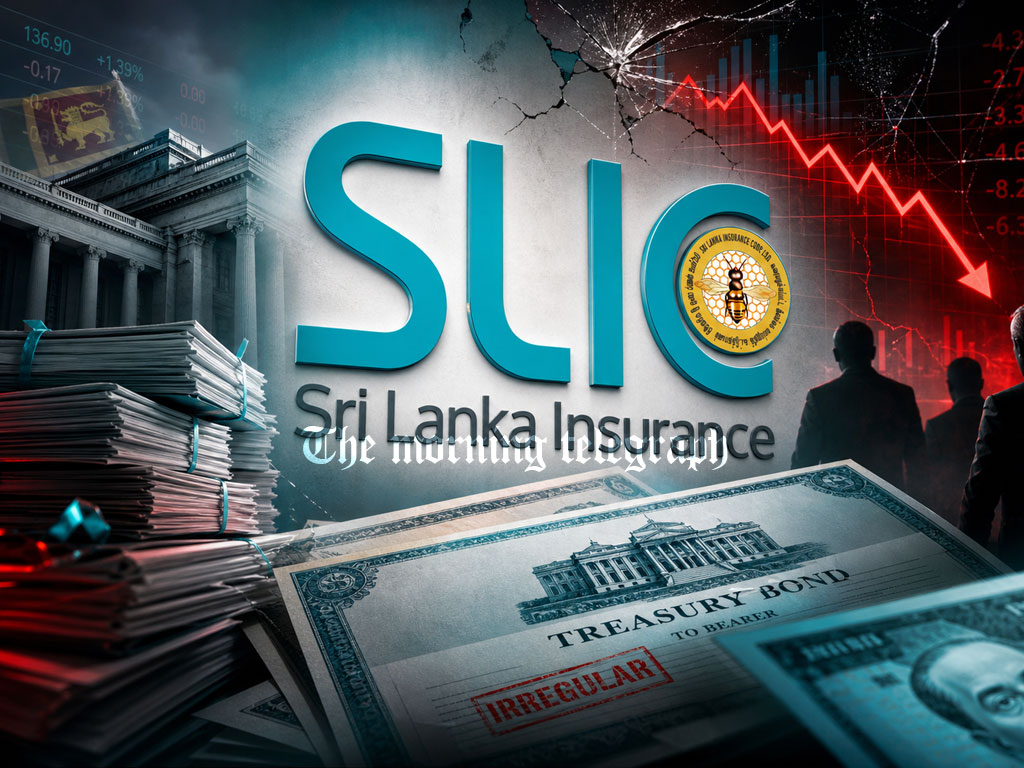
Sri Lanka Insurance bond scam allegations raise alarm over Rs.10B Treasury bond purchase, policyholder funds and Finance Ministry links.
Sri Lanka Insurance bond scam allegations have erupted after Niroshan Padukka claimed that policyholders’ funds were exposed to massive financial risk through a controversial Treasury bond purchase.
Addressing a media briefing, Padukka alleged that the Sri Lanka Insurance Corporation purchased Treasury bonds worth Rs. 10,000 million, or Rs. 10 billion, at an interest rate lower than the market rate and without official approval.
He described the transaction as a premeditated financial crime and warned that the decision could cause serious losses to one of the country’s most important state-linked financial institutions.

According to Padukka, the market interest rate at the time was at a higher level, ranging between 10.12 percent and 10.15 percent.
However, he claimed that the Insurance Corporation purchased the bonds at a much lower interest rate of 9.75 percent.
He further stated that the transaction involved the investment of Rs. 16,000 million of policyholders’ funds.
Padukka said the loss already incurred from this bond purchase exceeds Rs. 500 million.
He warned that if interest rates rise to 11.5 percent in the future, the total loss to the Insurance Corporation could exceed Rs. 2,000 million, or Rs. 2 billion.
This raises concerns about whether policyholders’ money was used with proper safeguards, professional oversight, and approval from the required internal bodies.
Padukka emphasized that President Anura Kumara Dissanayake and Secretary to the Ministry of Finance Harshana Suriyapperuma should be held directly responsible for the financial crisis.
He also alleged that the person behind the transaction was Somadasa Paliyawadana, a director of the Insurance Corporation.
According to Padukka, Paliyawadana’s role as managing director of Sherwood Capital, a private company dealing in government bonds, represents a serious conflict of interest.
The allegation has placed renewed attention on the relationship between public institutions, private market actors, and the handling of state-linked investment funds.
Padukka further claimed that Secretary to the Ministry of Finance Harshana Suriyapperuma appointed his associate, Paliyawadana, to the position within seven days of assuming office.
He also pointed out that Suriyapperuma had previously been investigated by the Securities and Exchange Commission for stock market manipulations.
Information revealed by Padukka suggests that the bond purchase was carried out without approval from the Insurance Corporation’s Investment Committee or the relevant subject ministers.
He alleged that the large-scale transaction was executed with the approval of only two officials, Nalin Subasinghe and Siyani Kulasinha.
However, questions remain over how a transaction involving billions of rupees in policyholders’ funds could proceed without broader institutional approval.
Padukka also claimed that many experienced senior officials of the Insurance Corporation are resigning due to what he described as arbitrary actions inside the institution.
Among those he named were Chief Executive Officer Chandana Aluthgama, Company Secretary Shiromi Kodagoda, Information Officer Ashoka Jayawardena, and Chief Business Officer Namali Silva, along with several other officials.
He further stated that the institution’s financial discipline is deteriorating.
According to him, individuals with only a few months of experience are being appointed to positions such as Company Secretary, which he said require approximately 18 years of experience.
Padukka also alleged that the current Chairman of the Insurance Corporation, Nusith Kumaratunga, who contested the Maharagama Municipal Council representing the Malima government, is among the inexperienced individuals damaging a once profitable institution worth billions.
The allegations come at a sensitive time, as the government is already facing criticism over financial governance, Treasury-related controversies, and questions surrounding appointments to key state institutions.
For policyholders, the central concern is whether their funds have been exposed to avoidable losses through poor judgment, weak oversight, or conflicts of interest.
For the government, the issue raises a larger political question: can public trust be maintained if major financial decisions are seen as being handled by politically connected individuals without full transparency?
What happens next could be critical.
Niroshan Padukka has urged the government to immediately halt what he called a financial crime before the Insurance Corporation becomes bankrupt.
He also called for an investigation through the Bribery Commission and the Criminal Investigation Department.
Until those investigations are carried out and the full details of the bond transaction are made public, the Sri Lanka Insurance bond scam allegations are likely to deepen pressure on the Finance Ministry, the Insurance Corporation, and the government’s broader promise of financial discipline.
SOURCE :- LANKACNEWS