
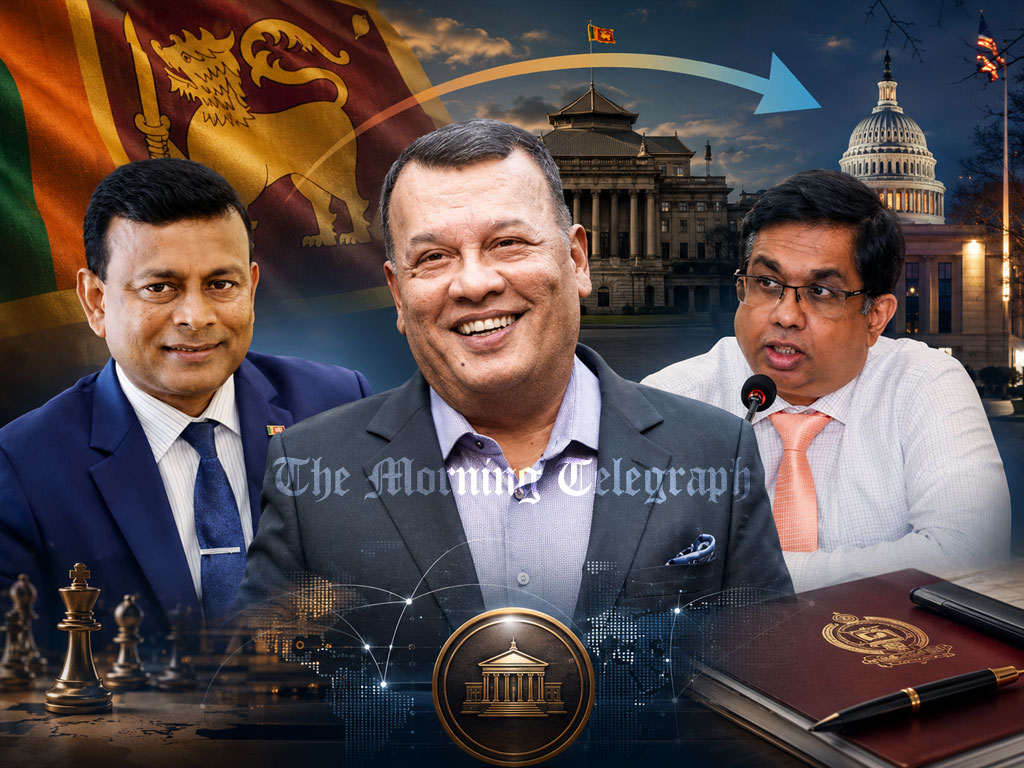
Sanath Kumarayake is tipped for US Ambassador as reports claim a Pelawatte loyalist may replace him as President’s Secretary.
Sanath Kumarayake is reportedly being considered for Sri Lanka’s US Ambassador post as fresh speculation grows over changes inside the President’s office.
The Daily Mirror newspaper reports that Mahinda Samarasinghe, who currently serves as Sri Lanka’s Ambassador to the United States of America, is expected to complete his term and return to the country in July.
Accordingly, reports indicate that Dr. Nandika Sanath Kumarayake, the current President’s Secretary, is highly likely to be appointed as the new Sri Lankan Ambassador in Washington.

Although the Ministry of Foreign Affairs and the Presidential Secretariat have not yet made a final decision regarding the appointment, reliable sources claim that Dr. Nandika has been informed to resign from the post of President’s Secretary.
This development reportedly follows a heated situation that recently arose at the Janatha Vimukthi Peramuna’s Pelawatte headquarters.
During that incident, a group of senior JVP members is said to have requested that a more suitable candidate be appointed to the position.
Dr. Nandika Sanath Kumarayake, who holds a PhD in Development Economics, is regarded as a highly qualified public officer.
He joined the government administrative service in 1997 as an Assistant Superintendent of Sri Lanka Customs.
He is also known to be a close associate of President Anura Kumara Dissanayake.
Following Dissanayake’s victory at the 2024 presidential election, Dr. Nandika was selected by the President to serve as President’s Secretary.
However, due to recent disputes within the JVP camp and unrest at the Pelawatte headquarters, the report states that a group has proposed appointing Prabath Chandrakirthi as the new President’s Secretary.
Chandrakirthi is described as an active supporter of the party.
He is a special grade officer of the Sri Lanka Administrative Service and was promoted last February.
He currently serves as Chief of Staff to President Dissanayake and has previously served as Commissioner General of Essential Services.
If the proposed appointments are made, Mahinda Samarasinghe will end his term and return to Sri Lanka in July.
Thereafter, Dr. Nandika is expected to leave for Washington as Sri Lanka’s Ambassador to the United States of America.
This possible diplomatic appointment comes at a critical time, as Sri Lanka continues discussions on developing trade relations with the United States.
If appointed, Dr. Nandika will have to engage with the Trump administration during a sensitive period for bilateral economic and diplomatic relations.
Meanwhile, political sources further state that Mahinda Samarasinghe, given his extensive experience in politics and foreign relations, is likely to play a key advisory role within the National People’s Power government after returning to the country in July.

This report should be read carefully, because at this stage it remains a reported political-bureaucratic reshuffle, not a formally confirmed appointment. Daily Mirror has reported that Dr. Nandika Sanath Kumanayake, the current President’s Secretary, is being considered for the Washington ambassadorial post, while Sri Lanka’s current Ambassador to the US, Mahinda Samarasinghe, is expected to return in July. The President’s Office still lists Dr. Kumanayake as Secretary to the President, so the official transition has not yet happened.
If this change takes place, its meaning goes beyond a normal diplomatic posting. The President’s Secretary is not just an administrative officer; he is the central coordinator between the President, Cabinet, ministries, public service, and policy implementation machinery. Therefore, replacing him so early would suggest either a planned strategic redeployment or an internal adjustment caused by pressure inside the governing political structure.
The deeper political issue is the balance between state administration and party control. If a highly qualified public officer is moved out because party headquarters wants a more politically trusted figure, that may strengthen internal party discipline in the short term. But it may also create a dangerous perception that the professional public service is being subordinated to party-centred command. For a government elected on clean governance and institutional reform, that perception can be politically costly.
The possible appointment to Washington also has strategic significance. The Sri Lankan Ambassador to the US will have to deal with trade access, investment confidence, IMF-related diplomatic coordination, diaspora relations, human rights concerns, and geopolitical balancing between the US, India, China, and regional interests. If Dr. Kumanayake is appointed, his development economics and administrative background may help in economic diplomacy. But Washington is not merely a technical posting; it requires political negotiation, strategic communication, and strong foreign-policy instincts.
The possible return of Mahinda Samarasinghe is also important. He is an experienced political and diplomatic actor. If he returns and becomes an adviser to the NPP government, it may signal that the government is quietly absorbing experience from the old political establishment while publicly maintaining an anti-establishment identity. That may be practical governance, but politically it creates a contradiction: can a movement built against “old politics” govern effectively without relying on selected figures from that same old system?
The futuristic consequences may be threefold. First, if the reshuffle improves coordination inside the President’s Office, the government may gain stronger command over administration. Second, if it is seen as a victory for party loyalists over professional administrators, it may weaken confidence among senior public officers. Third, if the Washington appointment succeeds, Sri Lanka could gain a technically capable economic diplomat at a sensitive time; but if it appears to be a face-saving transfer, it may feed the narrative of internal instability.
Therefore, the real question is not simply who becomes Ambassador or who becomes President’s Secretary. The real question is whether this government is building a professional state machinery, or whether it is gradually allowing party headquarters to become the invisible centre of administrative power. That distinction will shape not only the future of the Presidency, but also the credibility of the NPP’s entire governance promise.