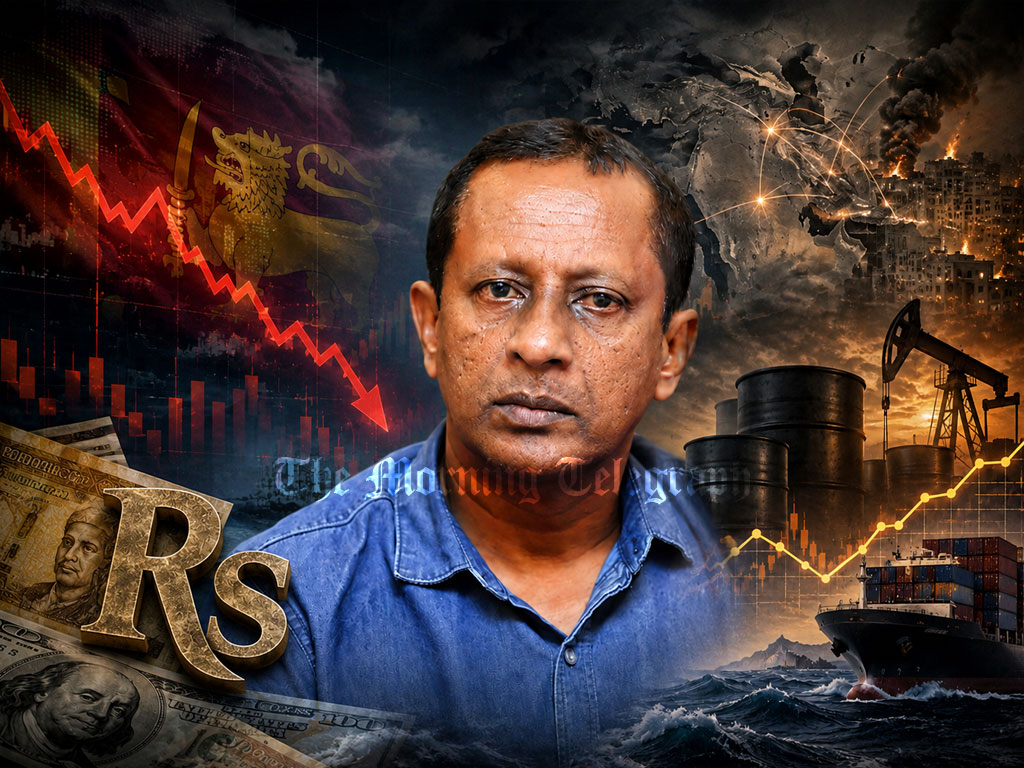
Middle East war disrupted Sri Lanka’s 7% growth target, Deputy Minister Nishantha Jayawera says, urging people to cut imports.
Middle East war disrupted Sri Lanka’s plan to raise economic growth to 7%, Deputy Minister Nishantha Jayawera told Parliament.
Deputy Minister of Economic Development Nishantha Jayawera said that, at this moment, he is requesting the public to think of the country, reduce import expenses, and support the government.
“We stabilised the economy much better in 2025. After that, in 2026, we hoped to take this stabilised economy to a broader level. That was our medium-term policy,” he said.

He stated that Sri Lanka achieved an economic growth rate of 5% in 2025.
Thereafter, he said the government had prepared plans to take that economic growth rate to around 7% in the medium term.
Jayawera said that, when looking at the first three months of 2026, all indicators had shown very positive results.
However, he said that at such a moment, unexpectedly, what he described as the Middle Eastern world war occurred.
He said this was a matter beyond Sri Lanka’s control.
According to the Deputy Minister, the Middle Eastern war created a major cost burden on Sri Lanka’s import expenditure, especially for fuel and energy.
He said shipping fees also increased, while the cost of all imports went up.
In addition, he pointed out that a large number of Letters of Credit had been opened for vehicle imports.
As a result, he said, a large amount of foreign exchange now has to be spent.
“As a country, we need to control this. What MP Harsha said is correct; establishing market stability is the main factor here,” he said.
Jayawera explained that imports increased suddenly, and expenditure connected to those imports also rose.
He said an opinion then emerged in society that imports could be banned in the future.
That created uncertainty and fear among the public, he said.
As a result, a large number of people began opening Letters of Credit to import more goods and vehicles.
At the same time, a large amount of money began to be spent on fuel costs.
Amid this situation, demand for dollars increased rapidly compared with supply.
According to Jayawera, this caused the rupee to temporarily depreciate to some extent.
He said that whatever the scale of such a situation, there is a limit to the purchasing power of the people.
People do not have the ability to spend beyond that purchasing power, he added.
Therefore, he said, this situation may naturally come under control to some extent in the future.
However, Jayawera emphasized that relying on natural control alone is not a successful outcome.
He said action must be taken.
The Central Bank of Sri Lanka is already taking several measures, he said.
As a government, Jayawera said, relevant policy decisions are also being taken to manage the situation.
He further stated that the public can also exercise self-control at this moment.
According to him, the public has the ability to temporarily limit imports by thinking of the country and its future.
“We request the public to reduce their expenditure on imports temporarily and provide their support for this,” he said.
Nishantha Jayawera made these remarks while addressing Parliament.