Sri Lanka’s main international airport, Bandaranaike International Airport in Katunayake, will not receive a second runway until at least 2055, raising fresh questions over whether the country is planning properly for future aviation growth or merely postponing a major infrastructure decision.
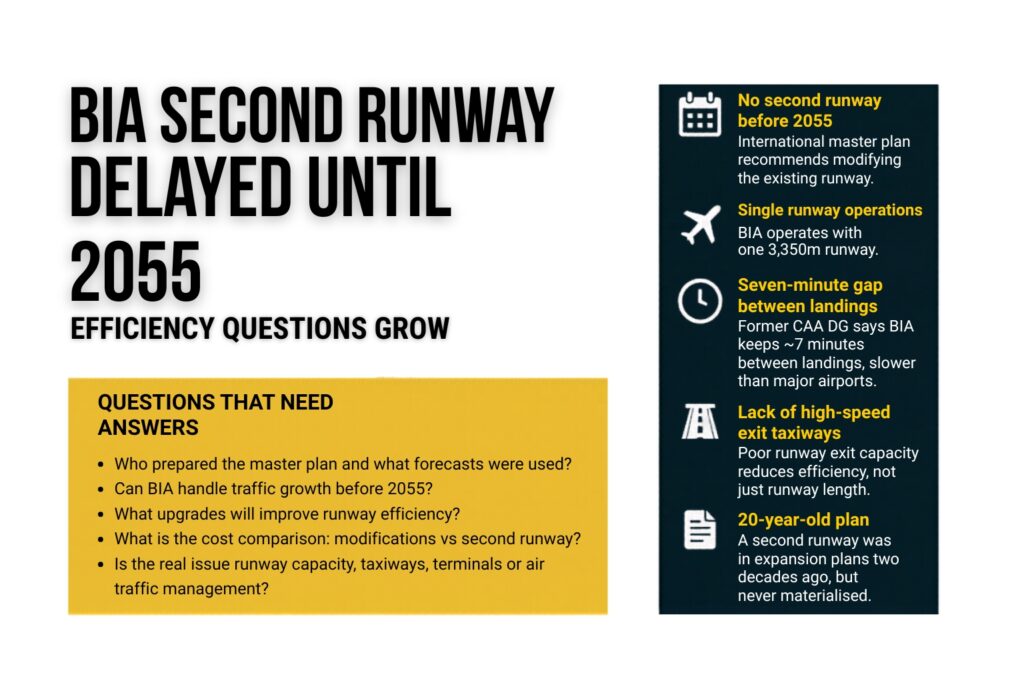
Deputy Minister of Ports and Civil Aviation Janitha Ruwan Kodithuwakku has said an international master plan found that BIA does not require a second runway before 2055. According to the Deputy Minister, the recommendation was to modify the existing runway rather than proceed with a second runway at this stage.
However, one important question remains unanswered:
Who prepared this international master plan, what traffic forecasts were used, and why has the full report not been placed before the public?
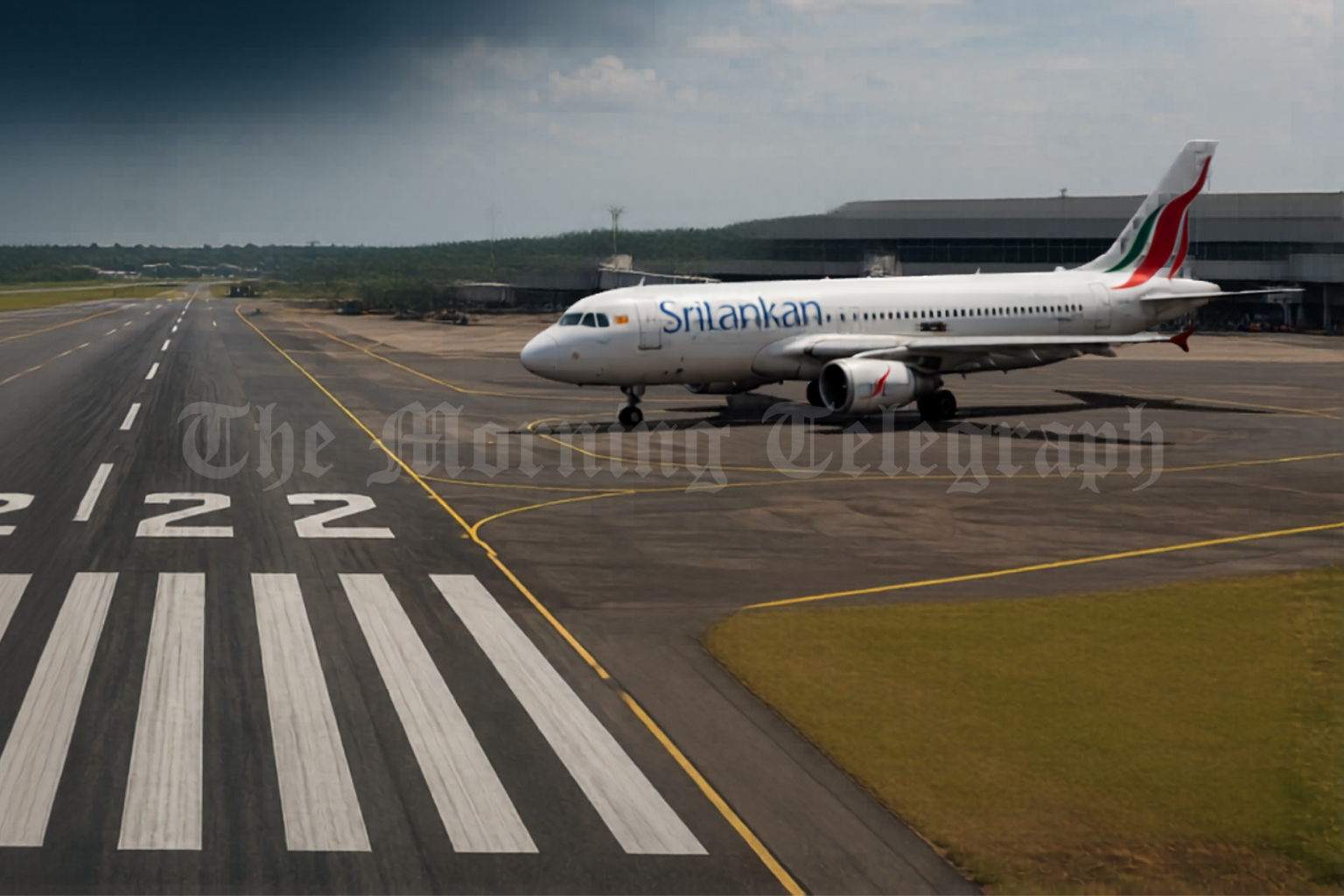
BIA currently operates with a single runway measuring 3,350 metres. That runway carries the burden of Sri Lanka’s main international passenger traffic, cargo operations, and emergency aviation requirements. This makes BIA heavily dependent on one strip of critical infrastructure.
Former Civil Aviation Authority Director General Themiya Abeywickrama has argued that the real problem may not simply be the absence of a second runway, but the poor efficiency of the existing runway system. He has pointed to the lack of high-speed exit taxiways as a major reason why aircraft cannot clear the runway quickly after landing.
This raises another serious question: if BIA can improve capacity through better taxiway design and faster runway clearance, why were these improvements not prioritised years ago?
According to Abeywickrama, BIA maintains around seven-minute separation between landing aircraft, while major airports with better systems can clear aircraft much faster. If that is correct, the issue is not only concrete, land, or runway length, but air traffic management, taxiway design, and operational confidence.

The government must therefore explain whether BIA’s future capacity problem is a runway problem, a taxiway problem, a terminal problem, or a management problem.
A second runway had been part of BIA expansion discussions for nearly two decades, but it never materialised. The latest 2055 timeline now pushes the idea further into the future, even as Sri Lanka speaks repeatedly about expanding tourism, attracting more airlines, and becoming a stronger regional aviation hub.
That creates another key question:
If tourism arrivals exceed expectations before 2055, will BIA still be able to cope with increased aircraft movements?
There are also safety and resilience concerns. With only one operational runway, any emergency, aircraft incident, maintenance closure, or technical problem can disrupt the country’s main international gateway. A second runway is not only about handling more flights; it is also about giving the airport backup capacity.
At the same time, building a second runway is expensive, complex, and likely to involve land, environmental, and financial challenges. If the current runway can be made more efficient through high-speed exit taxiways and better air traffic procedures, that may be a cheaper and faster solution.
But the public deserves clear answers before accepting 2055 as a reasonable deadline.
The government should disclose the master plan, explain the projected passenger and aircraft movement numbers, reveal the cost comparison between runway modification and a second runway, and state exactly what upgrades will be carried out on the existing runway.
Until those answers are given, the BIA runway issue will remain more than an aviation planning matter. It will remain a test of whether Sri Lanka is making long-term infrastructure decisions based on evidence, transparency, and national interest.