The Government’s latest announcement that Sri Lanka will introduce energy storage systems to maximise renewable energy use has been welcomed as a necessary step towards a cleaner energy future. However, the announcement has also raised important questions about transparency, procurement, financing, and whether the country’s power infrastructure is genuinely prepared to support the ambitious transition.
Speaking in Parliament, Prime Minister Harini Amarasuriya said the Government’s plans were linked to Sri Lanka’s target of generating 70 percent of its electricity from renewable sources by 2030. According to the Government, battery energy storage systems will help absorb excess solar and wind generation, store it, and release it when demand increases, reducing the amount of renewable energy currently wasted due to grid limitations.
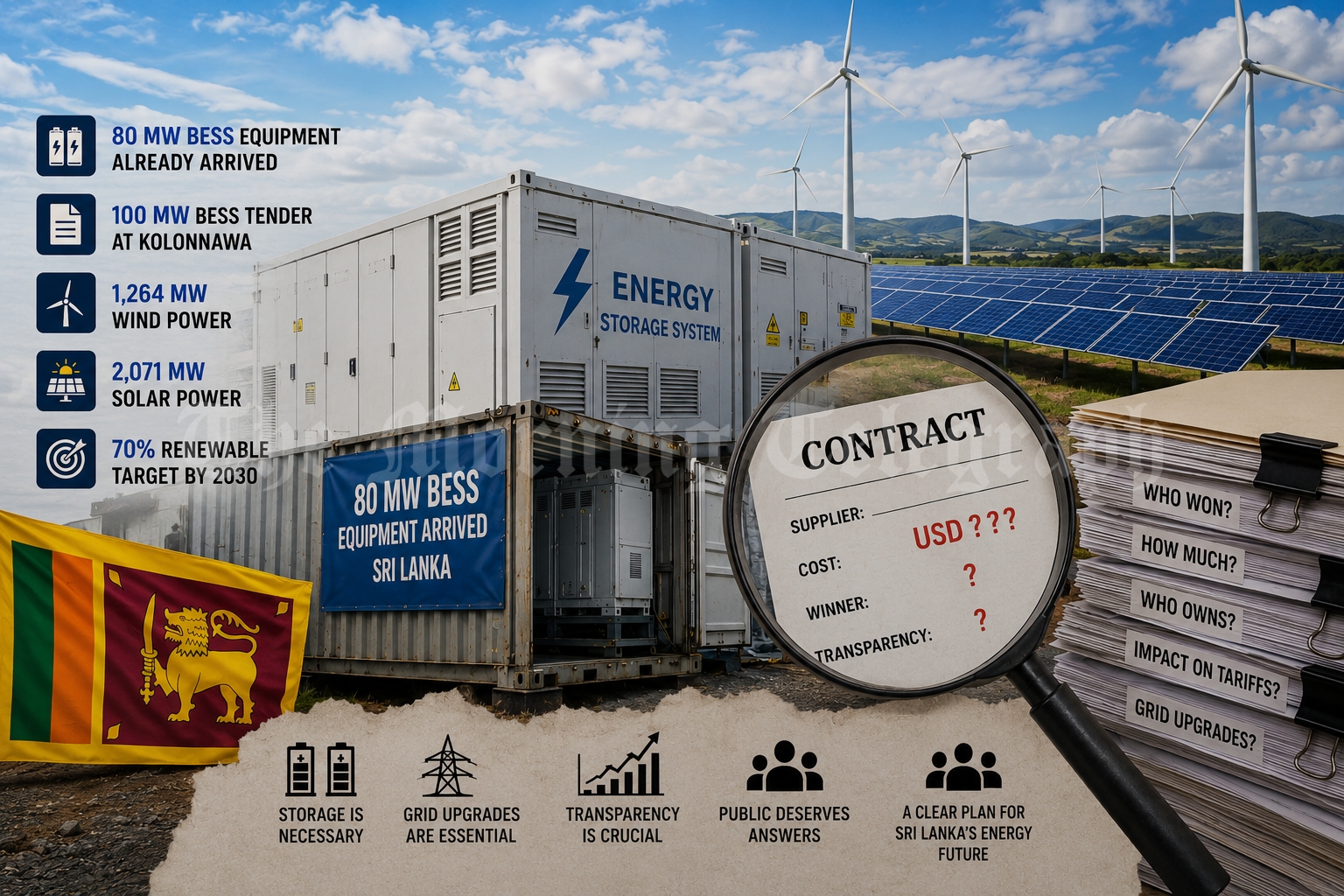
The renewable expansion programme itself is substantial. Official figures indicate plans for approximately 1,264 megawatts of additional wind power and 2,071 megawatts of solar power generation over the coming years. Authorities also point to the arrival of equipment for an 80 MW Battery Energy Storage System and say further projects are in the pipeline, including a proposed 100 MW facility at Kolonnawa and additional projects of 250 MW and 50 MW that remain under evaluation.
While few energy experts dispute the need for storage technology, questions are emerging over how these projects are being presented to the public. One of the most obvious concerns is timing. Reports earlier this year indicated that battery storage equipment had already arrived in Sri Lanka. If significant components have already been delivered, critics ask why the Government is now announcing that energy storage systems “will be introduced.” The discrepancy raises questions over whether this is a genuinely new policy initiative, a continuation of projects approved by previous administrations, or an attempt to claim political ownership of developments already underway.

Procurement is another area attracting scrutiny. The proposed 100 MW Battery Energy Storage System at Kolonnawa has reportedly been linked to an international tender process supported by development financing. Yet little public information has been released regarding bidders, pricing structures, evaluation criteria, or the eventual contract award. Given the substantial financial commitments involved, energy sector observers argue that full disclosure is essential to ensure public confidence and prevent future controversy.
The financial dimension presents another challenge. Independent assessments have previously estimated that Sri Lanka may require investments running into billions of dollars if it is to achieve its 70 percent renewable energy target by 2030. While battery storage systems form an important component of that transition, questions remain regarding the source of financing, the debt implications, and whether future electricity consumers will ultimately bear the cost through higher tariffs.
Industry specialists also caution that batteries alone cannot solve Sri Lanka’s renewable energy challenges. Storage systems are only one component of a much larger network that must function together. Without major upgrades to transmission infrastructure, improved grid management, enhanced forecasting systems, and greater network flexibility, additional solar and wind generation may still face curtailment. In practical terms, renewable energy can only contribute to national supply if the grid is capable of accepting and distributing it efficiently.
Grid stability remains a particular concern. As renewable generation increases, maintaining a stable balance between supply and demand becomes increasingly complex. Experts have repeatedly warned that storage investments must be accompanied by parallel investments in transmission capacity and system control technologies. Otherwise, the country risks investing heavily in renewable generation assets that cannot be fully utilised.
The ownership structure of future storage projects also remains unclear. Questions have yet to be answered regarding whether the facilities will be owned directly by the State, operated through public-private partnerships, or controlled by private developers under long-term contractual arrangements. The answers could have significant implications for electricity pricing, future energy policy, and public accountability.
None of these concerns diminish the importance of energy storage itself. On the contrary, most energy analysts agree that battery storage will be essential if Sri Lanka hopes to integrate large volumes of solar and wind power into its national energy mix. The issue is not whether storage is needed, but whether the projects are being implemented through a transparent, financially sustainable, and technically coherent national strategy.
As Sri Lanka accelerates its renewable energy ambitions, the public deserves clear answers. Who will supply the systems? Who will own them? What will they cost? How will they be financed? What impact will they have on electricity tariffs? And most importantly, are they part of a fully disclosed long-term plan to modernise the national grid?
Until those questions are answered, the Government’s energy storage push is likely to remain as much a matter of public scrutiny as it is a symbol of Sri Lanka’s renewable energy future.
SriLanka #RenewableEnergy #EnergyStorage #BatteryStorage #SolarEnergy #WindEnergy #EnergyPolicy #NationalGrid #Transparency #GovernmentContracts #PublicAccountability #SriLankaNews