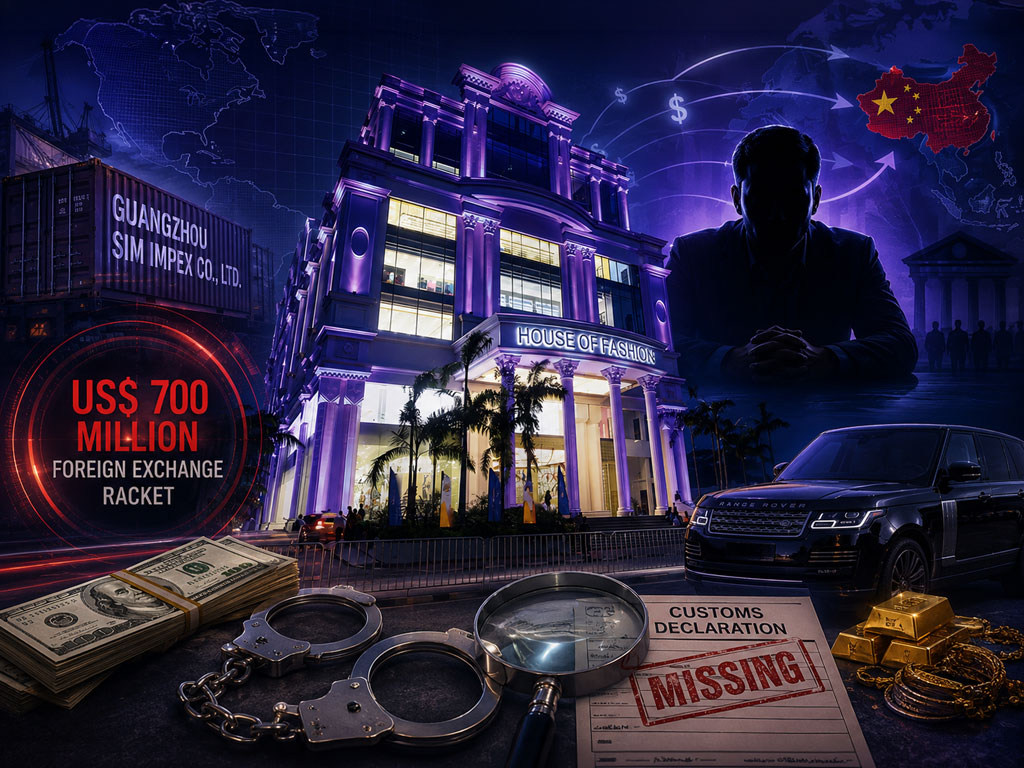
Sri Lanka foreign exchange racket investigators are probing alleged China-linked transfers, missing imports and thousands of suspicious transactions.
The Sri Lanka foreign exchange racket investigation has widened as the CID examines alleged links between local companies, overseas suppliers and thousands of remittances unsupported by Customs records.
The case concerns more than US$700 million, or nearly Rs.190 billion, allegedly transferred abroad under the guise of paying for imported goods.
The Criminal Investigation Department told Colombo Chief Magistrate Asanga S. Bodaragama that 21 major Sri Lankan companies were connected to transactions under investigation, according to the supplied court report.
A suspect identified as Jeffrey Mohamed has been arrested over an alleged scheme involving the transfer of nearly Rs.190 billion overseas.
However, the companies and individuals named in the investigation remain entitled to the presumption of innocence. The allegations require proof through admissible evidence and court proceedings.

Sri Lanka Foreign Exchange Racket Examines China Link
The CID’s Financial Crimes Division has reportedly identified six principal companies during the initial stage of the inquiry.
The supplied report names clothing retailer House of Fashion among the businesses under investigation. It alleges that documents relating to goods purportedly imported for the retailer involved China-based Guangzhou Sim Impex Co. Ltd.
Investigators are examining 10,156 foreign remittances allegedly sent to overseas companies. According to the report, Customs records do not show corresponding goods entering Sri Lanka for those payments.
The inquiry also covers suspected under-invoicing. Investigators believe some importers may have declared goods below their actual value, potentially depriving the government of substantial Customs duties and tax revenue.
These allegations have not yet produced final judicial findings against every company named in the investigation.
A.Y. Investment Operator Held Over Alleged Transfers
Investigators identify Jeffrey Mohamed as a central facilitator in the alleged operation.
The prosecution claims he represented himself as a director of A.Y. Investment, an entity operating in the Colombo Fort area. Reports also state that he maintained several bank accounts connected to the inquiry.
The CID reportedly seized a quantity of US dollar notes worth millions of rupees when officers arrested him.
Investigators also took custody of a luxury vehicle reportedly valued at more than Rs.200 million. They further seized a quantity of gold allegedly found in his possession.
The prosecution must still establish that those assets came from unlawful transactions.
Defence Seeks Bail as CID Warns of Evidence Risk
President’s Counsel M.A. Suweer and Attorney Asanka Perera appeared for Mohamed when the case came before the court.
The defence maintained that its client had imported goods in accordance with the required procedures. It requested his release under suitable bail conditions.
However, the CID opposed the application.
Investigators alleged that Mohamed had not disclosed information about other companies and businesspeople suspected of involvement. They argued that releasing him could create a serious risk of interference with witnesses or destruction of evidence.
The defence allegations and prosecution claims remain matters for judicial determination.
Magistrate Extends Remand Until August 6
Chief Magistrate Asanga S. Bodaragama rejected the bail request after considering the submissions from both sides.
According to the supplied report, the Magistrate found that the suspect’s alleged attempts to conceal evidence and avoid the court raised concerns about future cooperation with investigators.
The court therefore ordered Mohamed to remain in remand custody until August 6.
The CID’s Financial Crimes Division is now investigating the remaining 15 companies and business figures allegedly connected to the network.
Investigators are examining whether entities such as Guangzhou Sim Impex received foreign currency for imports that never arrived in Sri Lanka.
They are also probing whether underground banking, false documentation and Customs under-invoicing contributed to capital outflows and lost government revenue.
The final scale of the Sri Lanka foreign exchange racket may exceed the amount currently identified. However, investigators must trace each transfer, establish who controlled the relevant accounts and prove whether the transactions breached criminal, foreign-exchange or Customs laws.