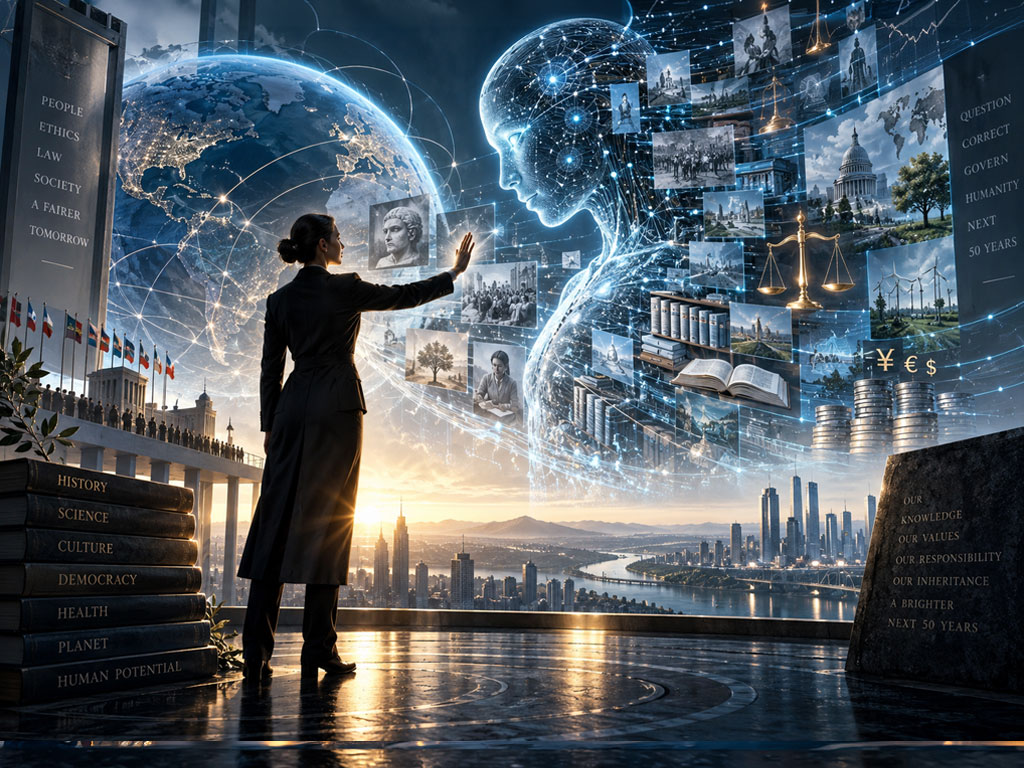
An Observation on Artificial Intelligence, Inheritance, and the Next Fifty Years
By Roshan Jayasinghe
I follow Yuval Noah Harari’s channel, so his talks often reach me on my phone in the middle of an ordinary evening while I am doing something else. One of his recent discussions about artificial intelligence and the next fifty years held me longer than I expected. Harari was looking ahead at what this new intelligence could become and what its growing power could mean for human beings. What stayed with me, however, took my thoughts in a slightly different direction. Instead of only asking what artificial intelligence may eventually do to us, I found myself asking what we, while we still have the opportunity, should consciously do with it.
Part of what brought me there was his discussion of how much of the world we live within was created through human communication and collective agreement. Money has value because we agree that it has value. Laws have authority because we created systems to recognize and enforce them. Countries have borders because human beings drew them and generations that followed inherited them. Governments, economies, corporations and institutions can feel permanent because they were already here when we arrived, but they are human constructions, built over generations and changed many times along the way.

I have written about those constructions throughout these pages, through justice, education, economics and the structures we inherit without ever being asked whether we would have designed them the same way ourselves. Artificial intelligence presents us with something different. We are not arriving generations later and discovering what it became. We are here while it is being built. That means our responsibility is not simply to predict its future or protect ourselves from it. We have an opportunity to shape what it serves, use its extraordinary ability to connect human knowledge to examine and correct some of the constructions we already live within, and at the same time keep AI itself open to questioning and correction as our understanding develops.
That last part is important to me. We do not know today everything that human beings fifty years from now will know, just as those who created many of the systems we inherited could not know everything we know now. I would not want us to build artificial intelligence around the assumption that our present understanding is final. I would rather see us build something capable of becoming more useful as human knowledge grows, while preserving the human ability to question its direction, correct its mistakes and decide what purposes its efficiency should serve. Efficiency can tell us how well something works. Human beings must still decide what is worth working toward.
Fifty years from now, another generation may inherit artificial intelligence as an ordinary part of life, just as we inherited money, governments, laws and borders. The difference is that we are fortunate enough to be here at the beginning. We can learn from what happened to the constructions that came before, use this new intelligence to understand them better, and avoid making the mistake of turning our newest construction into another one that future generations are simply expected to obey.
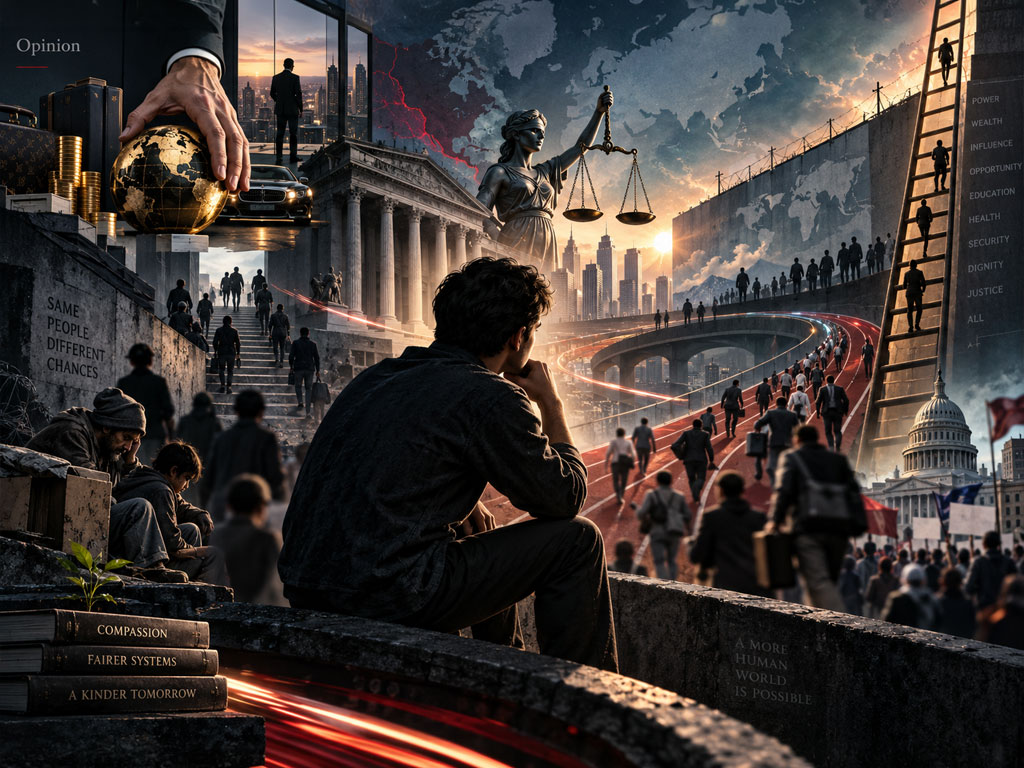
Enjoy the Human in the Rat Race.
Roshan Jayasinghe reflects on justice, human constructions, ambition, power and how not to lose the human being inside the race.
The Morning Telegraph • September 5, 2026 • 12 min readThis construction is being built while we are awake.
Words do not appear from nowhere. Behind them are thoughts, and behind many of our thoughts are feelings and the experiences that produced them. Fear makes us seek security. The need to belong draws people together and can just as easily set one group against another. Ambition pushes us toward achievement, competition has produced extraordinary invention along with consequences we did not intend, and love makes one generation give up things it will never get back so that the next generation might have more. The civilization surrounding us was not assembled through logic alone. It grew out of the complicated human mixture of thought, feeling, need and circumstance. If we want to understand what humanity has built, we cannot stop at the structures and the words. We also have to understand what was moving inside the human beings who gave those words their direction.
This is where artificial intelligence becomes genuinely interesting to me. What we are building is learning from an enormous record of what humanity has communicated. Our science, history, literature, laws, philosophies, arguments and beliefs have all become material it can process and connect. But that record holds far more than wisdom. It also holds fear, prejudice, propaganda, conflict and a long inventory of ideas that were accepted as truth until later generations proved them wrong. Artificial intelligence is therefore not developing apart from us. Much of what it understands about human beings comes from what human beings have left behind, which means we have been writing its inheritance for centuries without knowing that anything would ever read it. We are the authors of that record. That is not a small thing to be responsible for.
I have used the two sides of a coin, the roots beneath a tree and the spokes running out from the hub of a wheel to remind myself that whatever is immediately visible is rarely the whole picture, and there is no reason to walk through those arguments again here. What has changed is that we now possess an instrument capable of examining connections across our accumulated knowledge at a scale no individual mind could hold. That changes what becomes possible when we look at the constructions we inherited.
Humanity has gathered extraordinary knowledge, but we have always struggled to see the entire picture at once. Economists understand one region of it, doctors another, educators another, lawyers and scientists and historians each hold their own. Governments divide responsibility into departments, universities divide knowledge into disciplines, and businesses divide themselves into functions because human beings need manageable pieces in order to work at all. Life is not divided that way. A decision made about housing arrives years later in a classroom. A policy written to improve one measurement produces an effect somewhere no one was measuring. A war ends and continues moving through families long after the last agreement is signed. Everything touches something else, and the instrument we are now building may allow us to see more of what touches what.
That does not mean handing over the decision about how human beings should live. It means being able to see more of the consequences before we decide. The two sides of the coin can be examined with better information, the roots beneath a visible problem can be traced further down, and what were once useful analogies for looking past the obvious can now be supported by a capacity to connect knowledge on a scale we have never possessed. I find real hope in that because so much of the damage I have watched human beings do to one another has come from acting on one part of a situation without seeing what else that action touched.
I want to be plain about where the authority sits at this moment, because the language already circulating around this technology can make it sound as though the authority sits somewhere else. We are told what artificial intelligence will do to work, what it will mean for our children and what it will require of us, as though it were weather arriving on a schedule none of us set.
It is not weather.
These systems are being developed by human beings, trained on material human beings have accumulated, shaped toward purposes human beings decide upon and introduced into societies under conditions human beings establish. Whatever artificial intelligence becomes over the next fifty years will not be separate from the decisions being made about it now. Those decisions can be questioned, and decisions that can be questioned can also be changed. I find that steadying rather than frightening. The first correction available to us is to stop describing our own choices as though they were simply happening to us.
There is something else we should understand clearly. The same intelligence capable of connecting knowledge is capable of influencing human feeling, and feeling is where many of our constructions began. Words have always carried that power. Fear spreads through communication and so does hope. Division can be created just as understanding can. What is different now is the speed, reach and growing precision with which technology can understand and influence human behavior. That carries enormous power. It should neither be ignored because the technology is useful nor used as a reason to reject the technology altogether. It should be understood and consciously directed. That responsibility belongs to those of us living through its development, not only to the generations who will inherit its consequences.
For all our advancement, the human being has not stopped wanting what we have always wanted. We want security, belonging, dignity, some control over our own lives and better opportunities for our children. Alongside those we carry fear, jealousy, greed and the appetite for power over others. Technology does not remove any of that. It extends the reach of what we choose to do with it. The question in front of the next fifty years is therefore not simply how intelligent AI becomes. It is whether we remain conscious enough to decide what we are asking that intelligence to serve.
We are standing at the beginning of this construction while holding the recorded consequences of many that came before it. Some of what humanity built served us extraordinarily well and deserves to be carried forward with gratitude. Some produced consequences their creators could not have foreseen. Others gradually came to protect themselves or serve those who controlled them more effectively than the human beings they were originally intended to serve. Their importance to this discussion is that we have evidence, and it is not abstract evidence. A decision about education can affect a person’s opportunities for the rest of their life. A decision about housing can affect where a family lives, where their children go to school and what opportunities reach them. A decision about punishment can continue affecting a person long after the punishment itself has ended. We can now see how decisions made in one part of society continue producing consequences somewhere else.
Human constructions can achieve extraordinary things, and they can also outgrow, distort or lose sight of the purpose they were built for. Artificial intelligence gives us an opportunity not only to examine individual decisions, but to connect more of their consequences. We can look across an enormous record of human experience and ask what worked, what failed, who benefited, who carried the consequences and what happened when institutions became difficult to question or correct. Used in that way, AI does not replace human judgment. It gives human judgment access to more of the picture.
That is the work I would like to see us do while this construction is still young: sort the inheritance honestly, carry forward what served people well, examine what did not and remain willing to correct what the evidence tells us needs correcting. Artificial intelligence may be particularly useful in showing how a decision made in one place produced consequences somewhere else entirely. Its greatest contribution may not be giving humanity all the answers. It may be helping us see enough of the whole to ask better questions before we decide.
If I were asked what we should protect above everything else, I would begin with the ability to question and correct. We should know who is making the important decisions behind these systems and what they are trying to achieve. Those decisions should be understandable enough for ordinary people to examine and argue with. The knowledge and assumptions shaping these systems should remain open to examination, and no generation should inherit them with the instruction that they are finished and beyond correction.
The same principle must apply to what we believe today. We should not replace old fixed constructions with a new one carrying our present assumptions permanently into the future. What seems correct to us now may be incomplete when seen through knowledge gained twenty or fifty years from now. Artificial intelligence should therefore be built not only to become more capable, but to remain open to correction as human understanding develops. Human correction should not be treated as interference with the system. It should be part of how the system continues to serve human beings.
These are not brakes on progress. They are what allow progress to remain progress.
I do not see this as a contest between human beings and what we are building. I see another human construction being born, except that this time we are present at its beginning with access to an extraordinary record of what happened to many of the constructions that came before. We know that something created to serve human beings can eventually become something human beings spend their lives serving. History gives us enough evidence to recognize that possibility while this construction is still taking shape. That knowledge carries responsibility.
Fifty years from now, the people living with this technology may regard it as ordinary. They may never know a world without it, in the same way we walked into a world where money and governments and borders were already waiting. What they inherit from this period will depend on what we establish while the construction is still visible to us as a construction. I would like them to inherit something better than a finished arrangement they are expected to accept. I would like them to inherit something extraordinarily capable, but still open to understanding, questioning and correction.
That permission to correct is also at the heart of why I have been assembling what I think of as a Living Human Manual. It is not intended to be a set of final conclusions. It is a record deliberately kept open, built on the understanding that anything in it may need correcting by whoever comes next, and that correction is not a failure of the original work. It is part of the work. No generation owns human understanding. Each generation holds it for a while, adds what its experience teaches, corrects what new evidence shows to be mistaken and passes it forward.
That is also how I would like us to think about artificial intelligence. Not as a finished authority we are constructing for future human beings to obey, but as an extraordinary human tool that can continue learning while remaining answerable to the people whose lives it touches. As its capabilities grow, our ability to question its direction should grow with them. As our knowledge changes, we should be able to correct what we previously believed. And as humanity itself continues to evolve in understanding, the intelligence we create should help us see more clearly without taking from us the responsibility of deciding what we do with what we see.
We built much of this civilization out of our thoughts, our words, our feelings and our need to organize life together. We are now building something capable of examining the record of all of it in ways no one of us could manage alone. We should use that ability not only to become more efficient at what we already do, but to understand what we have done, correct what needs correcting and make more informed choices about what we build next.
That should not make us surrender authorship. It should make us far more conscious of holding it, and more careful about how we pass it on.
We are creating the tool. We still choose what it serves.