Sri Lanka’s recent political history has been marked by leaders who entered office promising change, only to confront economic crises, public dissatisfaction and declining political support.
Maithripala Sirisena’s presidency ended after one term. Gotabaya Rajapaksa, elected in 2019 with a decisive mandate, resigned in 2022 amid an unprecedented economic and political crisis. Ranil Wickremesinghe, who succeeded him through a parliamentary vote, finished third in the 2024 presidential election.
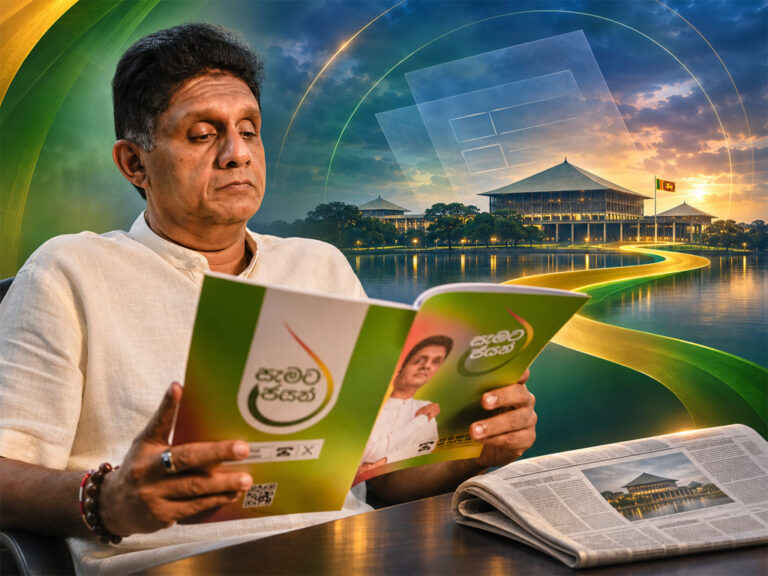
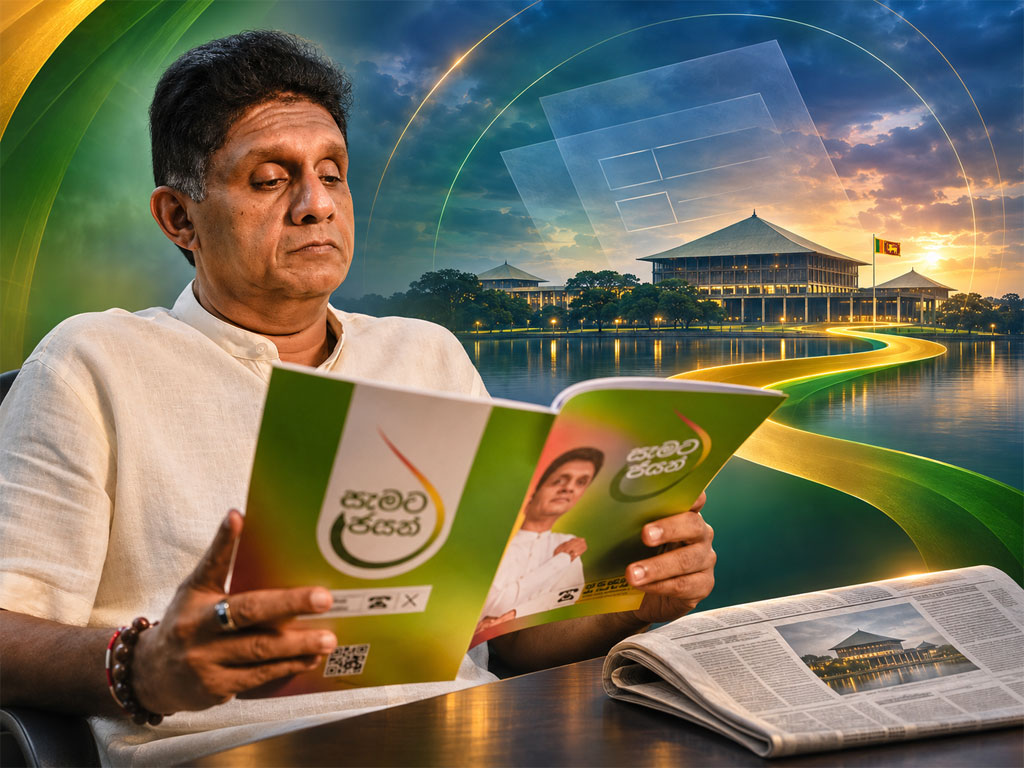
These developments raise a question that will become increasingly relevant as Sri Lanka approaches its next presidential contest: has the country’s political establishment underestimated Sajith Premadasa?
Despite losing the 2019 and 2024 presidential elections, Premadasa remains a central figure in opposition politics. His supporters argue that his political experience, electoral base and approach to public policy make him a credible alternative to the current administration.
The challenge is whether he can convert those strengths into the broader public confidence required to win a presidential election.

The Sajith Factor and a Political Career Beyond Family Legacy
Premadasa’s political journey cannot be separated entirely from the legacy of his father, former President Ranasinghe Premadasa.
Yet it would be misleading to suggest that his parliamentary career began simply through an immediate transfer of political power from father to son.
Ranasinghe Premadasa was assassinated in 1993. Sajith entered Parliament seven years later, following the 2000 general election.
Rather than beginning his parliamentary career in Colombo Central, the constituency associated with his father, Premadasa established his political base in Hambantota.
The district was closely associated with the Rajapaksa family’s political influence, making it a demanding environment for a young United National Party politician.
His emergence there helped him develop an electoral identity that extended beyond his family’s traditional Colombo connections.
An account attributed to Ranasinghe Premadasa suggests that the former President discouraged associates from promoting his son politically while he remained in office.
According to that account, he believed Sajith should enter politics on his own terms if he wished to pursue such a career.
The exact wording of the statement requires confirmation from a reliable historical source.
Nevertheless, Sajith Premadasa’s subsequent parliamentary career demonstrates that he established a sustained political presence after his father’s death.
His electoral support in Hambantota and later leadership positions within the United National Party contributed to his rise as a national political figure.
The 2019 Presidential Election and the UNP’s Internal Divisions
By 2019, the United National Party was struggling with internal disagreements over leadership and political direction.
The coalition arrangements that had brought Maithripala Sirisena to the presidency in 2015 had deteriorated, while tensions between competing factions within the UNP complicated the selection of its presidential candidate.
Premadasa ultimately secured the party’s candidacy and contested the election against Gotabaya Rajapaksa.
For supporters who wanted a presidential candidate drawn from the UNP’s own leadership, his nomination represented a significant political breakthrough.
However, Rajapaksa won the election.
Premadasa’s supporters have subsequently argued that divisions within the opposition weakened his campaign.
Some have gone further, suggesting that political actors deliberately undermined his prospects.
Such accusations remain interpretations of the campaign unless supported by evidence establishing coordinated efforts to secure his defeat.
The Janatha Vimukthi Peramuna-led political movement also contested the 2019 election independently, with Anura Kumara Dissanayake as its candidate.
That decision divided the anti-Rajapaksa electoral space, although it does not establish that the JVP’s objective was specifically to defeat Premadasa.
What is clear is that the 2019 contest exposed divisions that would reshape Sri Lanka’s opposition politics.
Building the Samagi Jana Balawegaya
Following the 2019 presidential election, Premadasa broke with the UNP’s established leadership and formed the Samagi Jana Balawegaya (SJB) in 2020.
The new alliance contested that year’s parliamentary election and secured 54 seats, becoming the principal opposition party.
For a political organisation established only months earlier, the result demonstrated Premadasa’s ability to bring together candidates, supporters and allied parties under a new electoral platform.
It also confirmed that his political relevance had survived the presidential defeat.
The SJB subsequently became the main parliamentary vehicle for challenging the Gotabaya Rajapaksa administration.
Its formation was an important moment in the longer struggle over the leadership of the centre and centre-right opposition.
Nevertheless, building a successful parliamentary opposition and assembling a winning presidential coalition are different challenges.
Premadasa’s future prospects depend partly on whether the divisions that contributed to the UNP-SJB split can be overcome.
COVID-19, Economic Warnings and the Rajapaksa Government
Premadasa’s supporters point to his interventions during the COVID-19 pandemic and the economic crisis as evidence of his political judgment.
During the pandemic, he urged stronger public-health precautions, supported access to vaccines and criticised elements of the government’s response.
He also warned about the country’s deteriorating economic position and advocated engagement with the International Monetary Fund, debt restructuring and measures to secure essential imports.
The Rajapaksa administration initially resisted an IMF-supported adjustment programme, maintaining confidence in its domestic economic strategy.
Sri Lanka subsequently experienced a severe foreign-exchange crisis that disrupted imports and contributed to shortages of fuel, cooking gas, medicines and other essential goods.
The economic collapse eventually helped trigger the mass protests that forced Gotabaya Rajapaksa to leave office.
Premadasa’s supporters argue that earlier engagement with international creditors and more effective economic management might have reduced the severity of the crisis.
That is a legitimate argument for political analysis.
However, it cannot be established that adopting every proposal advanced by Premadasa would necessarily have prevented the economic collapse, the pandemic’s consequences or the subsequent protest movement.
Those outcomes depended on numerous domestic and international factors.
The more useful question is whether Premadasa’s policy positions demonstrated an understanding of risks that the government failed to address adequately.
The Aragalaya and Premadasa’s Political Position
The 2022 protest movement, commonly known as the Aragalaya, brought together Sri Lankans from different political and social backgrounds.
Many participants sought the resignation of Gotabaya Rajapaksa, stronger democratic institutions and greater accountability.
Premadasa supported the demand for political change but also maintained that any transition should include constitutional and institutional safeguards.
His supporters argue that he was unwilling to accept the premiership under Rajapaksa without clear commitments to political reform.
Among the proposals associated with his position were a timetable for the President’s departure, restoration of independent institutions and arrangements for a democratic transition.
The original account refers to discussions involving opposition leaders and protest representatives at Colombo’s Janaki Hotel.
The precise commitments made during those discussions require confirmation from contemporary records.
Premadasa’s relationship with sections of the protest movement was nevertheless complicated.
Some demonstrators viewed him as part of the established political order they wanted to replace.
That perception limited his ability to become a leading political representative of the uprising.
A Reassessment of Premadasa’s Role
The supplied account attributes a significant retrospective assessment to political commentator Dr Mahesh Hapugoda.
According to the translated remarks, Hapugoda argued that protest participants should have been more willing to engage with Premadasa.
He suggested that opposition to traditional political figures had contributed to the movement’s rejection of him.
Hapugoda also reportedly expressed the view that Premadasa had demonstrated restraint during earlier political crises and was not someone prepared to pursue power through every available opportunity.
These comments, if accurately represented, reflect an argument that Premadasa’s political conduct may have been misunderstood during the protest period.
The full quotation should be checked against the original interview or recording before publication.
Such a reassessment would not mean that Premadasa’s political positions were necessarily correct. It would, however, invite a more careful examination of how the protest movement distinguished between established politicians and the political practices it opposed.
The 2024 Election and the Opposition Vote
The 2024 presidential election presented Premadasa with another opportunity to challenge for the presidency.
He entered the contest as Opposition Leader and the SJB’s presidential candidate.
Anura Kumara Dissanayake, representing the National People’s Power, ultimately secured victory.
Premadasa finished second, while incumbent President Ranil Wickremesinghe placed third.
The first-preference results gave Dissanayake 42.31% of the vote, Premadasa 32.76% and Wickremesinghe 17.27%.
The contest demonstrated the strength of the National People’s Power’s campaign and the continuing division of voters between the SJB and Wickremesinghe’s political constituency.
Premadasa’s supporters contend that the division prevented a more competitive challenge to Dissanayake.
Some believe Wickremesinghe’s candidacy disproportionately weakened Premadasa’s electoral prospects.
That conclusion remains a political interpretation.
The fact that two candidates competed for overlapping sections of the electorate does not establish that one entered the contest solely to engineer the other’s defeat.
Nor can their vote totals simply be combined to predict the result of a hypothetical alliance. Voters supporting one candidate would not necessarily have transferred their preferences to another.
Nevertheless, the election revealed a strategic problem that Sri Lanka’s opposition must address before the next presidential contest.
Is Opposition Unity Possible Before 2029?
One argument gaining attention is whether the UNP and SJB could reunite or establish a broader electoral understanding ahead of 2029.
Supporters of such cooperation believe that a consolidated opposition could offer a stronger challenge to the National People’s Power.
Critics question whether the parties’ organisational differences, leadership rivalries and competing political identities can be resolved.
Even if an agreement were reached, electoral success would remain uncertain.
A common platform would need to offer more than opposition to the government.
It would require credible proposals for economic recovery, public-sector reform, employment, education, investment and the cost of living.
Premadasa would also need to demonstrate that he could unite voters beyond the SJB’s existing support base.
The suggestion that an opposition alliance cannot win in 2029 is no more certain than the claim that such an alliance would inevitably defeat the government.
Both outcomes depend on political developments, public opinion and the performance of competing parties over the coming years.
What Has Premadasa Learned From Two Defeats?
Two presidential defeats provide both a political burden and an opportunity for reassessment.
Premadasa has accumulated decades of parliamentary experience, held senior positions in government and established himself as a major opposition leader.
His supporters see political maturity in his willingness to maintain constitutional positions during periods of national instability.
They also point to his interest in scientific research, technology and new approaches to economic development.
Those strengths will matter only if they can be translated into convincing policies and effective political leadership.
The electorate will want to know how a future Premadasa administration would differ from previous governments.
It will also expect specific commitments on fiscal management, corruption prevention, public services and institutional reform.
The opposition cannot rely indefinitely on the argument that earlier administrations failed.
It must demonstrate how it intends to govern differently.
A Political Future That Remains Open
Sri Lankan voters have repeatedly demonstrated a willingness to reject established leaders when expectations are not met.
The defeat of Mahinda Rajapaksa in 2015, the collapse of Gotabaya Rajapaksa’s presidency in 2022 and the victory of Dissanayake in 2024 each reflected different forms of political dissatisfaction and demands for change.
It would be premature to conclude that voters have already rejected the current administration or settled upon its successor.
The next presidential election remains several years away, and public opinion can