COLOMBO, November 28, 2026 — The Mawbima Ceylon Today employee dispute has renewed scrutiny of the Government’s enforcement of labour laws as journalists seek unpaid salaries and statutory contributions. A separate report has revived historical allegations against former Minister Tiran Alles, raising questions that require careful examination of official records and judicial findings.
Mawbima Staff Crisis Puts Government’s Labour Pledges to Test
COLOMBO — The continuing dispute over unpaid salaries, statutory contributions and employment rights at Ceylon Newspapers (Private) Limited, publisher of Mawbima and Ceylon Today, has renewed calls for stronger government intervention while drawing fresh attention to former Public Security Minister Tiran Alles and several controversies associated with his political career.
A report published by Lanka e News on November 26, 2026, questioned the Government’s handling of the employees’ complaints and revisited allegations concerning the 2005 presidential election, the Reconstruction and Development Agency (RADA), the controversial electronic visa programme and several criminal investigations.
The publication also suggested that political considerations could explain what it described as insufficient action against Alles. Those claims, however, require separate examination. The existence of an allegation, an investigation or a court proceeding does not establish personal criminal responsibility.

The immediate labour dispute is supported by independently reported complaints, public demonstrations and intervention by the Ministry of Labour.
Employees and media organisations have sought payment of outstanding wages, Employees’ Provident Fund (EPF) and Employees’ Trust Fund (ETF) contributions, gratuity and other employment benefits.
The situation has become a test of whether the Government can enforce labour protections consistently, regardless of the political standing or commercial influence of the employer concerned.
Journalists Seek Salaries, EPF and ETF Payments
Ceylon Newspapers, associated with Alles, has faced mounting complaints from employees following the suspension of the daily print editions of Mawbima and Ceylon Today in March 2026.
The Sunday editions were subsequently discontinued in August, adding to uncertainty about the company’s operations and the employment prospects of its staff.
Journalists, provincial correspondents and other employees have complained about outstanding remuneration and alleged failures to remit statutory contributions.
On July 3, 2026, Deputy Minister of Labour Mahinda Jayasinghe instructed the Commissioner General of Labour to investigate complaints involving Ceylon Newspapers, including allegations concerning EPF and ETF payments.
A subsequent Labour Department inspection was reported in September.
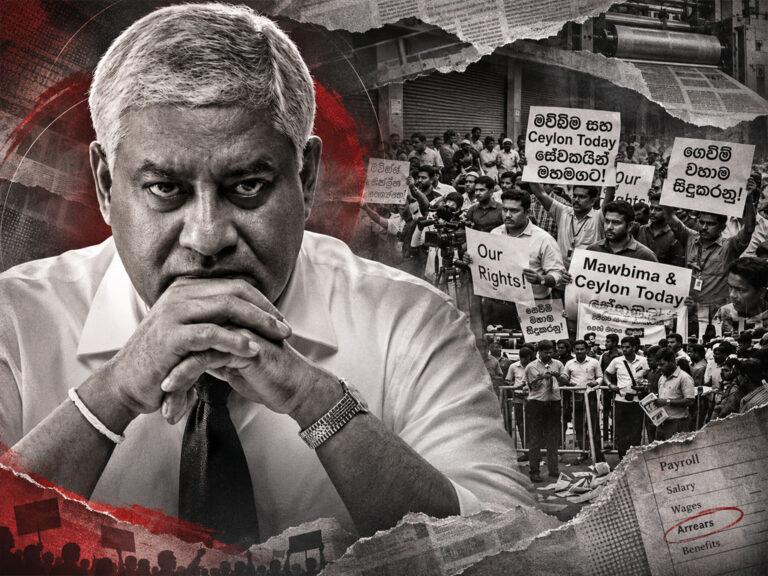
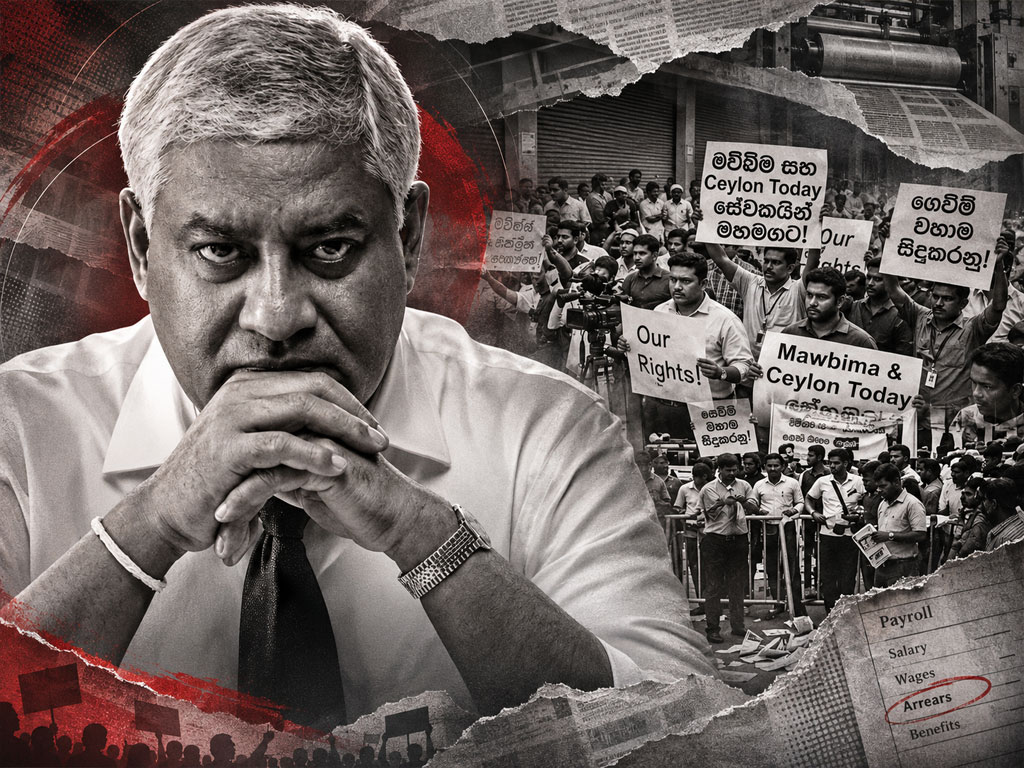
Employees publicly demonstrated outside the newspapers’ Colombo offices on November 3, demanding settlement of outstanding payments and protection of their employment rights.
The dispute attracted further attention on November 16, when seven media organisations and trade unions formally sought intervention from Commissioner General of Labour Nadeeka Wataliyadda.
Their petition raised concerns about unpaid salaries, outstanding statutory contributions, gratuity and alleged unfair termination of employment.
These complaints are substantial, but their precise financial extent and the legal responsibility for each alleged breach must be established through the relevant employment records and regulatory proceedings.
Lanka e News further alleged that representatives of the company failed to attend a meeting convened by the Labour Commissioner.
An independently verified account of the meeting, any explanation for non-attendance and subsequent departmental action was not available for this report.
The company should be given an opportunity to clarify its position, including the amounts disputed, payments already made and any arrangements for settling outstanding obligations.

Questions Over Government Enforcement
The Government has repeatedly emphasised workers’ rights, accountability and the importance of enforcing existing laws.
Its response to the Ceylon Newspapers dispute is therefore being examined against those commitments.
The Ministry of Labour’s decision to initiate an investigation demonstrates that the authorities have taken at least some action. It would consequently be inaccurate to suggest that the Government has entirely ignored the employees’ complaints.
What remains unclear is whether the investigation has resulted in enforceable directions, legal proceedings, verified settlement arrangements or other measures to protect affected workers.
The distinction between announcing an investigation and securing compliance is important.
Employees awaiting salaries or statutory benefits require more than an assurance that their grievances are being examined.
They need a transparent process capable of determining outstanding amounts, establishing responsibility and securing payments where legally required.
The dispute also has wider implications for Sri Lanka’s media industry.
Journalists and other media workers often face uncertainty over employment contracts, remuneration, social security contributions and the financial sustainability of their employers.
These concerns extend beyond one newspaper company and require consistent regulatory oversight.
Historical Allegations Against Tiran Alles Revisited
The Lanka e News article also revisited several allegations involving Alles, arguing that the Government should explain whether the relevant matters have been adequately investigated.
Some of the incidents concern documented court proceedings. Others involve disputed accusations, claims attributed to individuals or interpretations advanced by the publication itself.
They cannot all be treated as established wrongdoing.
The appropriate distinction is between confirmed judicial developments, allegations that remain subject to investigation and accusations for which sufficient independent supporting evidence has not been presented.
The 2005 Presidential Election and Alleged LTTE Contacts
One accusation revisited by Lanka e News concerns alleged contacts between representatives associated with Mahinda Rajapaksa’s 2005 presidential campaign and the Liberation Tigers of Tamil Eelam (LTTE).
The publication referred to claims involving Basil Rajapaksa, LTTE-linked figure Emil Kanthan and Alles, including allegations that financial inducements were offered to secure an electoral boycott in northern and eastern Sri Lanka.
These allegations have circulated in political debate for many years.
The report also referred to statements attributed to Alles following a grenade attack on his residence on January 22, 2010, and to earlier accusations advanced by political figures following the 2005 election.
Mahinda Rajapaksa defeated Ranil Wickremesinghe in that election by 180,786 votes.
The electoral result does not, by itself, establish the alleged arrangement or prove that any individual committed bribery or another criminal offence.
The specific accusations concerning payments, meetings and their alleged purposes require authentication through reliable records and evidence.
No judicial finding establishing Alles’s criminal responsibility for the alleged arrangement was identified in the material reviewed for this article.
The RADA Case and the 2020 Acquittal
The Reconstruction and Development Agency controversy concerns allegations of financial irregularities involving funds intended for post-tsunami reconstruction in northern and eastern Sri Lanka.
RADA was associated with projects intended to provide housing and assistance to communities affected by the December 2004 tsunami.
Alles, who previously chaired RADA, was among four individuals prosecuted over alleged misappropriation of public funds.
The proceedings also involved former RADA officials Saliya Wickramasuriya and Jayantha Dias Samarasinha, and Emil Kanthan.
The source article refers to Rs. 124 million, although other published court accounts describe allegations involving Rs. 200 million. The exact amount applicable to the relevant charges should therefore be checked against the indictment.
On July 10, 2020, the Colombo High Court acquitted Alles and three other accused.
The proceedings involved evidence from former RADA Chief Executive Officer Chandrakanthi Fernando, whose testimony raised difficulties for the prosecution.
The prosecution subsequently declined to proceed, resulting in the acquittals.
Lanka e News questioned the circumstances surrounding the prosecution’s decision and suggested that political influence may have played a role.
That interpretation is an allegation by the publication, not an established judicial finding.
The acquittal remains an essential part of the record. Any suggestion that the prosecution was deliberately undermined would require independent evidence rather than inference from the outcome.
The Controversial Electronic Visa Agreement
The electronic visa arrangement introduced during Alles’s tenure as Minister of Public Security became the subject of substantial public criticism and litigation.
The controversy concerned the transfer of electronic visa processing functions to a private consortium associated with VFS Global and IVS-GBS, replacing the previous electronic travel authorisation arrangements.
Questions were raised about procurement procedures, service charges, transparency and the financial implications for the Government and travellers.
Several parties, including Transparency International Sri Lanka, challenged the arrangement before the Supreme Court.
On August 2, 2024, the Court issued interim orders suspending the Cabinet approval connected to the private electronic visa arrangement and directing measures to restore the earlier system.
Former Controller General of Immigration and Emigration Harsha Ilukpitiya subsequently faced contempt-of-court proceedings relating to the implementation of judicial directions.
The National Audit Office also examined the visa arrangement, while questions concerning procurement and official accountability continued to attract scrutiny.
Lanka e News alleged that Alles improperly influenced the procurement process and questioned the adequacy of subsequent action.
The existence of the litigation and audit findings provides grounds for examining how the agreement was approved and implemented.
It does not automatically establish criminal misconduct by every official named in the proceedings.
Any conclusion concerning individual wrongdoing must be supported by the findings of the competent court or a properly conducted investigation.
Weligama Shooting: CID Questioned Alles in March 2025
Another controversy raised in the Lanka e News article concerns the December 31, 2023, shooting near the W15 Hotel in Weligama.
The incident involved officers attached to the Colombo Crimes Division and resulted in the death of a police sergeant.
Former Inspector General of Police Deshabandu Tennakoon and several police officers subsequently became subjects of legal proceedings connected to the incident.
Lanka e News alleged that Alles had not been questioned over the matter.
That particular assertion is contradicted by contemporaneous reporting.
On March 31, 2025, Alles appeared before the Criminal Investigation Department (CID), where investigators recorded a statement lasting approximately five and a half hours concerning the Weligama incident.
His questioning does not establish guilt, nor does it conclusively establish that every relevant aspect of the investigation has been completed.
Nevertheless, it is a material fact that must be included when assessing accusations of investigative inaction.
Questions about the eventual outcome of the proceedings, any additional evidence obtained and the status of the individuals involved remain matters for the relevant authorities and courts.
Rs. 300 Million Allegation and Police Investigation
The publication also revisited allegations made by Nadun Chinthaka Wickramaratne, widely known as Harak Kata, against Alles and former IGP Deshabandu Tennakoon.
On May 14, 2025, Wickramaratne publicly alleged that the two former officials had demanded Rs. 300 million from him and that his detention conditions were connected to his refusal to pay.
These were allegations made by Wickramaratne, not judicially established findings.
On May 15, 2025, police confirmed that an investigation had been initiated into the claims.
Reports identified the Terrorism Investigation Division as the unit examining the allegations.
The existence of that investigation must be distinguished from the question of whether investigators subsequently obtained sufficient evidence to support criminal proceedings.
No verified final judicial determination establishing the alleged demand against Alles or Tennakoon was identified in the information reviewed.
The appropriate question is therefore whether the inquiry progressed, what conclusions investigators reached and whether those conclusions were communicated through the appropriate legal channels.
Alleged Abduction of a Political Party Secretary
A further controversy concerns the alleged abduction and intimidation of Ven. Wedinigama Wimalatissa Thero, who served as General Secretary of the Ape Jana Bala Party during the dispute over its National List parliamentary seat following the August 2020 general election.
The dispute involved competing political claims associated with Ven. Athuraliye Rathana Thero and Ven. Galagoda Aththe Gnanasara Thero.
Wimalatissa Thero’s alleged abduction subsequently became the subject of police investigations and court proceedings.
Rathana Thero was remanded in 2025 in connection with allegations arising from the incident.
The Lanka e News article additionally alleged that Wimalatissa Thero was taken to Alles’s Ward Place office, where he was threatened and compelled to sign documents.
Those specific accusations require corroboration through police statements, court records and other reliable evidence.
The existence of proceedings against another individual does not establish Alles’s involvement.
Any assessment of the claims must distinguish between the alleged victim’s account, investigative findings and charges formally brought before a court.
Political Allegations and Claims of Undisclosed Influence
Beyond the individual controversies, Lanka e News advanced a wider argument that Alles possesses information capable of influencing political figures and that this could explain the Government’s purported reluctance to act against him.
The publication referred to alleged political relationships formed during the 2010 presidential campaign of former Army Commander Sarath Fonseka.
It questioned the handling of campaign contributions and suggested that financial dealings could have created continuing political obligations.
The article also made allegations involving the alleged recording of private meetings, undisclosed assets and a purported compromising arrangement involving political figures associated with the Janatha Vimukthi Peramuna.
These assertions are not supported in the supplied material by independently authenticated financial records, recordings, judicial findings or other evidence sufficient to establish the conduct alleged.
They must therefore remain attributed allegations and speculation, rather than conclusions adopted by this publication.
In particular, an insinuation that political leaders have been compromised through private or sexual relationships cannot responsibly be presented as fact without credible and independently corroborated evidence.
The broader question of whether personal relationships, financial interests or political connections influence the enforcement of Sri Lankan law is legitimate.
Establishing such influence in a specific case, however, requires demonstrable evidence connecting an identifiable decision, official or institution to improper conduct.
Political association alone is insufficient.
The Government’s Responsibility to Enforce Labour Law
The immediate and independently documented concern remains the position of the employees of Mawbima and Ceylon Today.
Journalists and other staff have sought intervention over alleged unpaid salaries, statutory contributions, gratuity and employment insecurity.
The Labour Ministry initiated an investigation, while media organisations subsequently called for further action.
Those developments establish that complaints have entered the official regulatory process.
They do not establish that the process has been completed or that all employees have received their outstanding entitlements.
The Government’s responsibility is to ensure that the relevant authorities can investigate the complaints independently, determine what is owed and enforce applicable employment laws.
Any alleged failure by the employer must be assessed against documentary evidence, statutory obligations and the company’s response.
The same principles apply to historical allegations involving Alles or any other former public official.
Investigations should proceed where credible evidence warrants them, but criminal liability must be established through lawful proceedings rather than political accusations or media commentary.
The status of previous acquittals, existing investigations and pending litigation must also be represented accurately.
Employee Rights Must Not Depend on Political Influence
The Ceylon Newspapers dispute highlights a wider difficulty confronting Sri Lankan journalists: the vulnerability of employees when media organisations face financial distress or suspend operations.
Workers may lose their regular income while remaining uncertain about unpaid statutory contributions, accumulated benefits and future employment.
For a Government that has placed labour rights and institutional accountability among its stated priorities, the dispute presents a practical opportunity to demonstrate that enforcement decisions are determined by law rather than political status.
The Government should clarify the outcome of the Labour Department’s investigation, the status of the employees’ claims and any steps taken to secure legally due payments.
Ceylon Newspapers should also be afforded the opportunity to respond publicly to the complaints and explain its financial and employment arrangements.
The historical controversies revisited by Lanka e News deserve scrutiny wherever credible, verifiable evidence exists. They should not, however, obscure the immediate rights of the employees whose complaints brought renewed attention to the company.
The central unresolved question is whether the relevant institutions will deliver a transparent, lawful and enforceable resolution to the employees’ claims.