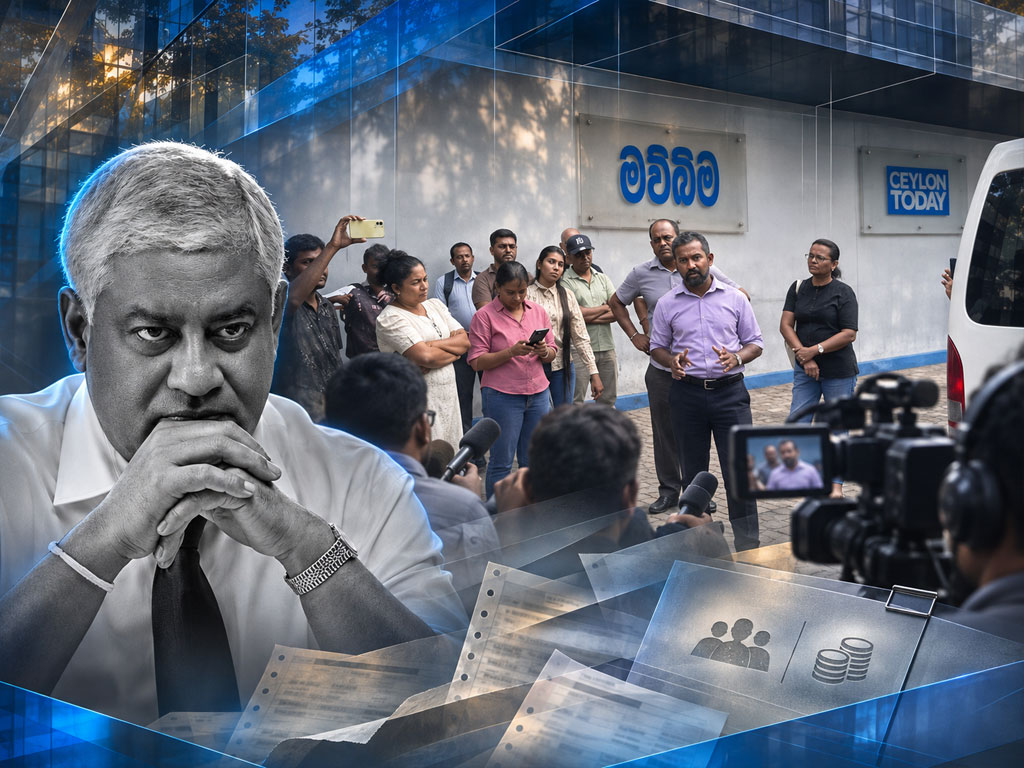
COLOMBO, 4 November 2026 – Journalists demand outstanding pay and statutory contributions as the Government faces calls to enforce labour protections regardless of media ownership or political influence.
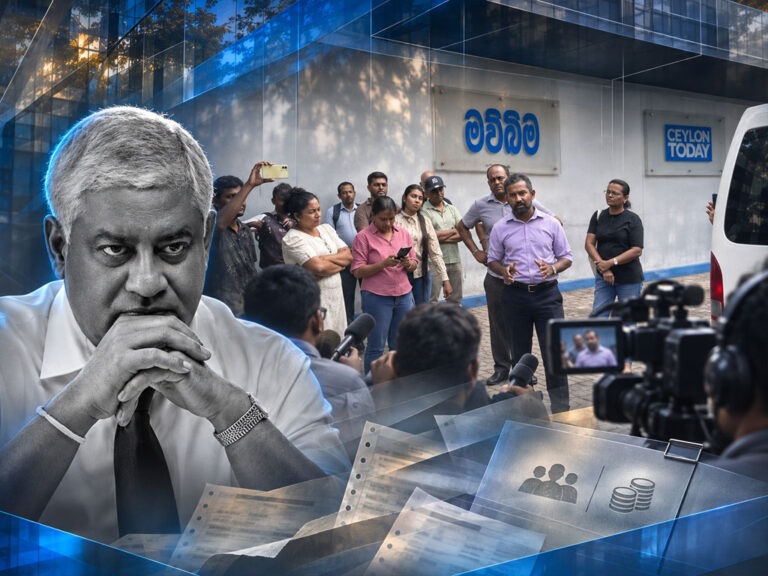
Journalists and other employees of Mawbima and Ceylon Today staged a protest outside their offices in Colombo on Tuesday (3), demanding the payment of outstanding salaries and statutory employment benefits in a dispute that has become a test of the Government’s commitment to protecting workers’ rights.
Current and former employees of the two publications, which operate under Ceylon Newspapers (Private) Limited and are associated with former Public Security Minister Tiran Alles, raised concerns about delayed remuneration and alleged arrears in Employees’ Provident Fund (EPF) and Employees’ Trust Fund (ETF) contributions.
The demonstration, accompanied by a signature campaign, was held near the newspapers’ offices at Rosmead Place, Colombo 7.
For the protesting journalists, the dispute extends beyond unpaid wages. It concerns the financial security of media workers, the enforcement of statutory obligations and the influence that politically connected media ownership may exert over employment conditions.

Journalists Take Their Demands to the Street
The demonstration brought together employees who say prolonged delays in receiving their earnings have placed them under financial pressure.
Participants called for the settlement of salary arrears, the payment of outstanding statutory contributions and intervention by the Department of Labour.
Their protest highlighted a contradiction facing journalists who routinely report on public grievances but must now publicly campaign for their own employment rights.
Media workers perform an important public function by scrutinising powerful institutions and giving a voice to people whose concerns might otherwise go unheard. Their ability to carry out that work can be weakened when their own employment and financial security remain uncertain.
The dispute has therefore prompted questions about the conditions under which journalism is practised and the safeguards available to employees when media organisations encounter financial or administrative difficulties.
Concerns Over EPF and ETF Contributions
Beyond unpaid salaries, protesting employees have raised allegations concerning outstanding EPF and ETF contributions.
Both funds form part of Sri Lanka’s statutory framework for protecting eligible employees’ financial interests.
Failure by an employer to make legally required contributions is a matter for the relevant authorities to examine and address under the applicable legislation.
The employees’ complaints warrant a clear accounting of what contributions were due, what payments were made and whether any arrears remain outstanding.
Although the allegations have been publicly reported, their precise financial extent and the responsibility for any statutory violations must be established through documentary records and the appropriate investigative process.
Labour Authorities Previously Ordered an Investigation
The controversy is not new.
On 3 July 2026, Deputy Minister of Labour Mahinda Jayasinghe directed the Commissioner General of Labour to investigate complaints involving Ceylon Newspapers, including alleged failures to remit EPF and ETF contributions.
The instruction followed concerns raised about employment conditions at the company.
The latest protest brings renewed attention to that intervention and the progress made since it was announced.
Employees are entitled to know whether the investigation has been completed, what it established and what action has followed.
If violations have been identified, the relevant authorities must explain the steps being taken to secure compliance and recover any amounts legally owed.
If the allegations have not been substantiated, that finding should also be communicated clearly.
Media Organisations Stand With Employees
The protest drew support from representatives of several media and journalists’ organisations.
Previous complaints to the labour authorities were reportedly made by groups including the Free Media Movement, the Sri Lanka Professional Journalists’ Association and the Federation of Media Employees’ Trade Unions.
Representatives of the Young Journalists’ Association of Sri Lanka and other media organisations also expressed solidarity with the affected workers.
Senior journalist Bingun Menaka Gamage highlighted the financial difficulties facing journalists and the importance of securing employment rights as part of any meaningful effort to improve Sri Lanka’s media environment.
The participation of professional associations has broadened the dispute from an individual workplace grievance into a discussion about employment protections across the media industry.
Minister Says Government Will Act Within the Law
Health and Mass Media Minister Dr. Nalinda Jayatissa has stated that the Government is prepared to intervene through the existing legal framework to protect the rights of media employees.
Responding to questions about the dispute, the Minister indicated that the Ministry of Mass Media would cooperate with the relevant authorities in addressing complaints involving media institutions.
He also said investigations into unpaid statutory contributions and other employment-related violations should proceed without preferential treatment for politically connected individuals or organisations.
That undertaking is significant. The challenge for the administration is now to demonstrate that the promised legal and administrative measures produce results.
An investigation alone does not settle outstanding wages or guarantee that workers receive contributions to which they are legally entitled.
Political Ownership and Editorial Independence
The ownership of media organisations by individuals with political connections raises wider questions about the relationship between journalism, commercial interests and political power.
Political ownership does not automatically establish editorial interference or unlawful employment practices.
Nevertheless, it makes transparent governance and consistent enforcement especially important.
Employees of a media institution should receive the same legal protections as workers in any other sector, regardless of an owner’s wealth, political background or public standing.
The present dispute also demonstrates why editorial independence and fair employment conditions must be considered together.
Journalists facing prolonged financial insecurity may be less able to work independently, challenge powerful interests or pursue investigations without fear of professional consequences.
Protecting media freedom therefore involves more than safeguarding the right to publish. It also requires respect for the employment rights of the people producing the news.
Government Faces a Test of Enforcement
For the National People’s Power administration, which has repeatedly emphasised accountability and reform, the dispute presents a practical test of its stated principles.
The central question is whether the authorities will apply labour laws consistently when complaints concern an organisation associated with a prominent former minister.
The same standard must apply to every employer. Political connections cannot justify special treatment, but neither should they substitute for evidence or due process.
The Government should now clarify the status of the July investigation, establish the amount of any verified arrears and ensure that legally required payments are made.
Ceylon Newspapers and its management should also be afforded the opportunity to respond to the employees’ allegations and explain the company’s position.
For the journalists who gathered outside their workplace, the outcome will ultimately be measured in practical terms: payment of lawful entitlements, protection against unfair treatment and confidence that labour protections can be enforced without political favour.
That outcome will say more about the Government’s commitment to reform than any public declaration of support for workers’ rights.