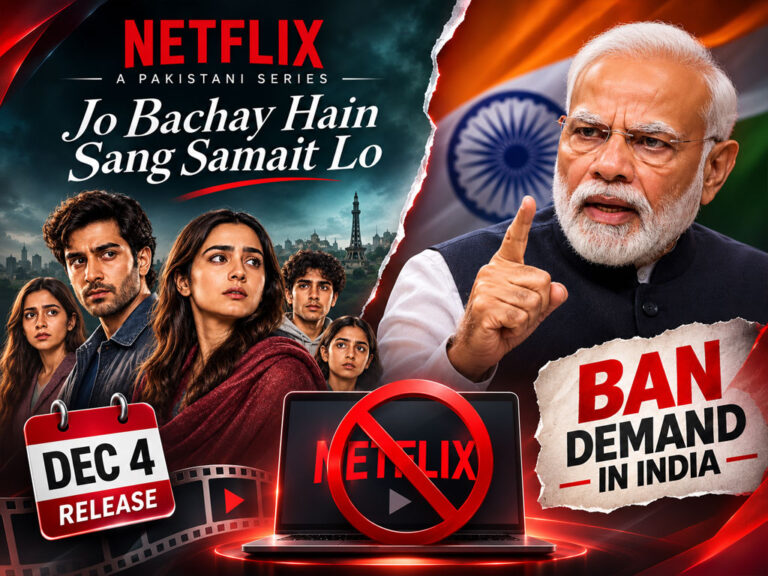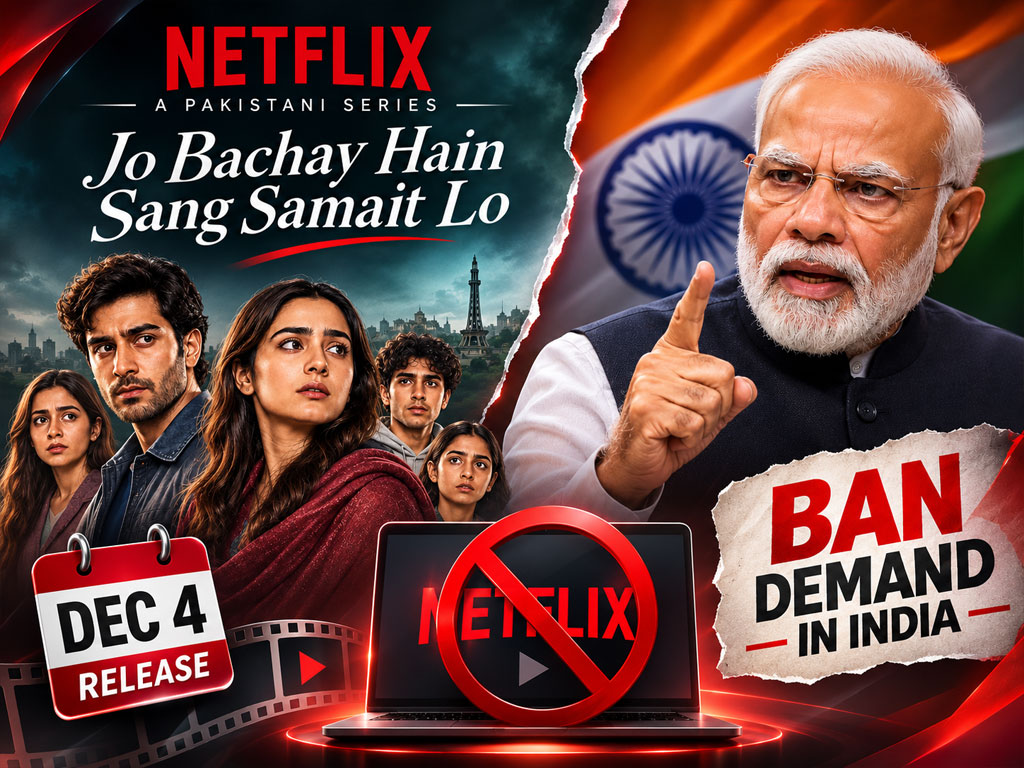
NEW DELHI, November 28, 2026 — A leading Indian film workers’ association has asked Prime Minister Narendra Modi to prevent Netflix from streaming its first Pakistani original series in India. The demand comes days before its December 4 premiere, reviving tensions over cross-border entertainment.
The All Indian Cine Workers Association (AICWA) has formally appealed to Indian Prime Minister Narendra Modi to block the release of Netflix’s first Pakistani original series, Jo Bachay Hain Sang Samait Lo, in India, citing national security concerns and existing restrictions on Pakistani entertainment content.
The association submitted its request ahead of the series’ scheduled December 4, 2026, premiere, calling for immediate government intervention and permanent legal restrictions on the distribution of Pakistani productions in India.
Adapted from a popular Urdu novel by Pakistani author Farhat Ishtiaq, the romantic drama features an ensemble cast that includes Fawad Khan, Mahira Khan and Sanam Saeed, all of whom have established substantial audiences across South Asia.
The dispute has brought renewed attention to the restrictions imposed on Pakistani entertainment following the deterioration of diplomatic and military relations between India and Pakistan in 2025.
Although Netflix has announced the production’s international release, its availability to Indian subscribers remains uncertain amid the association’s objections and the government’s earlier advisory against streaming Pakistani content.

Film Association Demands Permanent Ban on Pakistani Productions
In a letter addressed to Prime Minister Modi, the AICWA urged the government to prevent the series from being released or streamed on Netflix India.
The association adopted an uncompromising position on Pakistani participation in India’s entertainment industry, declaring:
“No Pakistani face, voice or story has a place on Indian screens.”
Beyond opposing this particular production, the organisation called for legislation introducing a permanent prohibition on Pakistani films, television programmes and other entertainment content in India, supported by strict penalties for violations.
Its demand extends beyond the existing government advisory, seeking a binding legal framework that would restrict the distribution of Pakistani productions through digital streaming services.
The association also alleged that certain Pakistani actors involved in the series had made statements critical of India during periods of political and military tension between the neighbouring countries.
Those allegations form part of the association’s justification for its opposition. The letter’s reported claims do not, by themselves, establish wrongdoing by the actors or demonstrate that the forthcoming series contains material threatening India’s national security.
The controversy highlights the continuing influence of political relations on entertainment distribution in South Asia, where artists and productions have frequently become subjects of diplomatic disagreement.
What Is Jo Bachay Hain Sang Samait Lo?
Jo Bachay Hain Sang Samait Lo, whose English title is All the Love Our Hearts Carry, is Netflix’s first Pakistani original series and a landmark Urdu-language production for the streaming platform.
Based on Farhat Ishtiaq’s novel of the same name, the drama explores interconnected relationships, emotional conflicts and the search for love.
The production brings together several prominent Pakistani performers, including actors already familiar to Indian audiences through Bollywood films and television dramas.
Among its best-known cast members is Fawad Khan, who appeared in the Hindi films Kapoor & Sons and Ae Dil Hai Mushkil.
Mahira Khan also established a following in India after appearing alongside Shah Rukh Khan in the 2017 film Raees.
Sanam Saeed gained recognition among Indian television viewers through the Pakistani drama Zindagi Gulzar Hai, which attracted audiences beyond Pakistan.
Their established popularity reflects the cross-border appeal that Pakistani television and music have maintained despite recurring political restrictions.
The series’ international release is scheduled for December 4, but whether Indian viewers will receive access on that date remains an unresolved issue.
Kashmir Attack and India’s Restrictions on Pakistani Content
The dispute has emerged against the backdrop of tensions following the April 22, 2025, terrorist attack in Pahalgam, Indian-administered Kashmir, which killed 26 people.
The attack and the subsequent military confrontation between India and Pakistan brought relations between the neighbouring countries to one of their most difficult periods in recent years.
In May 2025, India’s Ministry of Information and Broadcasting issued an advisory directing digital platforms and streaming services operating in India to discontinue content originating from Pakistan.
The advisory covered films, television series, music, podcasts and other streaming material, including content offered through paid subscriptions and free digital services.
Indian authorities cited national security considerations when issuing the directive.
The AICWA has now invoked those restrictions in its campaign against Netflix, arguing that making the Pakistani drama available to Indian subscribers would be inconsistent with the government’s existing position.
An important distinction remains between a government advisory and a new statutory prohibition. While the May 2025 directive establishes the government’s publicly stated position, the association is seeking additional legal measures that would impose permanent restrictions.
Pakistani dramas have nevertheless maintained an audience among Indian viewers through online platforms, including YouTube, illustrating the continuing demand for entertainment produced across the border.
Netflix Faces a Decision Over Its Indian Audience
India represents an important market for Netflix, supported by a large population, growing digital connectivity and increasing consumption of online entertainment.
The country’s relatively affordable mobile internet services have also helped streaming platforms reach younger audiences seeking regional and international productions.
For Netflix, the controversy presents a challenge involving its international release strategy and the regulatory environment governing content distribution in India.
The series was developed for a wider audience, yet the association’s objections specifically target its availability within the Indian market.
Blocking the programme in India would not necessarily prevent Netflix from releasing it in other countries.
Equally, announcing a global premiere does not establish that the production will be available in every market without restrictions.
The debate also extends beyond the commercial prospects of a single television series.
It concerns the extent to which political disagreements between neighbouring countries should influence the availability of films, television programmes and other cultural productions.
For Indian authorities, the immediate consideration is how the forthcoming release fits within existing national security advisories and digital content regulations.
For the entertainment industry, the dispute reflects the continuing separation between the popularity of Pakistani artists among Indian audiences and the restrictions sought by some professional organisations.
December 4 Release Remains the Immediate Focus
The AICWA’s appeal has placed the proposed Indian release of Jo Bachay Hain Sang Samait Lo under scrutiny less than two weeks after Netflix’s announcement of its premiere date.
Reports of the association’s demand have attracted attention across India and Pakistan, particularly because the production represents an important step in bringing Pakistani television drama to a major international streaming platform.
As of November 28, the series remains scheduled for its December 4 international premiere. Its availability in India has not been conclusively established in the reporting reviewed.
The outstanding question is whether Indian authorities will issue a specific decision concerning the programme or whether Netflix will adjust its distribution arrangements in response to the existing advisory.
Until that position is clarified, the association’s demand remains a request for government action rather than confirmation that a fresh ban has been imposed on the series.
Latest Development: Indian Ministry Reportedly Reminds Netflix of Restrictions
Further reporting published on November 28 indicates that India’s Ministry of Information and Broadcasting has reportedly contacted Netflix, asking it to ensure that Pakistani-origin content remains unavailable to subscribers in India.
According to an ANI report carried by Zee News, the ministry reiterated its May 8, 2025 advisory following complaints from Indian film industry organisations. The reported communication cited Netflix’s earlier assurance that it was not making Pakistani productions available in India.
The Federation of Western India Cine Employees (FWICE) has also joined the opposition, separately appealing to Prime Minister Modi and warning of industry action if the programme becomes available in India.
These developments provide a more recent picture than the original article’s statement that authorities had not responded. The ministry’s reported communication should be distinguished from a newly published statutory ban specifically naming the series.