An Observation on Justice, Our Constructions, and Ourselves
By Roshan Jayasinghe
There are thoughts that keep returning to me from observing the world around me. They do not come from political theory, law books or any belief that I know how humanity should organize itself. They come while driving, meeting people, listening to conversations and watching what happens around us. One basic observation sits beneath all of them. We arrive in this world as human beings before we become anything else. We do not arrive understanding wealth or poverty, borders or nations, political parties or religions, prisons or governments, social status or power. We enter a world where all of these already exist. We inherit them as normal, learn to live within them and continue developing them. Many are necessary for organized life. Yet they are still our constructions. They cannot think for us, feel compassion for us or become more human on our behalf. Only we can do that.

Even the ordinary way we look at one another reveals how deeply some of these constructions have entered us. A well dressed, confident person carrying the appearance of success can receive our attention differently from someone in worn clothes who appears lost, homeless or struggling. Do we respect the suit before knowing the person wearing it? Do we dismiss the torn clothes before knowing the life inside them? Most of us never consciously decided to measure people this way. We entered a world that had already arranged human beings into visible levels, and we absorbed some of those measurements without realizing it. Hierarchy does not live only in governments, corporations and institutions. It can quietly take residence inside our own thinking.
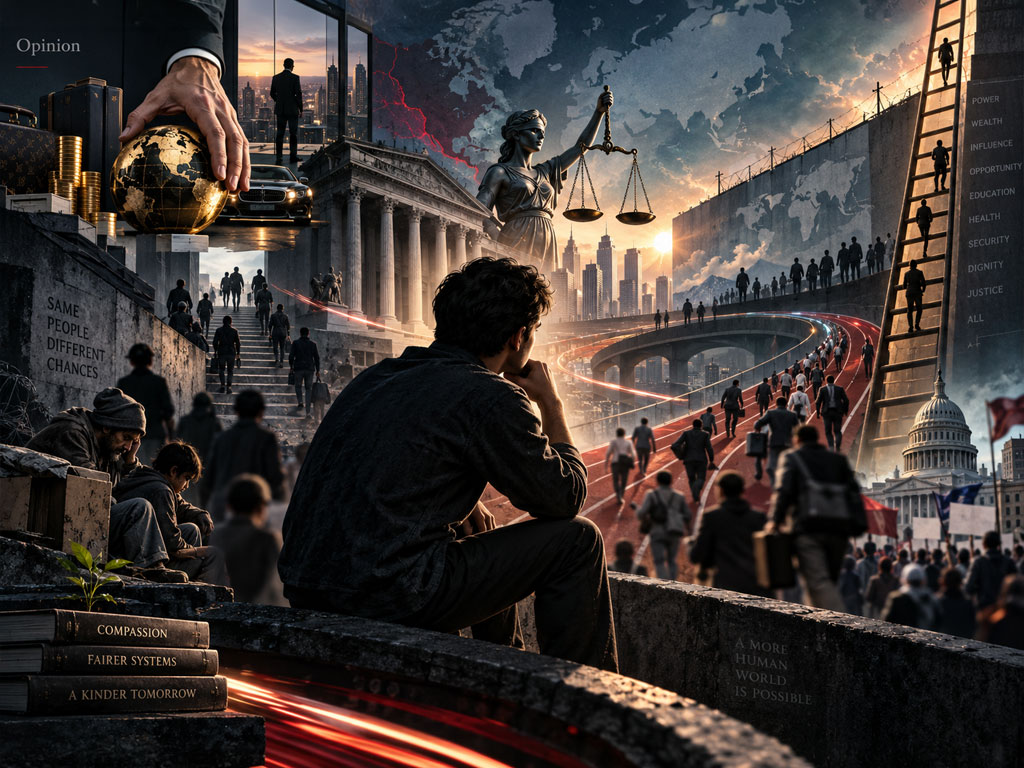
That makes me question what we casually call getting ahead. Human societies created positions of authority, ownership, wealth, status and control, often for practical reasons. Over time, those positions also created the ability for one person to rise through the lives and labor of others. The higher someone climbs, the greater their ability can become to influence the conditions experienced by those below. If my progress requires another person to remain beneath me, have I advanced, or merely changed my position on the ladder? Achievement, ambition, leadership and wealth are not wrong simply because they produce different outcomes. My concern begins when developing ourselves turns into advancement at another person’s expense. If the way upward requires stepping over another person, we should also look down and ask who we are standing on.
Justice brings this into sharper focus. I can drive through one of the wealthiest societies humanity has created and see someone sleeping beside a road, another struggling with mental illness, another trapped by addiction, another unable to find a way back into ordinary life. Eventually we identify people by their condition: homeless, addict, mentally ill, criminal, poor. The description can slowly replace the person. At the other end of society, wealth can provide representation, privacy, influence and choices unavailable to someone without those resources. Power can provide even more. Poverty should not excuse deliberately harming another person, and wealth should not soften responsibility. When accountability changes according to where someone stands on the human ladder, the meaning of justice deserves examination.
Punishment raises another question. When one person harms another, accountability is necessary. The person who suffered cannot disappear while we try to understand the person responsible. Their pain and loss must be recognized, and society has a responsibility to protect people from genuine danger. But after suffering has occurred, deliberately creating more suffering does not automatically tell me that something has been corrected. What caused the act? What can be repaired? What responsibility belongs to the person who caused it? What can be learned to prevent another victim? Understanding cause does not excuse an action. It allows us to see more of it. If we punish what happened without understanding why it happened, we may deal with yesterday’s act while leaving tomorrow’s cause untouched.
The same contradiction appears in the way humanity uses its resources. We hear how complicated and expensive it is to address homelessness, mental illness, hunger, rehabilitation and education. Yet when nations prepare for conflict, extraordinary resources, technology and human intelligence become available. Protection from genuine aggression is necessary, but have we given peaceful human resolution the same seriousness and determination that we have given preparation for war? Negotiation is not surrender. Understanding another side does not require accepting injustice. Human advancement cannot be measured only by how powerful we have become. It should also be visible in how effectively we prevent the circumstances that require that power to be used.
The words national security also take on a wider meaning. A nation has a responsibility to protect itself, but a nation is ultimately something human beings created. A country can possess heavily protected borders and extraordinary military capability while people inside those borders sleep without shelter, deteriorate through untreated mental illness or live without the basic security of an ordinary life. This is not an argument against national defense. It is an observation about what we choose to include when we speak of security.
Across the border stands another person. A child does not enter this world knowing which flag will eventually represent that life or which history may one day describe another group of people as an enemy. History is real. Aggression is real. Nations have responsibilities. None of that makes the civilian living under a government we oppose less human. We should be capable of loving our own country without needing another country’s people to become less valuable. When suffering close to us feels personal while suffering far away becomes statistics, strategy or collateral damage, the difference tells us something about ourselves.
Politics and ideology reveal another part of the same condition. Democracy, conservatism, socialism, communism, capitalism and all the other names we have created can become powerful identities. We defend them, attack one another through them and speak as though the construction itself possesses morality.
Yet underneath every one of them is the same participant.

Before We Call It Education
Roshan Jayasinghe reflects on learning, curiosity, nature, experience and what education should preserve in a developing human mind.
The Morning Telegraph • August 27, 2026 • 14 min readUs.
We can speak about freedom while denying another person’s dignity. We can speak about equality while privately measuring people according to wealth, education, appearance or usefulness. We can condemn power when the other side possesses it and become comfortable with the same power when our own side holds it. A label does not make the human behavior beneath it truthful. Changing the construction without examining the people operating within it can give familiar behavior another name.
These competing ideas bring to mind a scale. Humanity can load enormous weight onto one side until the imbalance becomes impossible to ignore, then react by loading the other. Generations can move weight back and forth while each side believes its victory will finally correct what came before. Truth does not automatically sit halfway between opposing positions, and injustice does not become just by meeting it in the middle. The equilibrium I am searching for is deeper than political compromise. The reference point is the human life underneath the argument.
The harder part begins when this observation turns back toward me. We talk loudly about what is wrong with the world and become skilled at recognizing hypocrisy in people who disagree with us. Turning that same attention inward is more difficult. Do I demand from another person what I excuse in myself? Do I oppose power only when somebody else possesses it? Do I speak about equality while unconsciously placing people on different levels? Do I defend a principle consistently, or only when it gives me the result I want?
There is no distant system that can answer those questions for me. I have to answer them myself.
We often speak about “the system” as though it were another living thing standing somewhere above us. We blame it, defend it, demand things from it and wait for it to change. But a system has no consciousness. Democracy cannot be compassionate. Capitalism cannot look into another person’s eyes. Government cannot feel the suffering of someone sleeping beside a road.
We can.
Whatever compassion, fairness or dignity we expect to find within our institutions has to be carried into them by people.
While I was putting these observations together, something happened this morning that changed the way I began seeing my conclusion.
I was listening to Bob Marley’s “Rat Race.”
I was a big Bob Marley fan when I was young. During my high school years we listened to his music because we enjoyed it: the rhythm, the popularity, the personality and everything surrounding Marley at that time. Looking back, I cannot say I understood many of the human observations I can hear in the music today. Even the public image surrounding him could become larger than the words themselves. We could become occupied with the image and miss what the person was saying.
Listening this morning was different.
The song had not changed since my school days.
The man listening to it had.
A lifetime now stood between the young person who enjoyed those songs and the man hearing them today. I had lived enough of life, with its responsibilities, achievements, losses, mistakes and lessons, to hear something I could not have heard in the same way when I was young.
What I once heard mainly as music, I was now hearing through a life.
Marley named the race.
What stayed with me was the human being inside it.
Until that moment I had been looking at hierarchy, wealth, power, justice, punishment, nations, politics and our endless desire to get ahead as observations about the race around me.
The music turned the observation inward.
I am in the race too.
I work. I earn. I have responsibilities. I have wanted success and still want to accomplish things. I have benefited from constructions I did not create and struggled against others I did not choose. I have judged people and later discovered that my judgment was wrong.
Recognizing the rat race does not require me to escape everything humanity has constructed. Nor does it make ambition, achievement or success meaningless. What has changed for me is the measurement.
Getting ahead does not have to mean getting ahead of another person.
Living within a construct does not require that construct to become my identity.
Success does not require another person to become smaller so that I can feel larger.
It means becoming more conscious of the human being who is running it.
That changes the larger question. Instead of only asking what is wrong with our systems, I have to ask what we carry into every one we create. Fear, greed, compassion, prejudice, generosity, loyalty, ambition, the desire to belong, the desire for power and our ability to justify ourselves travel with us. Humanity can replace one construction with another and eventually discover familiar problems under a different name because we entered the new construction too.
Before politics, economics, justice or government, there appears to be an earlier education: understanding what it means to be human among other human beings. A person should not first have to prove wealth, education, nationality, usefulness, appearance, beliefs or success before being recognized as one of us. This does not require eliminating disagreement, ambition or competition. It requires enough awareness to recognize when what we have created begins separating us from the humanity we share.
I do not know how to construct a perfect society, nor am I offering another ideology. These are observations from where I stand today. Future generations will see things we cannot see, just as we now recognize mistakes previous generations accepted as normal. I hope they correct us. The danger begins when our constructions become so important and our beliefs so certain that observation and correction are no longer welcome.
At the end of the day, whatever the construct, whatever name we give it and whatever position we occupy within it, I have arrived at a simpler understanding of where I presently stand.
I do not need to escape the entire rat race to recognize the human being within it.
The race is still there.
So am I.
I would rather spend the life I have left observing, learning, contributing, accomplishing what I still can, questioning what no longer makes human sense and seeing the person beside me without first needing to know where that person stands on the ladder, than reach the end having only learned how to run.
None of this solves justice, politics, poverty, war or inequality.
But it changes the human being I bring into them.
There is no system capable of becoming human on our behalf. Whatever humanity we hope to see in the world has to enter through us.
After all these years, that may be what I am finally hearing in music I have known since I was young.
Not how to escape the race.
How not to lose the human being inside it.
Enjoy the human in the rat race.
About the Author
Roshan Jayasinghe is a writer and observer of human systems. His work explores the gap between man made constructs and lived humanity, with a focus on how economics, trade and everyday choices intersect with questions of fairness, responsibility and inner alignment. Through essays for publications in The Morning Telegraph, he aims to remind readers that they are not passengers in a fixed machine, but active custodians of a shared world.