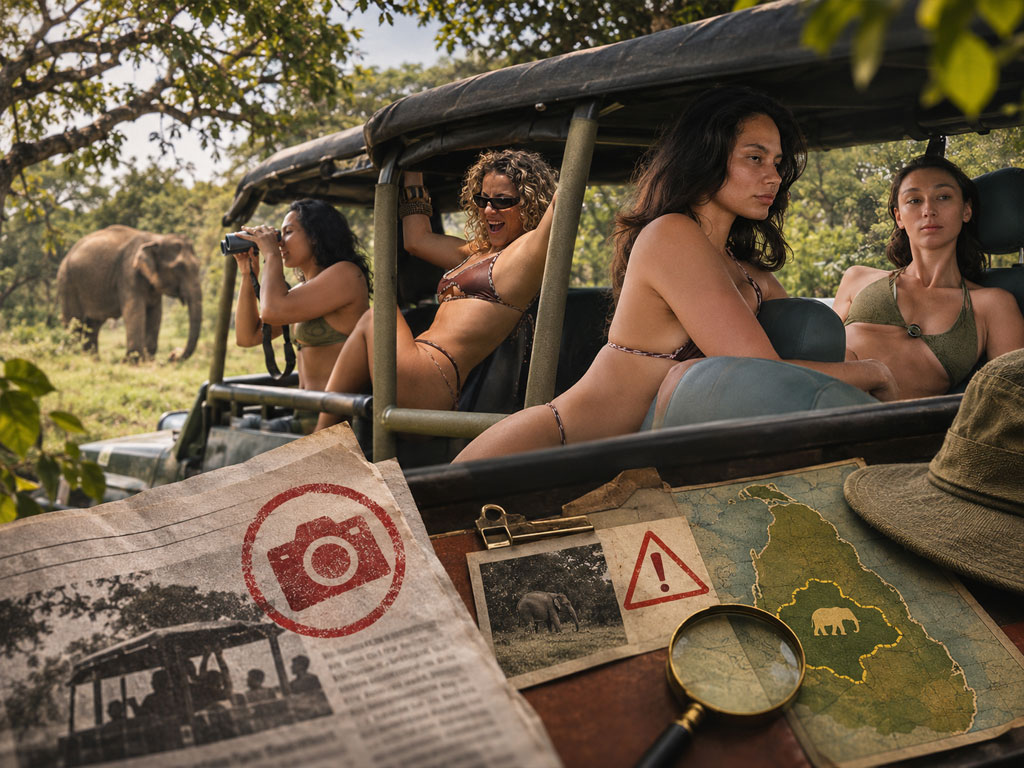
COLOMBO, November 12, 2026 – Are Sri Lanka’s protected wildlife reserves being turned into commercial photography studios? Allegations of bikini and semi-nude modelling packages marketed to foreign visitors have raised serious questions about commercial filming permits, safari operators, immigration compliance and the ability of wildlife authorities to protect Yala, Kumana and Lunugamvehera from unauthorised activities.
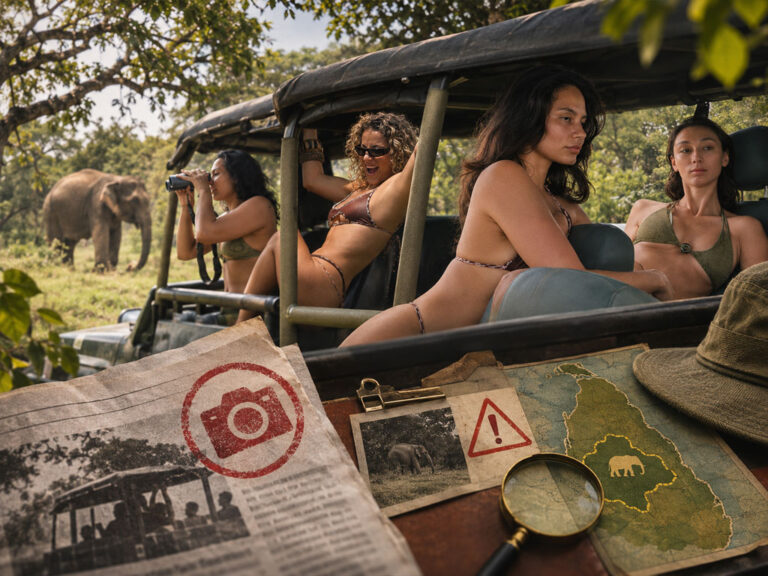
Allegations that private tourism operators are promoting commercial bikini and semi-nude photography packages inside Sri Lanka’s national parks have raised concerns about the use of protected wildlife habitats for profit and the effectiveness of existing conservation regulations.
Former Director General of Zoological Gardens Sharmila Rajapaksa has drawn attention to what she describes as organised commercial photography operations targeting sensitive ecosystems, including Yala, Kumana and Lunugamvehera National Parks.
According to Rajapaksa, packages advertised through social media involve transporting foreign models into wildlife reserves aboard open safari vehicles to conduct photography sessions.
Her concerns have prompted questions about whether the organisers obtained the necessary authorisations, whether participating safari operators complied with park regulations and whether wildlife officials were aware of the reported activities.
The allegations have not been independently established through the examination of permits, booking records or official investigation findings.
Nevertheless, the controversy raises important questions about the commercial use of Sri Lanka’s protected natural environments and the responsibility of public authorities to ensure that such activities are conducted lawfully.

Commercial Photography or Ordinary Tourism?
Wildlife tourism is an important part of Sri Lanka’s visitor economy, with national parks attracting local and international tourists seeking to observe elephants, leopards, birds and other wildlife in their natural habitats.
Photography is a normal component of these visits.
However, commercial modelling or promotional photography organised as a business activity may involve different authorisation requirements from those applicable to ordinary tourists photographing wildlife for personal use.
The distinction becomes particularly important when organisers charge customers for specialised photography packages, employ professional models or crews, or use protected landscapes as locations for commercial content.
Questions may also arise where activities involve extended stops, restricted areas, additional equipment or behaviour that could disturb wildlife.
Observers concerned about the alleged packages argue that national parks should not be treated as unrestricted commercial locations merely because paying visitors can enter them.
At the same time, the nature of the photography alone does not establish a criminal offence. Any alleged violation must be assessed against the applicable law, park regulations, permits and circumstances.
Five Legal Issues That Require Examination
The allegations raise concerns under several areas of Sri Lankan law.
1. Fauna and Flora Protection Ordinance
Sri Lanka’s Fauna and Flora Protection Ordinance, No. 2 of 1937, as amended, provides the principal legal framework for protecting wildlife, habitats and designated reserves.
The legislation regulates activities within national parks and seeks to prevent the misuse of protected natural environments.
Rajapaksa’s concerns raise the question of whether the reported commercial photography operations complied with the conditions governing entry and activities inside these reserves.
Investigators would need to determine whether the organisers remained within areas accessible to ordinary visitors, complied with directions issued by wildlife officials and obtained any additional permission required for commercial activities.
Ordinary park admission should not automatically be assumed to authorise every form of commercial production.
2. Commercial Filming and Photography Permits
Commercial photography and filming within protected areas may be subject to specific permission and fee requirements administered by the Department of Wildlife Conservation.
Where a proposed activity requires additional authorisation, organisers must comply with the applicable procedures before proceeding.
The central question is whether the individuals and companies allegedly promoting modelling packages obtained the permissions required for their particular activities.
Authorities should examine booking arrangements, promotional material, equipment used, relevant permit applications and any approvals granted by wildlife officials.
If organisers conducted activities requiring permits without obtaining them, the Department should determine what enforcement action is available under the applicable regulations.
Equally, if the operations were properly authorised, the Department should clarify the nature and conditions of those approvals.
3. Penal Code and Public Conduct
The original allegations also raise questions about public decency and the suitability of certain commercial photography activities within national parks frequented by families and schoolchildren.
However, bikini photography or semi-nude modelling is not automatically a criminal offence merely because it takes place in a location accessible to the public.
Any investigation into allegedly indecent or offensive conduct would need to identify the precise behaviour involved and the statutory provisions applicable to it.
Authorities should avoid treating clothing choices, nationality or the appearance of models as substitutes for evidence of unlawful conduct.
The relevant consideration is whether any particular activity breached a legally applicable prohibition, caused an actionable disturbance or violated established park conditions.
4. Immigration and Emigration Requirements
Sri Lanka’s immigration framework distinguishes between tourism and activities involving employment, trade or business.
Foreign nationals entering on ordinary tourist Electronic Travel Authorisations are subject to conditions restricting work and commercial activities outside the purposes permitted by their visas.
If foreign models were engaged in paid commercial assignments while visiting Sri Lanka, immigration authorities may need to determine whether those activities were consistent with their entry permissions.
Such an inquiry would require evidence of the individuals’ visa categories, contractual arrangements, remuneration and actual participation in commercial work.
A foreign visitor appearing in photographs would not, by itself, establish an immigration violation.
Any decision concerning enforcement would have to be made under the applicable immigration law and procedures.
5. Tourism Industry Registration and Regulation
The Tourism Act, No. 38 of 2005, provides the principal modern framework for regulating Sri Lanka’s tourism industry through the Sri Lanka Tourism Development Authority.
Where operators provide services that require registration, licensing or compliance with prescribed tourism standards, those obligations must be observed.
The reported sale of combined safari and commercial photography packages raises questions about the registration status of the businesses involved.
Authorities should determine whether the organisers were operating as recognised tourism service providers and whether their activities complied with relevant regulatory conditions.
The existence of an advertised photography package does not automatically establish an offence under tourism legislation.
However, where a business undertakes regulated activities without the necessary authorisation, appropriate administrative or legal action may be justified.
Three Questions Wildlife Authorities Must Answer
Beyond the legal questions, the allegations have prompted criticism of the systems responsible for monitoring activities within national parks.
1. Why Did Wildlife Officials Not Intervene?
Safari operations are subject to regulations and supervision by the Department of Wildlife Conservation.
Depending on the applicable arrangements, wildlife trackers or other authorised personnel may accompany visitors and monitor compliance with park rules.
If commercial modelling sessions took place without the necessary permission, questions arise about whether officials observed them, received complaints or submitted reports.
Authorities should establish the dates, locations and identities of the vehicles involved before determining whether any officer failed to discharge an assigned responsibility.
It would be premature to conclude that wildlife personnel deliberately ignored illegal activity without examining those records.
2. What Action Was Taken Against Safari Drivers?
Safari drivers play an important role in ensuring that visitors respect wildlife, remain within permitted areas and comply with instructions issued by park authorities.
The allegations raise questions about whether drivers knowingly transported customers for activities that breached park regulations.
Relevant inquiries should establish whether operators promoted the packages themselves, merely provided transport or were unaware of the commercial arrangements.
If any driver or operator is found to have violated applicable conditions, authorities should consider the penalties or administrative restrictions legally available.
Such decisions must be based on verified conduct rather than assumptions about all safari operators.
3. How Effective Is Park Management Supervision?
The reported use of Yala, Kumana and Lunugamvehera for commercial photography also raises questions about management oversight.
National park administrators must balance tourism access with habitat protection, conservation priorities and compliance with statutory requirements.
If private companies are publicly advertising specialised activities within these reserves, officials should establish whether the promotions accurately describe authorised operations.
Park management should also review whether existing monitoring arrangements adequately identify activities that fall outside ordinary tourism.
Where administrative weaknesses are established, corrective measures should address the underlying failures rather than rely solely on action against individual visitors.
Calls for a Coordinated Investigation
Environmental observers have urged the Department of Wildlife Conservation, Sri Lanka Tourism Development Authority, relevant police units and immigration authorities to examine the allegations within their respective responsibilities.
A coordinated review could establish whether the reported packages were actually conducted inside national parks, who organised them, what payments were involved and whether the necessary permissions were obtained.
The inquiry should also distinguish between legitimate commercial photography, activities requiring additional approval and conduct that constitutes an identifiable legal violation.
Such an approach would protect conservation interests while ensuring that organisers, models, drivers and public officials are treated fairly.
Sri Lanka’s protected areas are valuable national assets whose ecological importance extends well beyond their contribution to tourism revenue.
Commercial opportunities should not override the legal protections intended to preserve those environments.
**The central question is not whether visitors are wearing bikinis or taking photographs. It is