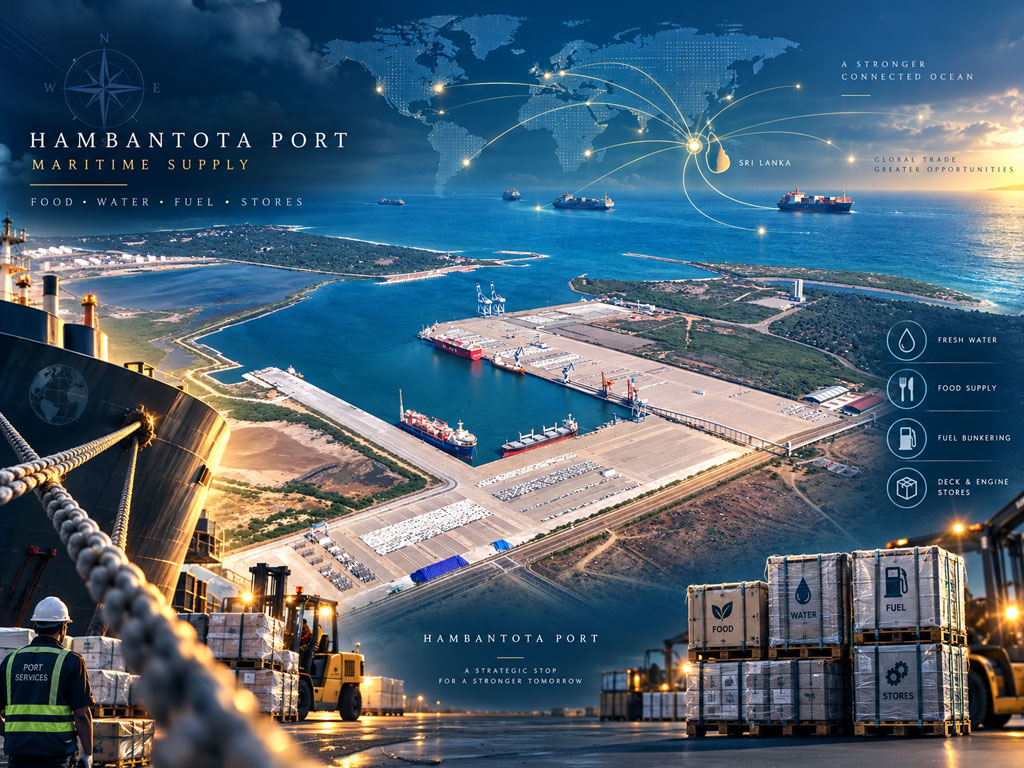
Hambantota maritime supply could link Sri Lankan food, fuel and manufacturing to global shipping while raising local products to world standards.
Hambantota maritime supply could become a powerful new economic opportunity for Sri Lanka by turning passing commercial vessels into direct customers for locally produced goods and services.
A large commercial vessel spending months at sea is more than a mass of steel. It functions like a “floating city” where hundreds of people may live and work.
That city needs a constant supply of drinking water, food, medicine and fuel. It also requires materials to maintain its engines, decks and onboard systems.
Hambantota Port sits close to one of the world’s busiest shipping routes. If Sri Lanka can turn it into a major “pit stop” for passing vessels, the impact could extend far beyond the port itself.
The opportunity is not simply about exporting Sri Lankan products to compete in overseas shops.
Instead, it is about producing goods inside Sri Lanka to international standards and supplying them directly to vessels already moving through global trade routes.

What Hambantota Maritime Supply Actually Means
Ship chandling and maritime services cover the goods and support a vessel needs when it enters a port or anchors within off-port limits.
These supplies allow the ship to continue its journey while also meeting the daily needs of its crew.
However, ship chandling is not comparable to buying ordinary goods from a local store.
The industry depends on strict standards, reliability, speed and precision.
Maritime supply services generally fall into several major categories.
Food and drinking water supplies include fresh vegetables, fruit, meat, fish, dry foods, dairy products and clean drinking water. Ships may require these goods in tonnes.
Bunkering covers the marine fuel oil and lubricants needed to operate large vessel engines. Hambantota Port has already shown significant growth in this sector.
Deck and engine stores include paints, ropes, steel cables, engine parts, safety equipment and cleaning chemicals used during maintenance.
Bonded stores include duty-free cigarettes, alcohol, electrical appliances, toiletries and perfumes intended for crew members’ personal use.
International Standards Could Lift Local Production
International vessels cannot simply accept any bottle of water or parcel of food available in an ordinary domestic market.
Ship operators purchase goods that meet strict standards.
Ship chandlers must comply with requirements associated with organisations such as ISSA, the International Shipsuppliers & Services Association, and IMPA, the International Marine Purchasing Association.
Food suppliers must also meet safety standards such as ISO 22000 and HACCP, or Hazard Analysis Critical Control Point.
Building a Hambantota maritime supply network would therefore require Sri Lankan producers to adapt.
Bottled water manufacturers, vegetable farmers, spice producers and packaging companies would all need to meet the standards demanded by international shipping.
That process could also improve the quality of products entering the domestic market.
Instead of Sri Lankan businesses adjusting only when they export goods abroad, international requirements would become part of local production itself.
In that way, higher standards could become a competitive advantage.
Seafarer Lifestyles Could Create New Products
A commercial ship’s crew rarely comes from a single nationality.
Filipinos, Indians, Europeans and Chinese nationals may all work aboard the same vessel.
For Sri Lankan entrepreneurs, that diversity creates opportunities to develop products around different cultural and dietary preferences.
Filipino and other Far Eastern seafarers often consume rice and pork-based products.
Sri Lankan farmers could cultivate varieties such as Jasmine rice for that market. Businesses in the Hambantota region could also process ready-to-eat meat products designed for those preferences.
Indian seafarers may seek vegetarian meals, lentils, specialised spices and wheat flour products used for chapati or roti.
That demand could directly connect Sri Lanka’s spice and food-processing industries with maritime customers.
European seafarers may require cheese varieties, bakery products such as specialised breads, olive oil and fresh vegetables.
By studying these preferences, Sri Lankan businesses could develop “Customized Maritime Kits” for different groups of seafarers.
Such products would represent more than another supply chain.
They could provide a direct link between Sri Lankan agriculture, food processing and manufacturing and the global maritime market.
Sri Lanka also has the potential to create products suited to consumers from many geographical regions and first adapt them for use aboard ships.
Developing the maritime supply industry around Hambantota Port therefore goes far beyond supplying fuel to passing vessels.
It could create an indirect export channel in which locally produced goods reach international customers without first leaving Sri Lanka through conventional retail export routes.
If developed properly, Hambantota could become a point where global shipping demand, Sri Lankan production and international quality standards meet.
That could allow local businesses to sell goods at higher dollar values while giving the wider domestic economy a stronger connection to the world market.