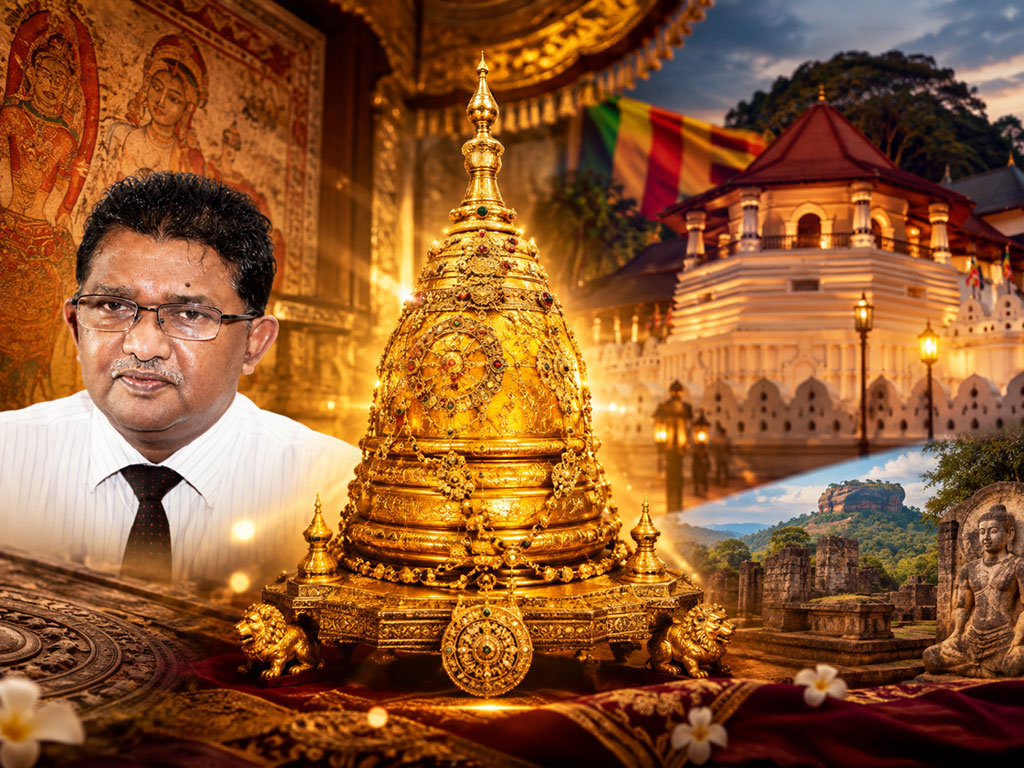
Sacred Tooth Relic casket has archaeological, historical and artistic value beyond its gold content, former Archaeology chief Anura Manatunga says.
COLOMBO — Former Director General of Archaeology Senior Professor Anura Manatunga has called for the nearly 300-year-old gold-plated casket formerly used to house the Sacred Tooth Relic at the Sri Dalada Maligawa in Kandy to be preserved as an archaeological heritage artefact, arguing that its significance extends far beyond the monetary value of its gold.
Speaking to Aruna, Manatunga said he had personally examined the matter after receiving an official written inquiry issued under the instructions of the Ministry Secretary.
He subsequently visited the Sri Dalada Maligawa, where the Mahanayake Theros of the Asgiriya and Malwatte Chapters and Diyawadana Nilame explained the circumstances surrounding the casket.
Manatunga said his responsibility was to establish the relevant facts and report them to the Ministry Secretary.
“That report was handed over to the Ministry Secretary on the same day,” he said.
He added that the matter was linked with the President’s Office but said he did not know what action had subsequently been taken by the Ministry Secretary and therefore could not comment publicly on the inquiry.

Heritage Value Goes Beyond Gold
Debate surrounding the casket has focused partly on the replacement of the historic gold-plated casket with a newly made solid gold casket and what that means for the older object’s heritage value.
Manatunga drew a clear distinction between monetary worth and archaeological significance.
“It is true that gold has monetary value. However, if we evaluate value based purely on monetary worth, then nothing matters other than money,” he said.
From an archaeological perspective, he said, the older casket is an artefact dating back nearly three centuries and carries substantial historical and artistic value.
“Therefore, from an archaeological perspective, that casket must be considered a heritage artifact and preserved.”
The interview also addressed speculation that gold from the older casket may have been melted down and used in producing the new solid gold casket. Manatunga did not confirm that claim, instead concentrating on the archaeological status of the earlier object and the need to distinguish its material value from its wider heritage significance.
Separate reporting on the new casket states that it was formally offered to the Sacred Tooth Relic on September 8. The Sri Dalada Maligawa has also said steps are being taken to preserve the older casket within the temple because of its historical value.
Protecting Archaeological Heritage Across Sri Lanka
Manatunga also discussed the wider challenge of identifying and protecting archaeological sites, including those in the North and East.
He rejected the suggestion that archaeological preservation in those regions should simply be regarded as more difficult than in the South, pointing to surveys using GPS technology to establish the locations of sites.
Those surveys have covered ancient Buddhist temples, historic ruins and ancient settlements. Researchers, he said, travelled considerable distances through dense forests to examine sites and determine which possessed genuine historical value.
According to Manatunga, some archaeological sites identified in the North and East date back more than 3,000 years, adding to evidence of the regions’ long historical record.
Tourism could also play a greater role in presenting Sri Lanka’s archaeological heritage, he said.
Sites including Sigiriya, Polonnaruwa, Dambulla, Anuradhapura, Kandy and Galle are already major attractions for international visitors, but Manatunga said many other locations could be developed through better infrastructure, accessibility and visitor facilities while maintaining the protection of sacred and historic sites.
Limited Resources and Thousands of Sites
Addressing criticism that the Department of Archaeology has failed to prevent the looting and destruction of antiquities, Manatunga pointed to the scale of the department’s responsibilities and its limited manpower and resources.
Sri Lanka’s Antiquities Ordinance No. 9 of 1940 provides the principal legal framework for protecting antiquities, archaeological heritage and ancient monuments. The legislation includes provisions governing objects and monuments of historical and archaeological significance.
Thousands of archaeological sites have been registered across Sri Lanka, Manatunga said, while many others remain undocumented.
The department works with law-enforcement authorities and local communities to protect sites, with public awareness and cooperation playing an important role in preventing illegal excavations and the smuggling of artefacts.
Manatunga also highlighted “Urumaya”, a nationwide programme intended to identify, document, preserve and manage Sri Lanka’s archaeological heritage.
The programme covers sites associated with Buddhist, Hindu, Islamic and Christian traditions and includes professional qualifications under the National Vocational Qualification framework for archaeology workers, with the aim of improving conservation standards and developing a skilled heritage-management workforce.
The debate surrounding the historic Tooth Relic casket has therefore raised a broader question extending beyond the value of the precious metal from which an object is made: how Sri Lanka identifies, values and preserves artefacts whose historical and cultural significance has accumulated over centuries.